Renewal Negotiation: How to Get a Fair Price Without Switching
Turn this article into takeaways for your work.


Each assistant summarizes the article only for you and suggests best practices for your work.
Key Facts: SaaS Renewal Negotiation
- The median SaaS renewal price increase in 2024-2025 sat at 8-10%, with 20%+ increases reported on roughly 1 in 4 enterprise renewals (Vendr, Gartner benchmarks).
- Buyers who initiate renewal conversations 90+ days before expiry achieve outcomes 18-24% better than buyers who engage inside the 30-day window.
- Roughly 60% of SaaS contracts include auto-renewal clauses, and an estimated 40-50% of mid-market buyers miss the cancellation notice window at least once in a 3-year portfolio.
- Customer acquisition cost in B2B SaaS runs 5-7x the cost of retention, which is why vendors almost always have room to move on price if you ask in time.
- A credible competitive price ballpark (even without a full evaluation) correlates with 5-12% better renewal outcomes in Vendr benchmark data.
The Renewal Leverage Window
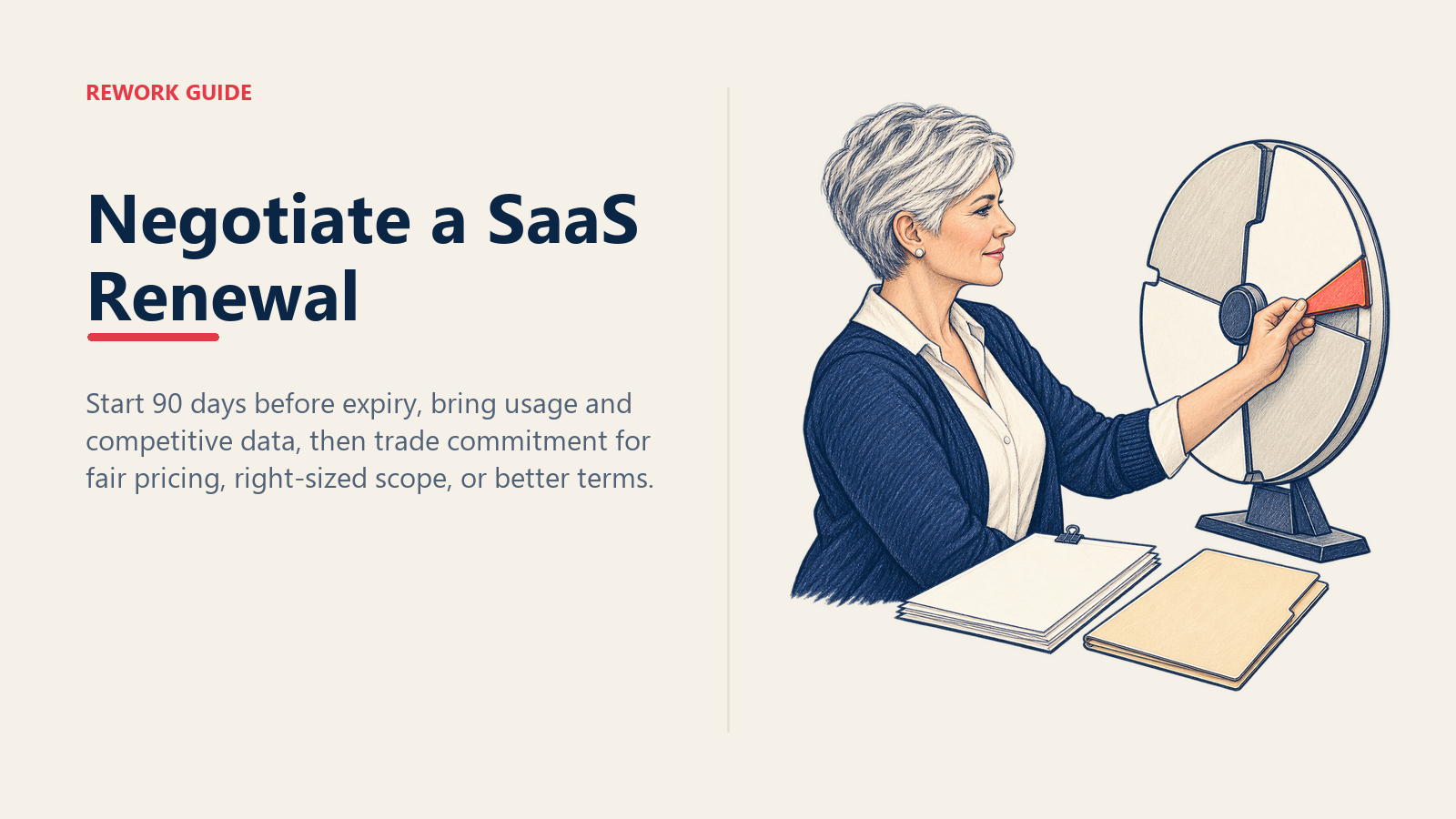
The Renewal Leverage Window is the 90-day period before contract expiry during which a buyer still has the time, information, and optionality to run a competitive check, pull usage data, and force the vendor into a commercial conversation rather than an administrative one. Inside 30 days, the window is effectively closed: the buyer is negotiating against the clock and the vendor knows it. Between 60 and 90 days out is where 80%+ of the achievable savings get captured.
The CFO knew switching wasn't realistic. The tool was embedded. The data migration would take months. The team had just finished onboarding. And the replacement alternatives hadn't made meaningful feature progress since the original evaluation.
So when the renewal quote came in at 22% above the prior year, the CFO's calculation was simple: pay the increase or spend $80K and six months migrating to an inferior alternative. The math said pay.
The CFO paid. And never asked whether the vendor's floor was actually the number on the quote.
It wasn't. A peer CFO at a similar company had pushed back on the same renewal from the same vendor, run a quiet competitive check, and secured the renewal at 3% above prior year, not 22%. The only difference was that the peer CFO had started ninety days earlier, had done their homework, and had asked.
Most buyers have more room at renewal than they use. Here's the playbook.
Why Renewal Is a Different Negotiation
The first purchase negotiation and the renewal negotiation are structurally different deals.
At first purchase, leverage is symmetrical: you have options, the vendor wants to close, and neither side is committed. You have maximum leverage because you genuinely might not buy.
At renewal, leverage feels asymmetric: you're embedded, switching costs are real, and the vendor knows it. But the asymmetry isn't as complete as it appears, because the vendor also has something to lose. Churn is expensive. McKinsey's research on SaaS retention economics shows that customer acquisition costs in B2B SaaS average 5–7x the cost of retaining an existing customer, a ratio that gives well-prepared renewal negotiators more room than they typically use. A customer who renews (even at a discount) is more valuable to the vendor than a customer who leaves and forces a costly replacement sale.
That's your leverage at renewal: the vendor would rather keep you at a lower price than lose you entirely and spend $20K-50K in sales cost acquiring a replacement customer.
The goal of renewal negotiation isn't to pretend you're leaving when you're not. It's to demonstrate that you're informed about your options, that the current price isn't automatically acceptable, and that the vendor has reason to work with you on terms.
The Five-Step Renewal Playbook
Step 1: Start 90 Days Before Expiry
The single most important variable in renewal negotiation is timing. Buyers who start inside thirty days of expiry have almost no leverage. They're out of time to run an alternative evaluation, the vendor knows it, and the conversation becomes administrative rather than commercial.
Ninety days gives you:
- Time to pull and analyze your usage and adoption data
- Time to run a quiet competitive check (even a superficial one creates pressure)
- Time to have multiple rounds of conversation without artificial urgency
- Time to let the negotiation breathe without panic on either side
Vendr's SaaS buying research found that buyers who initiate renewal conversations 90+ days out achieve price outcomes 18–24% better than those who engage within 30 days of expiry. The time gap is the single most controllable variable in renewal negotiation success.
Calendar alert: Set a renewal reminder ninety days in advance for every contract over $10K/year. This is the most valuable administrative habit for a CFO or COO managing a SaaS portfolio.
Notice window check: Confirm the contract's cancellation notice window. If it's sixty days, your real deadline for meaningful negotiation is at day ninety. You need to know your position before that clock starts. The SaaS contract red flags guide explains how auto-renewal window lengths vary and what notice terms are worth renegotiating before the original contract is signed.
Step 2: Pull Usage and Adoption Data
Before any conversation with the vendor, know your numbers.
Vendors know their data. Their customer success systems track login rates, feature adoption, support ticket volumes, and integration activity. When they quote a renewal price, they've already looked at your account health score. You should know the same things they know.
Usage data to pull:
| Metric | Why It Matters for Negotiation |
|---|---|
| Active users / total provisioned | Low utilization rate weakens your renewal position from their side, but also gives you leverage to renegotiate seat count down |
| Feature adoption depth | Low adoption = lower perceived value = room to negotiate on price or scope |
| Support ticket history | High ticket volume = documented service cost that may warrant service concessions |
| Integration utilization | High integration depth = your actual switching cost is higher, but so is your demonstrated commitment |
| Business outcomes achieved | Strong ROI data = you're a reference-quality customer, which has value to the vendor |
Two scenarios and what they mean:
Low utilization + high cost: You have data to negotiate the contract down: fewer seats, lower tier, or reduced scope. The vendor would rather right-size a contract and keep a customer than lose them to a competitor over a mismatch between price and usage. If you're deciding whether the tool is worth keeping at all, the SaaS consolidation framework gives you the utilization scoring matrix to make that call systematically.
High utilization + strong ROI: You're a valuable customer, and the vendor knows it. Your leverage comes from the concession offer (reference status, case study, expanded usage) in exchange for a better renewal price or additional features. The ROI data from the 90-day measurement framework is your most credible input here.
Step 3: Build Your Concession List
Renewal negotiation isn't just about price. The vendor has multiple currencies they can use: price, seat count, contract terms, support tier, feature access, training credits, and service commitments.
Price alternatives to explore:
- Price hold at current year rates (0% increase)
- CPI-linked increase (3-4%) rather than vendor's proposed increase (10-22%)
- Volume discount for committing to expanded seat count
- Multi-year commitment in exchange for locked pricing
Non-price concessions worth asking for:
- Dedicated CSM (if not currently assigned)
- Complimentary seats for additional team members
- Early access to new features or beta functionality
- Free training credits or onboarding support for new hires
- SLA improvements (faster response times, dedicated support line)
- Integration development support at no cost
- Right-to-reduce seats if headcount decreases
Concession priority matrix:
| Concession | Your Priority | Vendor Cost | Negotiating Value |
|---|---|---|---|
| Price hold | High | Low-Medium | Medium |
| Multi-year price lock | High | Low | High (give to get) |
| Dedicated CSM | Medium | Low | Medium |
| Seat right-sizing | Medium | Low | High (lower cost, better fit) |
| Training credits | Medium | Very Low | Easy win |
| Feature early access | Low | Very Low | Easy win for vendor |
Step 4: Run a Quiet Competitive Check
You don't need to run a full evaluation to create competitive pressure. A phone call and a pricing ballpark from one or two alternatives is enough.
What a quiet competitive check looks like:
- Contact one or two alternatives (a direct competitor plus a category substitute)
- Tell them you're in the process of renewing your current contract and wanted to understand their current pricing
- Get a rough annual number at your seat count
- Don't commit to a demo unless you're genuinely open to switching
The number doesn't need to be lower than your current vendor's price. The existence of a current, credible alternative price is the leverage. It demonstrates that you have options and that you've done the work to understand them.
If the competitive price is genuinely lower, that's a stronger negotiating data point. But even a comparable price from a competitor creates pressure: it shows you're not trapped, you know the market, and your renewal decision isn't automatic.
Step 5: Structure the Opening Ask
Most buyers make their opening ask too close to their walk-away price. The opening ask should have room to negotiate down, which means it needs to start high enough that the final outcome is where you actually want to land.
The opening ask structure:
Acknowledge the relationship. "We've gotten real value from [tool] and we're planning to continue." Don't negotiate from a posture of unhappiness unless you genuinely are unhappy. It reads as inauthentic and can actually reduce the vendor's motivation to work with you.
Present your data. "We pulled our utilization data. Active user rate is %, core features in use are [Y of Z], and we've been able to document [outcome]." This signals preparation and makes the vendor aware you know your account health.
State the constraint. "The renewal quote came in at % above prior year. That puts us [above our budget / above market / above what our ROI data supports]."
Make the ask. "For us to renew on a [one-year / two-year] basis, we'd need to get to [target price]. We'd also want to talk about [additional concession: dedicated CSM, price lock, seat right-sizing]."
Give a timeline. "We need to have this resolved in the next [X weeks] to maintain our go-live continuity." A real deadline creates momentum without being artificial.
The Three-Email Renewal Negotiation Sequence
Email 1: Opening the conversation (90 days out)
Subject: [Company] Upcoming renewal discussion
Hi [CSM / Account Executive],
Our contract renews on [date]. We want to make sure we have time to work through any adjustments before the notice window closes.
We've been pulling our utilization data and reviewing our current scope. Could we schedule 30 minutes this week to discuss where we are and what renewal looks like?
[Name]
Email 2: After initial renewal quote (if price is above acceptable)
Subject: Re: [Vendor] Renewal Proposal for [Company]
Hi [Name],
Thanks for sending the renewal proposal. We've been reviewing it and need to work on the economics to make this viable for our next term.
The proposed increase puts the annual cost at [X]. Based on our current utilization and the ROI we've been able to document, the price point that works for us is [target price], which is [X]% [above / at] our current year rate.
If we can get there, we're ready to renew for [one / two] years. If a two-year term helps on your side, that's a structure we'd consider.
Can you come back to us with what's possible?
[Name]
Email 3: If vendor counter is still above acceptable (final push)
Subject: Re: [Vendor] Renewal, Updated Position
Hi [Name],
I appreciate the counter. We're close, but [current counter offer] is still [X] above where we need to be.
We've also gotten a current pricing estimate from [Competitor/Category alternative]: it comes in at approximately [price], which gives us a baseline comparison.
We'd prefer to stay with [Vendor]. We've built workflows around it and the team knows it. But we need to get to [final target price] to make that work financially. If you can get there, we can sign this week. If not, we'll need to move to the alternative.
Let me know by [date].
[Name]
Measuring Renewal Negotiation Success
Track these per renewal:
| Metric | How to Measure |
|---|---|
| Price delta vs. initial quote | [(Initial quote - Final price) / Initial quote] × 100 |
| Non-price concessions secured | List with estimated dollar value |
| Time invested vs. savings | Hours spent on negotiation ÷ annual savings |
| Contract term improvements | Renewal window shortened, termination rights added, etc. |
A well-run renewal typically takes four to six hours of preparation and two to three rounds of conversation. If the savings are $10K-50K and the time investment is five to six hours, the ROI on the negotiation itself is significant. Harvard Business Review's research on procurement as a value center positions software renewal management as one of the highest-return activities available to a CFO or COO, yielding $8–15 of savings per hour invested for organizations with a structured approach.
How Rework Work Ops Supports Renewal Negotiation
Most renewal failures aren't negotiation failures. They're calendar failures. The CFO didn't lose 22% because they were bad at negotiating. They lost it because no one flagged the renewal until the notice window had already closed. Rework Work Ops (Process Engine from $99/month billed yearly, 5 seats included) gives finance and procurement teams a structured renewal workflow built on top of the same platform the rest of the company runs on.
In a single Rework workspace, teams set up a SaaS contract register with renewal dates, auto-renewal flags, and notice windows as required fields. Automated reminders fire at 120, 90, 60, and 30 days before expiry, routed to the contract owner, the finance lead, and the CFO. A per-renewal task template walks the owner through the five-step playbook: pull usage data, run the competitive check, build the concession list, draft the opening ask, log the outcome.
Because Work Ops is cross-team, the CSM, finance, and department head can collaborate on the same renewal record instead of emailing threads. Every renewal outcome (price delta, concessions secured, hours invested) gets logged for the next negotiation.
Learn More
- Negotiating a SaaS Contract: Where the Leverage Actually Sits: the principles that apply equally to first purchase and renewal
- SaaS Contract Red Flags: Auto-Renewal, Usage Caps, and Termination Clauses to Watch: the clauses that affect your renewal options before you get to the negotiation
- Measuring SaaS ROI 90 Days After Purchase: the ROI data that becomes your primary leverage at renewal
- Switching SaaS Vendors: The Hidden Cost of Migration: how to calculate your true walk-away price before entering renewal negotiations
- TCO Modeling for SaaS: Beyond the Sticker Price: how to model multi-year renewal costs so the CFO has context beyond the single-year quote
- SaaS alternatives and pricing: competitive market data to strengthen your renewal position
Frequently Asked Questions About SaaS Renewal Negotiation
When should renewal negotiation start?
Ninety days before expiry is the practical minimum. That gives you time to pull usage data, run a quiet competitive check, and have two to three rounds of conversation without artificial urgency. Buyers who engage inside 30 days of expiry achieve 18-24% worse outcomes in Vendr benchmark data because the vendor can sense they're out of time.
How do I push back on a renewal price increase?
Present your utilization data, state a specific counter number (not just "that's too high"), and give the vendor a reason to work with you: a multi-year term, a case study, a reference. Something like "We've gotten real value from [tool], we're ready to commit to a two-year term, but we need to land at [target] to make that work." Don't negotiate from unhappiness if you're not actually unhappy, it reads as inauthentic.
Should I threaten to switch vendors?
Don't threaten. Inform. A quiet competitive check (a call with one or two alternatives, a rough pricing ballpark) gives you a credible data point to bring to the conversation. Saying "we've been looking at [alternative] and they're quoting [price]" is materially different from "we'll leave if you don't lower the price." The first is preparation; the second is a bluff the vendor will often call.
What's a fair renewal price increase?
Benchmark data from Vendr and Gartner puts the median at 8-10% for 2024-2025. CPI-linked increases (3-4%) are a reasonable counter. Anything above 15% without a corresponding feature expansion or scope change should trigger a detailed pushback. Increases above 20% typically signal a vendor testing how much you'll absorb, and roughly 1 in 4 enterprise renewals come in at that level.
What if auto-renewal has already kicked in?
You've lost the primary leverage window, but not all leverage. Most vendors will still negotiate mid-term on scope, seat count, or non-price concessions (training, CSM tier, feature access) because they'd rather keep a customer engaged than have them churn at the next cycle. Log it as a lesson, audit every other contract in your portfolio for auto-renewal clauses, and set 120-day calendar alerts going forward.
How do I track usage data before renewal?
Pull four numbers from the vendor's admin console: active users vs. provisioned seats, feature adoption depth, support ticket volume, and integration utilization. Most SaaS tools expose these in an admin dashboard or a quarterly business review deck. If the vendor doesn't give you visibility, ask your CSM for a usage report 120 days before renewal. That request alone signals you're preparing to negotiate.

On this page
- The Renewal Leverage Window
- Why Renewal Is a Different Negotiation
- The Five-Step Renewal Playbook
- Step 1: Start 90 Days Before Expiry
- Step 2: Pull Usage and Adoption Data
- Step 3: Build Your Concession List
- Step 4: Run a Quiet Competitive Check
- Step 5: Structure the Opening Ask
- The Three-Email Renewal Negotiation Sequence
- Measuring Renewal Negotiation Success
- How Rework Work Ops Supports Renewal Negotiation
- Learn More