Product Manager Tools and Tech Stack: What to Actually Buy (and What to Cut)
Turn this article into takeaways for your work.


Each assistant summarizes the article only for you and suggests best practices for your work.
The first thing you do as the new PM isn't open Jira. It's open the billing page.
Productboard. Aha. Pendo. Mixpanel. Dovetail. Amplitude. Canny. Notion. Figma. Maze. UserVoice (yes, still). Two Linear seats nobody remembers buying. Total: $4,200 a month, and when you ask "which tool owns the roadmap?" three different people give you three different answers.
The stack is doing the PM's job for them, badly. That's the actual problem you inherited.
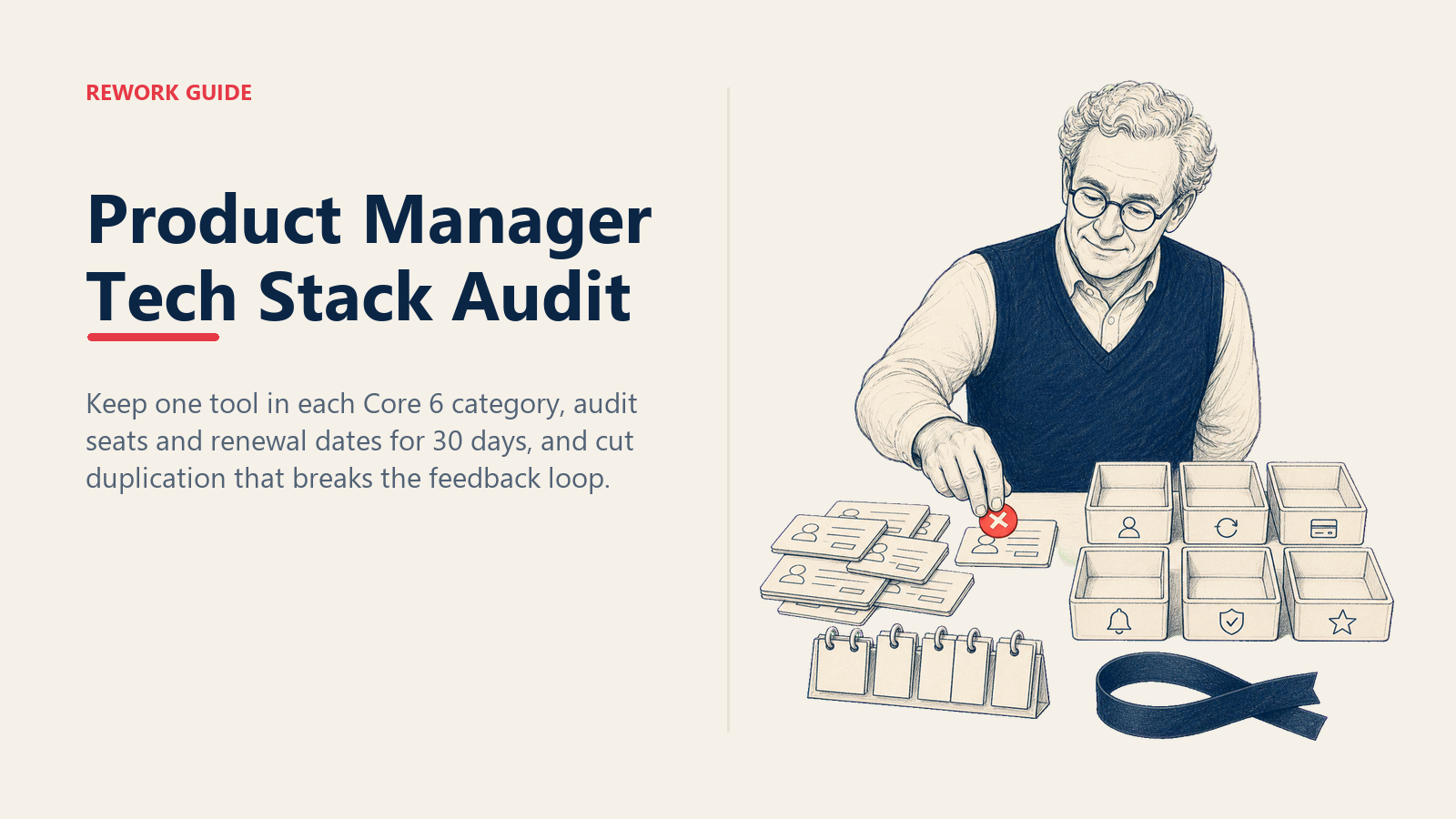
This is the audit I run every time I take over a product org, and the framework I'd give a friend who just got handed the keys. Six categories. One pick per category. A 30-day plan to cut the rest.
Why Most PM Stacks Are Over-Tooled
Tools accumulate by accident, never by design.
Two years ago a previous PM trialed Productboard for a quarter, never officially adopted it, and left $89/month on a corporate card. The growth team bought Mixpanel because their analyst liked the funnel UI. Support bought Pendo because someone needed in-app NPS surveys. Marketing bought Hotjar for session replay. Now four tools each hold roughly 30% of the customer signal, none of them speak to each other, and the PM spends Tuesday mornings reconciling which "feature request count" is correct.
Nobody owns the source of truth, which is another way of saying nobody owns the customer.
The fix is not buying a seventh tool that promises to integrate the other six. The fix is deciding what each category is for, picking one tool per category, and being ruthless about the rest. Below is the list I use.
The Core 6
1. Roadmap and delivery: Linear vs Jira vs Productboard
Pick by team size and existing footprint, not by feature checklist.
- Linear: engineering-led teams under 50 engineers. Fast, opinionated, the keyboard shortcuts actually work. $8/user/month standard, $14 business. If your eng team would mutiny at Jira, Linear is the answer.
- Jira: you're already paying for the Atlassian suite (Confluence, Bitbucket). Don't fight it. Jira at scale with a competent admin is fine. Jira without an admin is what you complain about on Reddit. $7.53/user/month standard, $13.53 premium.
- Productboard: only if you genuinely need prioritization scoring tied to customer feedback signals, and you have the discipline to keep the data clean. Most teams don't. $20/maker/month essentials, $80 pro. The math gets brutal fast: 8 PMs at the pro tier is $7,680 a year before anyone has shipped anything.
My default pick for a B2B SaaS under 200 people: Linear. The teams that buy Productboard for prioritization usually use it as an expensive feature backlog, which Linear already does for $12 less per seat.
2. Product analytics: Amplitude vs Mixpanel vs PostHog
Pick one. The instinct to "use Amplitude for product and Mixpanel for marketing funnels" is how you end up with two unreliable sources of truth and a quarterly fight about whose number is right.
- Amplitude: enterprise depth. Behavioral cohorts, governance, the feature breadth a 200-person product org needs. Free up to 50K MTUs, then "talk to sales" (budget $2K-$5K/month for a real deployment).
- Mixpanel: fastest time-to-first-funnel. If a PM needs a funnel chart in their first week, Mixpanel is friendlier. Free up to 1M events, then $24/month growth tier and up.
- PostHog: the answer if you want self-host, session replay, feature flags, and analytics in one tool, and your engineering team is comfortable running it. Free up to 1M events on cloud, then $0.00005/event. Self-host is free.
For a sub-Series-B B2B SaaS, PostHog is the sleeper pick. Session replay alone usually replaces a separate Hotjar/FullStory line item, and the feature-flag system means you stop paying LaunchDarkly $0.30/MAU on top of everything else.
3. Customer feedback: Productboard vs Canny vs Pendo Feedback
Canny is the cheap honest answer for most B2B SaaS under $50M ARR.
- Canny: $79/month starter, $359/month growth. Public roadmap, voting, simple ownership of what's been requested vs shipped. Customers can self-serve check the status of their request without emailing the CSM.
- Productboard: already covered above. If you bought it for roadmap, the feedback module comes along. If you didn't, don't buy it just for feedback.
- Pendo Feedback: bundled with Pendo Guides and Analytics. Useful only if you're already deep in Pendo for in-app messaging, which is its own decision.
The trap: buying Canny AND Productboard AND a Pendo Feedback module. I have seen this in the wild three times. Each one was an audit-day delete.
4. Discovery and interviews: Dovetail (or Notion if budget is zero)
This is the underrated category.
Where do raw customer transcripts live, get tagged, and re-surface six months later when someone asks "did anyone ever mention pricing friction in onboarding?" If the answer is "uh, maybe in a Loom comment somewhere," your discovery practice is broken.
- Dovetail: $30/user/month team, $75/user/month pro. AI-assisted tagging, transcript search, the actual tool of record for a real research practice. Worth it once you have more than ~20 interviews on file.
- Notion: free if you're already paying for it. Tag pages with topic, date, customer segment. Search is mediocre but real. Fine for a team of two PMs running 5 interviews a month.
If you have a dedicated researcher: Dovetail. If you have one PM doing discovery on the side: Notion is fine, stop overthinking it.
5. Design handoff: Figma
Not optional. No real alternative. $15/editor/month professional, $45 organization. Move on.
6. CRM and customer system of record
This is where most PMs go wrong. They think the CRM is sales' problem.
The CRM owns win-loss reasons, churn reasons, NPS scores tied to accounts, expansion patterns, support ticket volume per account, and account health. A PM without read access to the CRM is a PM building features in the dark.
The picks:
- Salesforce: already deployed, you have a Salesforce admin, the dashboards exist. Don't migrate. $25/user/month starter, $165/user/month enterprise (real deployments land at $100+).
- HubSpot: solid mid-market default, decent UX, gets expensive at the Marketing Hub Pro + Sales Hub Pro tier ($800-$1,600/month per hub before per-seat costs).
- Rework CRM: the Sales Engine starts at $69/month billed yearly, with 5 seats included. Worth a real look if the company is still small enough to consolidate sales, marketing, and customer ops on one platform, and the PM specifically wants the customer-feedback loop wired into roadmap triggers without a Zapier maze. More on the honest framing in the next section.
The Honest Rework Framing for PMs
Rework is not a roadmap tool. It will not replace Linear. It will not replace Amplitude or PostHog. It does not do session replay. It does not do A/B testing. It does not do roadmap prioritization scoring. If you are looking for any of those, this section isn't for you.
Where it earns the seat for a PM: closing the customer-feedback-to-roadmap loop.
The pattern that breaks at every sub-$20M ARR B2B SaaS I've seen:
- CSM logs a churn reason in the CRM ("missing native Slack integration").
- NPS detractor leaves a comment in a survey tool.
- Sales loses a deal and notes "lost to Competitor X, workflow automation gap" in CRM.
- Three weeks later, the PM is in a roadmap meeting having no idea any of those signals exist, because they live in three tools the PM doesn't open.
The Zapier-maze fix costs you four automations, two contractor hours a month maintaining them, and a feature-request board that's still a separate tool from the CRM.
The Rework version: NPS detractors auto-create a discovery task in the PM's queue. Churn reasons tagged in the CRM flow to a PM dashboard, grouped by theme. Win-loss notes are searchable next to feature requests in the same database. The Sales Engine at $69/month plus the Project Engine at $99/month (both billed yearly, 5 seats each) covers what you'd otherwise patch with Canny + a Zapier business plan + a custom Looker dashboard the analytics team won't maintain.
The honest caveats, again, because I've seen too many over-promised demos:
- Rework does not replace your product analytics tool. PostHog or Amplitude still owns event-level data.
- Rework does not replace Linear/Jira. Engineering tickets still live there.
- Rework does not replace Figma. Obviously.
- Rework's value to a PM is the customer system of record, the feedback loop, and the lightweight task system that bridges CSM/sales/PM without a Zapier middle layer.
If you're a PM at a 30-200 person B2B SaaS and the company is still deciding its CRM, this is the seat at the table to fight for. Pricing at rework.com/pricing.
The 30-Day Stack Audit
Copy-paste table. Do this in your first month.
| Day | Action | Output |
|---|---|---|
| 1-7 | List every tool, every seat, every renewal date, every owner | Spreadsheet: tool, monthly cost, seat count, renewal date, who bought it, who uses it |
| 8-14 | Map each tool to one of the Core 6 categories. Flag duplicates. | Annotated spreadsheet: category column, "duplicate?" column |
| 15-21 | Interview the actual users (CSM, sales, eng, design, support) on what they use weekly and what they'd genuinely miss | Notes: tool → "kill / keep / consolidate" recommendation per stakeholder |
| 22-30 | Propose the cut list with dollar amounts and the consolidation plan to the VP | One-page memo: before total, after total, savings, transition timeline |
A few rules for the audit:
- Renewal dates matter more than month-to-month cost. A $400/month tool on an annual renewal locked in three months ago is not a Q2 cut.
- "I might use it" is not a use case. If three weeks of Slack-asking can't find the active user, it's a kill.
- The CSM's opinion is more important than the previous PM's. They talk to customers daily; they know which tool actually closes a loop.
- Don't cut Figma. Don't cut the CRM if it's the system of record for sales. Don't cut your one analytics tool. Everything else is fair game.
The Cut List Pattern
After running this audit four times, the recommendation is almost always the same:
- Kill one of {Productboard, Aha, Pendo Feedback}. Keep Canny.
- Kill one of {Amplitude, Mixpanel, Hotjar}. Keep PostHog or one consolidated pick.
- Keep Figma.
- Keep Linear OR Jira, not both. (Yes, this happens. One team migrated from Jira to Linear and never turned off the Jira instance.)
- Decide whether the CRM is pulling its weight as a customer system of record. If it's just a sales pipeline tool and nobody logs churn or NPS in it, that's the actual hole, and that's where consolidating to a Rework-style platform earns its keep.
A real before/after
A 60-person B2B SaaS I worked with last year:
| Tool | Before | After |
|---|---|---|
| Roadmap | Jira + Productboard | Linear |
| Analytics | Amplitude + Mixpanel + Hotjar | PostHog |
| Feedback | Productboard + Canny | Canny |
| Discovery | Dovetail | Dovetail |
| Design | Figma | Figma |
| CRM | HubSpot Marketing Hub Pro + Sales Hub Pro | Rework CRM + Productivity |
| Monthly total | $5,840 | $1,920 |
That's $47K a year back, one fewer Zapier plan, and a roadmap meeting where everyone is finally looking at the same feature-request board.
The before number wasn't unusual. It was the median for the size of company. The after number is what happens when one PM does the audit nobody had done in three years.
Conclusion
Tools don't make a PM. The discipline of owning the feedback loop does.
Pick the smallest stack that lets you answer one question in under ten minutes: "What are customers actually telling us, and what are we shipping about it?" If you can't answer that question with the tools you have, more tools won't help. If you can answer it with six tools, the seventh is a tax.
The audit is boring. The cut list is uncomfortable. The savings are real and the focus you get back is bigger than the dollars.
Do it in your first 30 days. Your future self, in the middle of a roadmap meeting six months from now with one source of truth instead of four, will thank you.
Learn More

Principal Product Marketing Strategist
On this page
- Why Most PM Stacks Are Over-Tooled
- The Core 6
- 1. Roadmap and delivery: Linear vs Jira vs Productboard
- 2. Product analytics: Amplitude vs Mixpanel vs PostHog
- 3. Customer feedback: Productboard vs Canny vs Pendo Feedback
- 4. Discovery and interviews: Dovetail (or Notion if budget is zero)
- 5. Design handoff: Figma
- 6. CRM and customer system of record
- The Honest Rework Framing for PMs
- The 30-Day Stack Audit
- The Cut List Pattern
- A real before/after
- Conclusion
- Learn More