Delegating Work When You Used to Do It Yourself
Turn this article into takeaways for your work.


Each assistant summarizes the article only for you and suggests best practices for your work.
Key Facts About New-Manager Delegation
- Only 30% of managers believe they delegate well, and of those, just one in three is rated as a strong delegator by their direct reports (Institute for Corporate Productivity / Harvard Business Review).
- Executives who delegate effectively generate 33% higher revenue than those who don't (Gallup study of Inc. 500 CEOs).
- First-time managers typically hold 60-70% of tasks that a peer-level manager would have already handed off, based on delegation-audit patterns reported by the Center for Creative Leadership.
- Managers who learn to delegate reclaim an average of ~20% of their working week for higher-impact work within 90 days (HBR, 2019).
- Low delegation is one of the top three predictors of manager burnout and early-tenure turnover, per Gallup's State of the American Manager.
You got promoted because you were the best at the work. That's not a coincidence. It's the usual reason people become managers. You were reliable, fast, skilled, trusted. So they gave you a team.
And now the best thing for your team is for you to stop doing the work you're best at. Which feels inefficient. And wrong. And frankly a little insulting to everything you built to get here.
But here's the thing nobody says clearly enough: when you stay in execution mode as a manager, you become a bottleneck. Every task that only you can do or that you insist on reviewing is a task that slows down as soon as your calendar fills up. And your team never gets better, because you're doing the work that would have helped them grow. Gallup research on manager effectiveness shows that managers who struggle to delegate are among the primary drivers of team disengagement and high turnover.
The move from doing to leading runs through delegation. But delegation is a skill, not a personality trait, and most new managers do it wrong.
Why Delegation Feels Harder Than It Should
The pull back toward execution is real. It's not laziness or ego. It's three specific things that all feel reasonable in the moment.
"I can do it faster." Usually true, at least at first. But this is a short-term calculation that ignores the long-term cost. Yes, you can write that brief in 45 minutes. The first time your report writes it, it'll take two hours and need revisions. But the second time it takes 90 minutes. And the tenth time, they're faster than you. Except now it's not on your plate at all.
"I just want it done right." Also a reasonable instinct. But "done right" often means "done my way," and your way isn't always the only valid way. When you redo work because it's 80% of what you'd have done, you're training your report that their judgment doesn't matter. They'll start asking permission before making decisions. That's worse than the original problem. The shift from doing to leading goes deeper into why this pull happens and how to break the pattern.
"There's no one ready to take this on." Sometimes true. But more often, no one has been given the chance. Readiness usually has to be created, not waited for.
The Delegation Control-vs-Capability Matrix
A simple mental model for deciding how to hand work off. Plot every task on two axes: how much control the outcome demands (low = forgiving, high = high-stakes or irreversible) and the current capability of the person receiving it (low = new skill, high = already proven). High-control + low-capability tasks stay with you or get coached in real time; high-control + high-capability tasks get delegated with a brief and check-ins; low-control + high-capability tasks get fully handed off with authority to decide; low-control + low-capability tasks become training reps: let them run, review afterward, no rescue. The matrix forces you to separate "is this risky?" from "is this person ready?", two questions new managers routinely conflate into a single "I'd better do it myself."
The Delegation Audit
Start here. Before you can delegate differently, you need to know what you're currently holding.
Take your task list for the next two weeks and sort every item into one of three buckets:
Only I can do this. Strategic decisions only you have context for. Relationship management that requires your specific authority. Conversations that require manager-level presence. These stay with you, for now.
Someone else could learn this. Tasks that require skill or knowledge your team could develop with some support. These are your primary delegation candidates.
Someone else could do this right now. Tasks that are already within a team member's existing skills, or that they could handle with a brief handoff. These should have been delegated already.
Most managers doing this audit for the first time are surprised. A significant portion of what they're holding falls into the second or third bucket. They've been doing it themselves because it was faster, not because it was actually necessary.
Matching Tasks to the Right Person
Not all delegation is created equal. A task that's a growth edge for one person is boring maintenance for another. And a task that builds on someone's existing strength teaches them nothing new.
Before assigning something, ask:
- Who would grow the most from this?
- Who has the skills to succeed with minimal hand-holding?
- Who is under-challenged right now and would benefit from something more complex?
- Is this task a good showcase for someone whose work has been less visible lately?
Delegation done well is also a development tool. A stretch assignment, something slightly beyond someone's current comfort zone with enough support to succeed, builds skills faster than any training program. According to research from the Center for Creative Leadership, challenging stretch assignments are the single most effective leadership development mechanism available to managers. Read Setting Goals for a Reluctant Team to see how this connects to development goals you're setting together.
The Task Handoff Brief
Vague delegation is worse than no delegation. If you hand something off with "just handle this" and no context, you're setting the person up to either fail or come back to you with 15 questions.
Before delegating a task, fill out a simple brief, either in writing or verbally, depending on the complexity:
Task: What's being done.
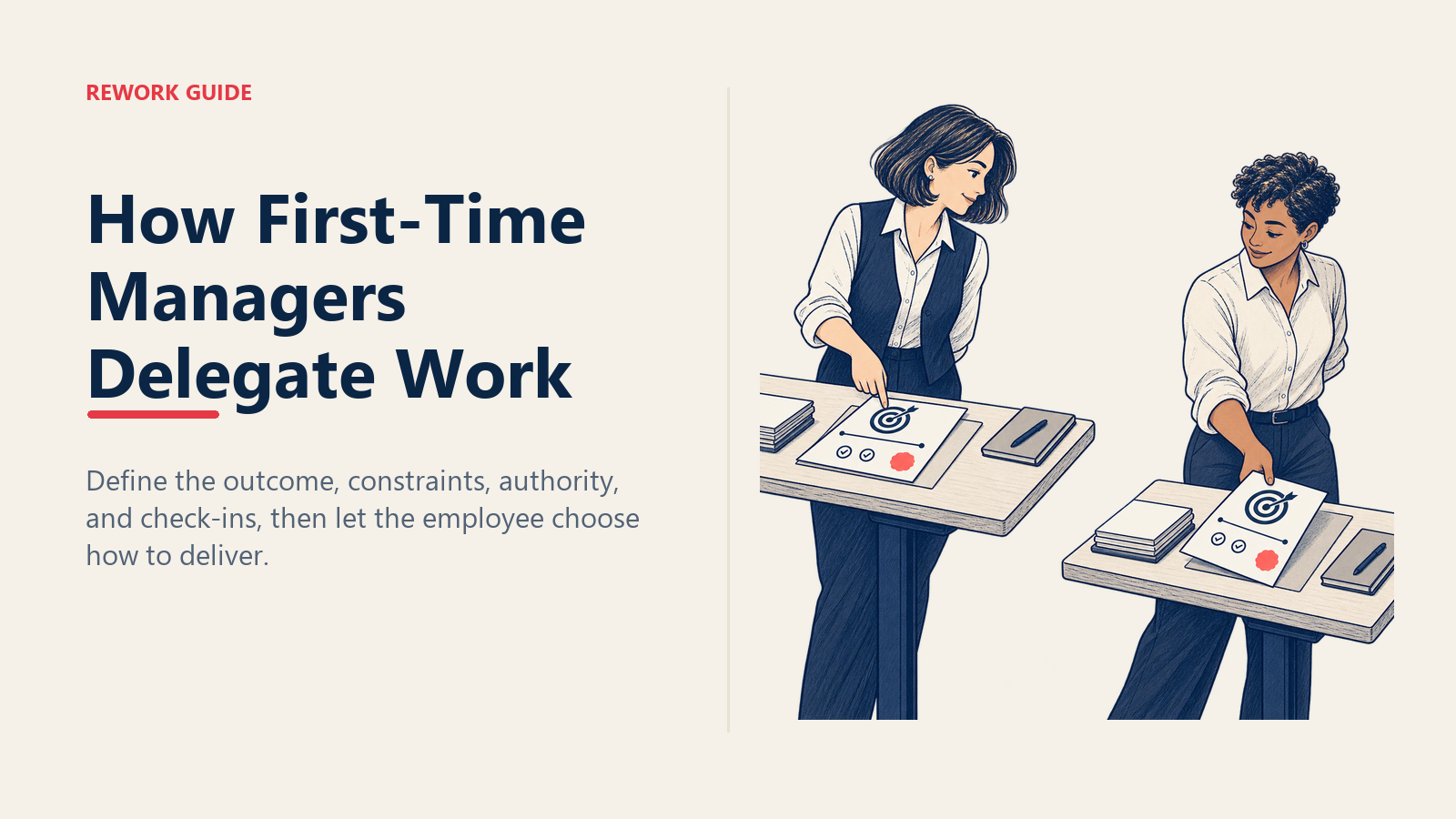
Outcome: What does done look like? Not the process, but the result. Be specific. "A one-page proposal that the client can respond to" beats "write something up."
Constraints: What are the non-negotiables? Timeline, budget, format, stakeholders who need to be involved, things to avoid. Give these explicitly.
Authority level: What decisions can they make without you? What needs sign-off? This matters. People often check back in on things they could have decided because no one told them they had the authority. A shared decision log helps teams track which decisions were made and at what level, reducing the ambiguity that drives unnecessary check-ins.
Check-in points: For longer tasks, when do you want to hear how it's going? Not to micromanage, but to catch blockers early and give feedback when there's still time to adjust.
Resources: What context, contacts, or materials do they need to succeed?
You don't have to use this template every time. But for any task with real stakes or learning potential, a three-minute brief up front prevents a lot of confusion.
The Check-In Cadence
How often you check in depends on the task and the person.
A quick guide:
| Task complexity | Person's experience level | Check-in frequency |
|---|---|---|
| Low | High | Once at handoff, once before deadline |
| High | High | Weekly until it's done |
| Low | Low | Mid-point check-in |
| High | Low | Every few days, or offer to be available on demand |
The goal is enough contact to catch issues early, not so much contact that you're effectively doing it yourself with extra steps.
The warning sign that you're over-checking is when your reports start saying "it's fine" or "almost done" without details, because they've learned that detailed updates lead to more questions and corrections. That's a sign you've slipped into micromanagement mode.
When You Want to Take It Back
This is the most common delegation failure. You hand something off, you see it coming together, it's not exactly how you'd do it, and you take it back. Either literally by jumping in and finishing it yourself, or indirectly by sending a long "feedback" email that rewrites most of the decisions.
Before you do this, ask yourself two questions:
Does this actually matter? Will this decision cause a real problem, or does it just feel like it could have been done better?
What's the cost of letting it stand? Is there a genuine quality issue, or is this your preference?
If the work meets the actual standard, even if it's not exactly how you'd have done it, let it stand. Acknowledge what worked first. Then add specific suggestions for next time if there are any.
If there's a genuine quality problem, name it specifically and ask for a revision. Point to the exact section. Don't redo it yourself. That removes all learning from the experience.
The debrief afterward is valuable regardless:
- "What do you think worked well here?"
- "What would you do differently if you had it to do again?"
- "What was harder than you expected?"
This turns every delegated task into a development conversation, which is what management actually is.
The Delegation Decision Matrix
When you're unsure whether to delegate something, run it through these four questions:
1. Does this require my specific authority or relationship? Some decisions and conversations need the manager present, not because of skill, but because of role. Compensation conversations. Escalations to senior leadership. Announcements that affect team composition. These shouldn't be delegated.
2. Is the quality risk acceptable? If this goes wrong, what's the actual consequence? A lot of tasks we protect have very forgiving failure modes. If the brief needs a round of edits, that's fine. If the client presentation falls apart, that's not. Calibrate accordingly.
3. Is someone better positioned to own this? Sometimes the right person is a team member who has more context, a stronger relationship, or a direct stake in the outcome. Give them the authority that matches their context.
4. What's the development value? Even if you could do it faster, what does delegating this task create for the person who gets it? A new skill. Visibility. Confidence. These have compounding returns.
What Success Looks Like
After three months of intentional delegation, your calendar should feel different. You should have time for conversations, strategy thinking, and removing blockers. That's the actual job of a manager. Harvard Business Review's analysis of manager time allocation found that managers who learn to delegate effectively reclaim an average of 20% of their working week for higher-impact activities within 90 days. Capacity planning at the team level becomes much more tractable once delegation is working: you can actually see who has room to take on more.
And your team should be running things you used to own. Not running them exactly your way, but running them well. The quality might be 85% of what yours would have been. But it's 85% with their names on it, delivered without your involvement. That's a real win.
Read The Shift from Doing to Leading to understand the identity shift that makes delegation stick. Without changing how you see your own role, you'll keep being pulled back into execution no matter how many frameworks you use.
How Rework Supports Delegation Without Micromanaging
The hardest part of delegation isn't the handoff. It's the visibility gap afterward. You either over-check (and micromanage) or under-check (and get surprised by missed deadlines). Rework's Project Engine, starting at $99/month billed yearly with 5 seats included, closes that gap without adding meetings. Every delegated task lives as a work item with owner, outcome, authority level, and check-in date captured on a single card: the Task Handoff Brief, made durable. Progress rolls up automatically, so you see movement without asking for status. Built-in handoff templates let you turn a recurring delegation ("weekly client report", "monthly hiring update") into a reusable brief in under a minute. For first-time managers running a full stack (delegation tracking, 1:1 notes, and team capacity in one place), Work Ops plus Rework CRM (the Sales Engine, from $69/month billed yearly) typically goes live in days, not the 4-8 weeks most point-tool stacks require. You stop being the bottleneck without becoming the hover-parent.
Frequently Asked Questions About Delegating as a New Manager
What should a first-time manager delegate first?
Start with recurring, low-risk tasks you already know how to do well: weekly reports, routine client check-ins, standard status updates, meeting prep. These are easy to document, forgiving if the first attempt isn't perfect, and give your team immediate reps. Save novel, high-stakes, or political work for later, once your team has built a track record and you've built the muscle of letting go.
How do I delegate without micromanaging?
Define the outcome and constraints, not the process. Agree on check-in points up front (not ad-hoc drive-bys), and name the authority level explicitly: what they can decide without you. Then let the work happen between check-ins. If you find yourself messaging for updates more often than you agreed, that's the micromanagement signal.
What if my team member does the task differently than I would?
Ask two questions before intervening: Does the outcome meet the standard? And is the difference a quality issue or just a preference? If it meets the standard, let it stand and acknowledge what worked. Rewriting 80% of someone's work trains them to stop making decisions, which is far more expensive than a stylistic difference.
When is it OK to NOT delegate?
Compensation conversations, performance reviews, escalations to senior leadership, announcements affecting team composition, and decisions that require your specific authority or relationship. Also: truly novel strategic calls where only you have the full context, but be honest that this category is smaller than it feels.
How do I delegate to someone more experienced than me?
Lead with their expertise, not yours. Frame it as "you have deeper context on X, I'd like you to own this and tell me what you need from me." Agree on outcomes and boundaries, then get out of the way. Senior people disengage fastest when a newer manager tries to supervise the how. Your job with experienced reports is clearing obstacles and connecting their work to the bigger picture, not directing it.
What's the difference between delegating and dumping?
Delegating transfers a task with context, authority, and support: the outcome, the constraints, what decisions they can make, and what resources they have. Dumping is "just handle this" with no brief, no authority, and no check-in. Delegation builds capability; dumping creates resentment and usually a worse result than if you'd done it yourself.
How do I know if I'm delegating enough?
Two signals. First, your calendar: if more than ~30% of your week is spent doing individual-contributor work that a report could do, you're under-delegating. Second, your team's growth: if none of your reports has taken on meaningfully new work in the last quarter, you're holding development work that should be theirs.
What if I delegate and the person fails?
Small failures with learning are the whole point: that's how capability gets built. Debrief calmly: what worked, what would you do differently, what was harder than expected. Large failures mean you miscalibrated the control-vs-capability matrix; the fix is better scoping and check-ins next time, not taking the work back permanently. Pulling delegation after one failure teaches the team that growth assignments are actually traps.
Learn More

Principal Product Marketing Strategist
On this page
- Why Delegation Feels Harder Than It Should
- The Delegation Control-vs-Capability Matrix
- The Delegation Audit
- Matching Tasks to the Right Person
- The Task Handoff Brief
- The Check-In Cadence
- When You Want to Take It Back
- The Delegation Decision Matrix
- What Success Looks Like
- How Rework Supports Delegation Without Micromanaging
- Learn More