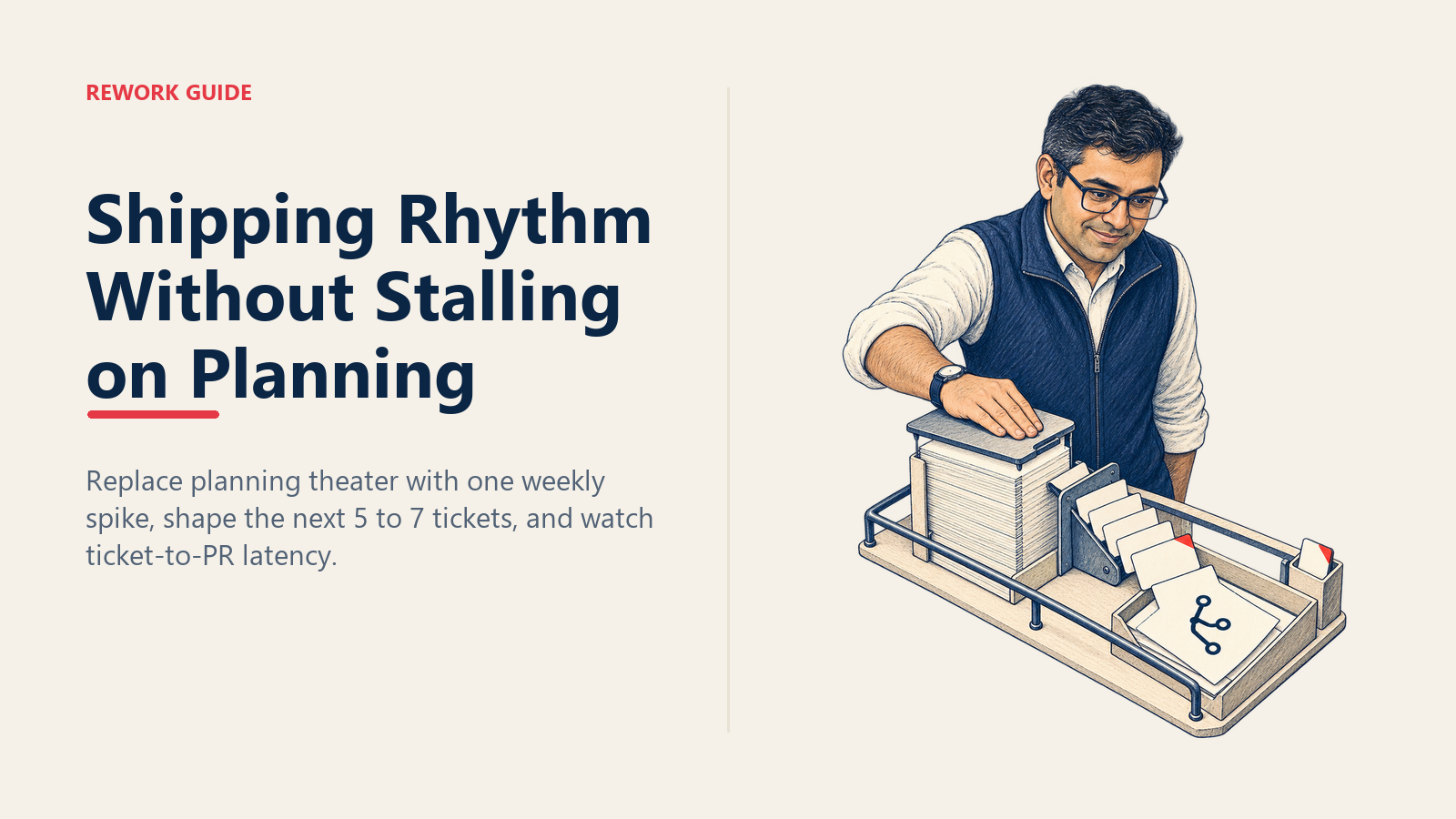
Shipping Rhythm Without Stalling on Planning
Turn this article into takeaways for your work.


Each assistant summarizes the article only for you and suggests best practices for your work.
It's Friday at 4:30 p.m. You open your calendar, count the meeting blocks shaded in blue, and add them up. Nine hours this week. Sprint planning on Monday. Mid-sprint refinement on Wednesday. A retro that turned into another planning session on Thursday. Three estimation huddles you scheduled because tickets weren't "ready." And the team shipped one feature.
It wasn't even the feature you planned. A senior IC on your team noticed something was obviously broken on Wednesday morning, opened a PR by lunch, and merged it before standup on Thursday. The thing nobody scoped, nobody pointed, nobody put on the board.
You think: my team shipped despite my planning, not because of it.
If that scene sounds familiar, this guide is for you. I've coached EMs through this exact pattern, and the fix is not "better planning." The fix is less planning, structured differently, with one real signal you actually watch.
Why Planning Eats Your Week (and Doesn't Fix Anything)
Run the math. Six engineers, two-hour planning every two weeks, plus a one-hour mid-sprint refinement, plus a one-hour retro. That's 24 engineer-hours per sprint just in formal planning. Add the EM's prep (typically 3-4 hours a sprint), the tech lead's prep (2 hours), and async ticket grooming in Slack threads (uncountable). You're spending the equivalent of a senior engineer's full week, every two weeks, on planning.
What does that buy you? In most teams I've seen, it buys estimates that are wrong by 3-4x, a backlog that gets re-prioritized every week anyway, and a retro action item that nobody owns by Wednesday.
The real question isn't "how do we plan better?" It's "what is planning actually for?" Strip it down. Planning produces three things a team needs: a short list of what to do next, named owners, and a shared sense of what's at risk. Everything else is theater.
The trap is that planning ceremonies feel productive. You leave the room with a populated sprint board. It looks like work happened. But populated sprint boards don't ship code. ICs writing PRs ship code. Every hour you keep an engineer in a planning meeting is an hour they're not shaping a problem or opening a PR.
Planning as a Spike, Not a Ceremony
Here's the reframe: planning is a spike. A short, focused investigation with clear inputs and outputs. Not a recurring ceremony. Not a calendar block of dread.
One hour. Once a week. Whole team optional, EM and tech lead required.
A sample agenda I've used with three different teams:
- 0-10 min, what shipped, what didn't. Walk last week's board. No blame. Just status. If something didn't ship, name why in one sentence: "blocked on review," "scope was bigger than we thought," "interrupted by an incident." That's it.
- 10-25 min, what's blocked. Anything sitting longer than 48 hours without movement. The tech lead and EM make a call: unblock it now, kill it, or escalate it. Decisions, not discussion.
- 25-50 min, next 5-7 tickets. Not the whole sprint. The next 5-7 things. For each one: owner, rough appetite (small/medium/large), and the one risk that might explode. No story points. No Fibonacci. No planning poker.
- 50-60 min, open questions. Anything anyone's worried about that didn't fit above. Park it in writing if it can't be resolved in 10 minutes.
That's it. The team I worked with at a 40-person engineering org cut planning from 8 hours a week to 1 hour using something close to this. Their throughput went up, not down, in the first month.
The hardest part is the discipline to leave the room when the hour is up. Open question? Write it down, take it offline, decide async. Don't extend the meeting. The meeting ends at the hour, every time, or the whole thing collapses back into ceremony.
The 6-Week Shape Up vs. 2-Week Sprint Debate
There's a long-running debate in engineering management about cadence: 2-week sprints (Scrum-flavored) versus 6-week shape-up cycles (Basecamp's model from "Shape Up"). I'll save you the religious war.
Use 6-week cycles when your work is feature-shaped. You've got 3-6 weeks of meaningful, well-defined scope. The team can commit to one big bet, work on it deliberately, and ship something substantial. Shape Up shines here because the appetite (max time you'll spend before cutting scope) is built into the model.
Use 2-week sprints when your work is reactive. Customer escalations, infra incidents, support engineering, platform work where requests come in faster than you can plan them. Two-week sprints give you a tighter feedback loop and let you re-prioritize without it feeling like a strategy reversal.
The honest test: ask your team this question with no warm-up. "Would you rather commit to one big bet for 6 weeks, or 5 small bets in 2 weeks?" Different teams give different answers. Both are valid. The wrong answer is mixing them. Running 2-week sprints with 6-week-shaped work means every sprint feels like a partial failure, and running 6-week cycles on reactive work means the cycle gets blown up by a customer incident in week 2 every single time.
Pick one. Commit for a quarter. Reassess.
Ticket-to-PR Latency: The Real Signal
Forget velocity points. Forget "burn-down charts that are actually burn-up charts because we keep adding scope." There is one number that tells you whether your shipping rhythm is working: ticket-to-PR latency.
Definition: the elapsed time from when a ticket is assigned to an engineer to when they open the first PR for it.
That's it. No story points. No estimation. Just two timestamps.
If that number is 4+ days on a ticket you'd estimated as a 5-day ticket, your planning is broken. Not because the engineer is slow. Because the ticket isn't shaped enough to start. They're spending day 1, 2, and 3 figuring out what the ticket actually means, what's in scope, what's not, and what to do when they hit the inevitable rabbit hole. That's planning leaking into execution.
What good looks like: median ticket-to-PR latency under 24 hours. p75 under 48 hours. p90 under 5 days. If your distribution has a long tail (a few tickets sitting at 10+ days), those are the tickets eating your sprint and they're the ones to investigate.
Build the chart once, in whatever tool you use. Linear, Jira, and Shortcut all expose this data through their APIs. Pull it weekly. Watch the median. When it climbs, planning has degraded. When it drops, something's working.
The "Estimated 3 Days, Took 11" Pattern
Every EM has lived through this. Ticket estimated at 3 days. Eleven days later, it's still in review. The engineer didn't slack off. The ticket was unshaped.
This isn't an estimation problem. Better estimates won't fix it. The work itself was ambiguous when it entered the sprint, and "ambiguous + I'll figure it out as I go" is how a 3-day ticket becomes 11 days.
The fix is a 30-minute shaping session before the ticket enters the sprint. Run by the tech lead or a senior IC. Output is a short shaping doc covering four things:
- In scope. The specific behavior or capability we're building. Concrete, not abstract.
- Not in scope. The two or three things that would seem related but we're explicitly not doing. This is the most important section. Without it, scope creeps every time.
- The rabbit hole. The known risk: "this might require touching the auth service, and if it does, we stop and re-scope." Naming it ahead of time means the engineer doesn't disappear into it for a week.
- The appetite. Maximum time we'll spend before we cut scope or escalate. Not an estimate. A budget.
Thirty minutes. One doc. A ticket that came out of shaping is 4-5x more likely to ship close to its appetite than one that didn't. I've seen this hold up across teams of 6 and teams of 60. The math on the time investment is obvious.
Tech-Debt Budgeting: The 20% Rule
Twenty percent of every sprint goes to tech debt. Not "if there's time." Not "we'll get to it next quarter." A committed, named, line-item allocation.
If you skip this, debt compounds. By quarter 3 your shipping velocity is half what it was, and nobody can quite explain why. The flaky test that takes three retries to pass. The migration that was supposed to be temporary 18 months ago. The service that nobody knows how to deploy except one engineer who's about to take parental leave.
Twenty percent isn't a magic number. It's the floor below which debt accumulates faster than you can pay it down. Some teams need 30% during catch-up periods. Some teams can run at 15% if their codebase is genuinely young. Below 15%, you're borrowing from your future quarter's velocity and you'll feel it.
How to pick which debt to pay down, in priority order:
- Customer-facing pain. Bugs the team has worked around but customers still hit. Performance issues that show up in support tickets. Always first.
- Developer-facing pain. Slow tests, broken local dev, deployment landmines. Anything that costs the team an hour a week or more.
- Theoretical cleanup. Refactors that would feel nice but don't have a forcing function. Last priority. Be honest about whether these belong in the sprint at all.
Make the 20% visible on the board. Tag tickets with "tech-debt." Report the percentage in your weekly planning spike. If a sprint slips below 20% three weeks in a row, that's a flag.
Unblocking Patterns: PR Review SLA + Decision Calendar
Two specific mechanisms that move the needle more than any planning change:
PR Review SLA. First review within 4 hours during work hours. Not a guideline. A blocking commitment. If a PR is sitting unreviewed for 4+ hours, the assigned reviewer drops what they're doing and reviews it. This sounds harsh. It works.
The teams I've seen adopt this ship 2-3x more than they did before, and the reason is straightforward: PRs sitting in review for 2-3 days mean engineers context-switch onto something else, then context-switch back when the review comes in, then context-switch again to address feedback. Each switch costs 30-60 minutes of real productive time. A 4-hour SLA collapses that loop.
The wording I'd put in your team's working agreement, verbatim:
First review within 4 hours during work hours, except when an engineer is in a focused block flagged in advance. Reviews block other work, including the reviewer's own active ticket. Comments-only reviews count. The expectation is feedback, not approval.
Decision Calendar. One 30-minute slot per week where the EM and tech lead decide everything that's been waiting. Architectural calls. Vendor choices. "Should we use library A or library B?" decisions. Any question that's been sitting in a Slack thread for more than 48 hours.
Without this, decisions stretch out for weeks. Engineers ask once, get a "let me think about it," and the question dies in a thread. The decision calendar makes a public commitment: by Friday at 11 a.m., that question gets a yes, a no, or a "we need 30 more minutes to look at it." No more "I'll get back to you" loops.
Both mechanisms are mechanical. They don't require a culture change or a buy-in roadshow. You commit to them on Monday and start running them on Tuesday.
When to Escalate (and What "Escalate" Actually Means)
Most EMs misuse the word "escalate." They think it means going to your boss when something's on fire. That's not escalation. That's a status update with extra steps.
Escalation is making the right invisible decision visible.
Three triggers for real escalation:
- Scope is bigger than the appetite. You shaped the ticket for a 1-week appetite. The engineer is now telling you it's a 3-week problem. The decision (do we still do it? do we cut scope? do we kick it to next quarter?) lives outside the team. Escalate.
- Dependency on another team is blocking you for 2+ days. You've asked. You've followed up. Nothing's moving. Escalate to the EM of the other team, with a specific ask and a specific deadline. Not "can you help us?" but "we need a yes/no on whether the auth team can prioritize this by Thursday EOD."
- An architectural decision affects more than your team. You're about to introduce a new database. A new auth pattern. A new deployment approach. If the blast radius is bigger than your team, escalate up so the decision is owned at the right level.
A 3-line escalation template that works in Slack or email:
Decision needed: [the specific question, framed as a yes/no or pick-one-option]
Why now: [what's blocked, who's affected, what's the cost of waiting]
Deadline: [when you need an answer, with a specific date and time]
That's the whole template. Three lines. No backstory paragraph. If the recipient needs context, they'll ask. The clarity itself is the unblocker.
The First 30 Days of This New Rhythm
Don't roll all of this out on Monday. The fastest way to lose a team's trust is to announce a new operating model and ask them to follow it before they've seen any of it work.
A 30-day rollout that sticks:
Week 1: Kill one recurring meeting. Pick the one nobody likes. Mid-sprint refinement, probably. Cancel it. Watch what breaks. Usually nothing. If something breaks, you've learned what that meeting was actually doing.
Week 2: Ship the new 1-hour planning spike. Run it once. Send a short note to the team explaining what the new format is and why. Get through the hour. Stick to the time box.
Week 3: Instrument ticket-to-PR latency. Pull the data from your tool. Make the chart. Don't share it yet. Just look at it yourself for a week so you understand what your distribution actually looks like.
Week 4: Review the data with the team and adjust. Bring the chart. Ask: "what do we see? what surprises us? what's one thing we'd change?" Let the team weigh in. Adjust the rhythm based on what they say.
By day 30 you'll have replaced 6+ hours of planning with 1 hour, instrumented the one signal that matters, and given the team a rhythm they can defend. You'll also have your time back. Use it to do the work an EM is actually paid to do: shape problems, unblock people, and grow your engineers.
The Friday afternoon scene from the start of this article? In 60 days you won't recognize it. Your calendar will have one planning block, one decision-calendar block, and a lot of empty space. Your team will be shipping more. And the senior IC who used to ship things despite your process will be shipping things because of it.
Learn More

Principal Product Marketing Strategist
On this page
- Why Planning Eats Your Week (and Doesn't Fix Anything)
- Planning as a Spike, Not a Ceremony
- The 6-Week Shape Up vs. 2-Week Sprint Debate
- Ticket-to-PR Latency: The Real Signal
- The "Estimated 3 Days, Took 11" Pattern
- Tech-Debt Budgeting: The 20% Rule
- Unblocking Patterns: PR Review SLA + Decision Calendar
- When to Escalate (and What "Escalate" Actually Means)
- The First 30 Days of This New Rhythm
- Learn More