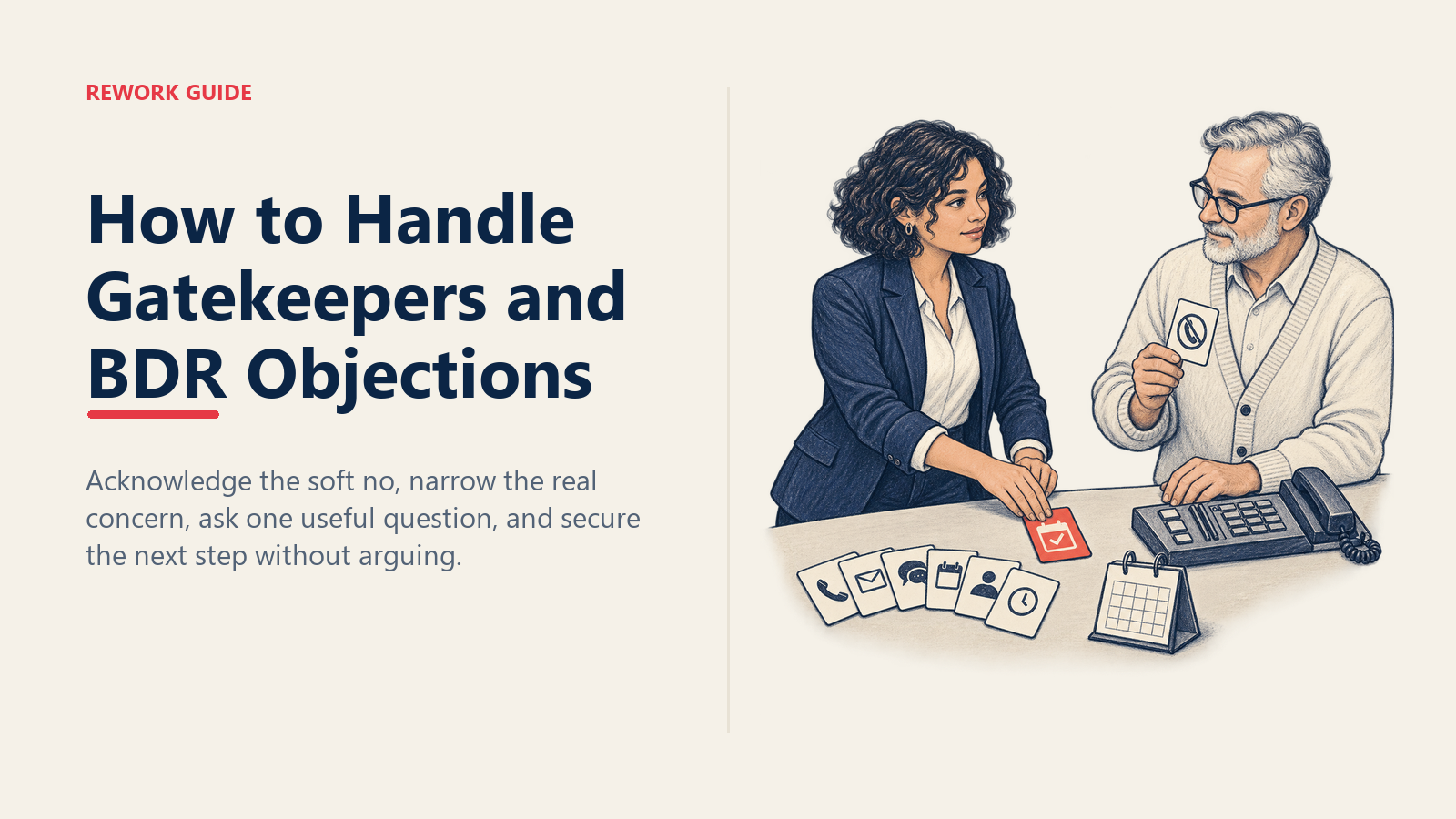
Handling the Gatekeeper and Other Top BDR Objections
Turn this article into takeaways for your work.


Each assistant summarizes the article only for you and suggests best practices for your work.
Three calls in a row this morning. The gatekeeper at the first one wouldn't put you through. The second asked you to "send some information." The third said they're "happy with their current vendor." It's 9:47 a.m. and you already feel done.
This guide is what to say on call number four.
Why This Matters
Objection handling is the single biggest difference between the BDR who hits 40% conversion from connect-to-meeting and the one stuck at 60%. (Lower is better. 60% means the rep is only converting the easy ones.)
Reps who can't push past a soft no leave 30 to 40 percent of bookable meetings on the table. This isn't about being pushy. It's about knowing the next sentence when most reps freeze. Your job isn't to convert every call. It's to never let a soft no end the conversation before the real objection surfaces.
Six objections account for roughly 90% of outbound. Learn the move for each. For the cold-open that gets you to the objection in the first place, see Cold Call Scripts That Actually Book Meetings.
The Six, in Order of Frequency
- Gatekeeper won't put you through
- "Just send me some information"
- "We're happy with our current vendor"
- "We don't have budget"
- "Bad timing / call me next quarter"
- "I'm not interested"
Scripts are in code blocks so you can copy them onto a sticky note and read them out loud until they sound like you.
1. The Gatekeeper Script
The gatekeeper isn't your enemy. They're filtering vendors. So your job is to not sound like one. Two moves do most of the work: name-drop the executive by first name only (signals familiarity), and assume access (don't ask permission, ask for redirection).
The line:
"Hi, this is [Your Name] over at [Company]. Could you put me through
to Sarah? I owe her a follow-up on something we were looking at last
month and I want to close the loop before end of week."
Say it like you've called this office fifty times. Bored, slightly rushed, friendly. Not bright. Bright is the giveaway.
If they ask what it's about, don't pitch:
"It's about the procurement question she had, I just need two
minutes of her time. If she's not in, can you give me her direct
line and I'll catch her later?"
You're framing the call as a continuation, not an introduction.
What NOT to say:
- "Is this Sarah's assistant?" (You just confirmed you don't know her.)
- "Hi, I'm calling from [Company], we help sales teams with..." (Identified as a vendor. Voicemail incoming.)
- "Could I please speak to your CRO if she has a moment?" (Real peers don't ask permission.)
Top quartile BDRs get past the gate on one in three attempts. If you're under one in five, your tone is the problem, not the script.
2. The "Send Me Information" Pivot
This is almost always a polite blow-off. They want you to email a deck they can not read in peace. It's a no with manners. Don't accept it as a soft yes.
The move is a two-question pivot. Agree, narrow, offer the alternative.
"Happy to send something over. So I send the right thing and not a
generic deck, what's the bigger priority for your team right now,
[Problem A] or [Problem B]? And are you the person evaluating, or is
there someone else on your side I'd be sending it to as well?"
You agreed (no fight), forced a content choice (surfaces actual pain), and uncovered whether they're the right person.
Nine times out of ten they'll start talking about Problem A or B. That's the conversation you wanted. Now you say:
"Got it. Honestly, the deck won't tell you anything you don't already
know. What would be more useful is fifteen minutes where I show you
how three other [Industry] teams solved exactly that. I've got
Thursday at 10 or Friday at 2, which is easier?"
You're not asking if they want the meeting. You're offering two times. Deck is gone. "I'll think about it" replaced with a calendar choice.
What NOT to say:
- "Great, what's your email?" (You just lost the call.)
- "Can I ask why you don't want to chat now?" (Arguing.)
- "Most of our prospects find a 15-minute call more useful..." (You sound like a script.)
3. The "Happy With Our Current Vendor" Reframe
This breaks new BDRs. They hear it and go quiet. What do you say? You can't argue someone out of being happy. So don't. Use the agree-narrow-question pattern.
"That's great to hear, honestly, most teams I talk to aren't
actually happy with their current vendor, they've just gotten used
to them. Quick question: if you could change one thing about how
[Vendor] handles [Specific Workflow], what would it be?"
That last question is the whole move. You agreed first (disarm), narrowed scope from "vendor" to "one workflow" (just admit a gap), and forced them to articulate something they wish were better.
Listen. Don't pitch yet. Whatever they say, follow with:
"Yeah, we hear that a lot. Worth fifteen minutes to compare notes?
Even if you stay with [Vendor], you'll know what's possible, and if
they ever drop the ball, you'll have a name to call."
You've reframed the meeting. Not "switch vendors." It's "due diligence so you have options." Almost any executive will take that.
What NOT to say:
- "Oh, but we're better than [Vendor] because..." (Feature war you can't win on a cold call.)
- "Are you locked into a contract?" (Too transactional, too soon.)
- "When does your contract come up for renewal?" (Save this for meeting two.)
4. The "No Budget" Probe
"No budget" is two objections wearing the same costume. Sometimes real (line item doesn't exist this year). Sometimes "no priority" (the budget exists, you haven't given them a reason to move it). Figure out which. Use the budget-cycle question.
"That makes sense, most of the executives I talk to are tight
this quarter. Quick question so I know how to be helpful: when does
your team plan budget for next year? And if [Specific Outcome] could
move the needle by 20%, would that be a [Department] line item or
something that goes through a bigger pool?"
First question reveals timing. Second reveals whether they have authority over the spend.
If they say "we plan in Q3 and yes it would be a [Department] line," you've got a real prospect. Book a meeting now and target the budget conversation in their planning cycle. Try:
"Got it. Worth getting on the calendar now so when planning starts
in Q3, this is already a known option instead of a cold pitch.
Thursday or Friday for fifteen minutes?"
If they say "we genuinely don't have it and won't until 2027," that's real. Mark them for re-touch and move on.
What NOT to say:
- "Most of our customers find ROI within 90 days..." (Pitching value before you've earned the right.)
- "Could you find budget if it was important enough?" (Condescending. They'll hang up.)
For how a top rep triages this live, A Day in the Life of a BDR/SDR walks through it.
5. The "Bad Timing" Disarm
"Now's not a good time" is one of the easiest to handle, and one of the most often botched. The mistake: "okay, I'll call you in three months" written on a sticky note. Three months later the prospect doesn't remember you and the call starts from zero.
Use the calendar trick. Book the meeting now, in the future they just admitted is better.
"Totally fair, let's not waste your time today. So I don't lose
track of you in the meantime, can we put thirty minutes on the
calendar for the second week of [Future Month]? That way it's there
when you're ready, and if something changes on your side, you cancel
and we'll find a new time. Sound okay?"
You're not asking them to commit to buying, just to a calendar slot they can cancel. Friction is almost zero. By the time the invite fires, they've forgotten the original ask was a brush-off.
If they push back ("I really can't commit to a future date"):
"No problem. What if I send a quick check-in note in [Future Month]
referencing this conversation? That way you don't get a cold call,
you get a 'hey, you said now wasn't right, is the timing better
yet?' Fair?"
You've earned permission to follow up warm. That's a win on a call that was about to be a loss.
What NOT to say:
- "Okay, I'll try you again in three months." (Gave away the call with no follow-up structure.)
- "What's the timing concern?" (Sounds like an interrogation.)
6. The "Not Interested" Graceful Exit
Push once, then walk.
"Totally understand. Most people I call aren't interested in a vendor
pitch, they're interested in solving [Specific Problem]. If I told
you we helped a team like yours cut [Metric] by 30% in a quarter,
would that change the conversation, or is it really just bad timing?"
You've reframed from "vendor pitch" to "specific problem," put a number on it, and offered a graceful out ("or is it really just bad timing") so they don't have to defend the original no.
If they engage, run the meeting move from objection #2. If they say "still not interested," walk. Exit script:
"Got it, no problem at all. Mind if I check back in 90 days in case
anything changes on your side? If you're a hard no forever, just
tell me and I'll take you off the list."
It's a power move. Almost everyone says "sure, check back in 90 days" because the alternative (telling a stranger to delete them forever) feels rude. You've bought a re-touch with permission.
What NOT to say:
- "Can I ask why?" (Arguing with the no.)
- "What if I sent you a case study?" (Back to the deck. We covered why that loses.)
- Silence, then "okay, bye." (You walked without earning the re-touch.)
Bonus: The Voice-Tone Reset
After a hard rejection, your voice flattens. The next prospect hears it and rejects you. The cycle compounds. Top BDRs run a 30-second reset. Stand up. Three breaths. Say this out loud:
"That call was about them, not me. The next person is a different
person and a different conversation. Voice up. Pace up. Smile."
Sounds ridiculous. Works. Especially the smile. Your voice picks up energy from your face, and the prospect hears it in the first three syllables.
The One-Page Cheat Sheet
Print this. Put it next to your monitor.
| Objection | First Move | Goal |
|---|---|---|
| Gatekeeper | First-name + "owe her a follow-up" | Transfer or the direct line |
| "Send info" | "What's the bigger priority, A or B?" | Surface real pain, pivot to calendar |
| "Happy with vendor" | "If you could change one thing about how [Vendor] handles X..." | Admit a gap |
| "No budget" | "When does your team plan next year's budget?" | Separate budget from priority |
| "Bad timing" | "Let's put it on the calendar for [Future Month]" | Book the meeting now |
| "Not interested" | One push, then "check back in 90 days?" | Earn re-touch with permission |
Common Pitfalls
Arguing with the objection instead of acknowledging it. You can't logic someone out of a feeling. Agree first, narrow, then ask.
Accepting "send me information" as a soft yes. It's a no with manners. The deck never gets read.
Giving up on no-show meetings. Send the same-day note: "Sorry we missed each other. Here are two times this week, or if it's just not a fit, reply 'no' and I'll close the loop." One in four no-shows recovers when you ask cleanly.
Matching the prospect's flat tone after a rejection. Run the reset. Every time.
Pushing past the second no on "not interested." One push, then walk. Two pushes is how a rep gets burned for the rest of the team.
For more, BDR/SDR Common Pitfalls (and How to Avoid Them) covers what compounds across a quota cycle.
When to Escalate to Your AE
You're not supposed to close. But when a prospect engages deeply, loop in your AE live. Triggers: pricing/timeline questions in the first five minutes, mention of an evaluation they're running, or "who else should I talk to?"
When it happens:
"This is a great conversation and the right person to dig into the
technical side is my AE, [Name]. Mind if I see if she's free for
fifteen minutes right now, or do you want me to put her in a
follow-up?"
You just turned a cold call into a warm AE meeting in real time. That's the rep skill that gets you noticed in promotion conversations. See SDR-to-AE Promotion Timeline.
Measuring Success
Three numbers matter. Track weekly.
- Objection-handling success rate. Percentage of calls where you got past the first "no" and kept the conversation going for 90+ more seconds. Top quartile: roughly 40%.
- Meetings booked from initial-no calls. Out of ten meetings booked in a week, how many came from a call that started with a soft no? Fewer than three means you're cherry-picking the easy yeses.
- Gatekeeper-bypass rate. Percentage of dials where you reached the decision-maker on the first attempt. Trend matters more than absolute number.
The Bottom Line
Every "no" has a workable next step. The gatekeeper has a redirect. The brush-off has a pivot. The incumbent has an admitted gap. The budget objection has a planning cycle. The bad timing has a future calendar slot. The hard no has a 90-day re-touch.
Print the cheat sheet. Read the scripts out loud until they sound like you. Run the reset between calls. Tomorrow morning, on call number four, you'll know exactly what to say.

On this page
- Why This Matters
- The Six, in Order of Frequency
- 1. The Gatekeeper Script
- 2. The "Send Me Information" Pivot
- 3. The "Happy With Our Current Vendor" Reframe
- 4. The "No Budget" Probe
- 5. The "Bad Timing" Disarm
- 6. The "Not Interested" Graceful Exit
- Bonus: The Voice-Tone Reset
- The One-Page Cheat Sheet
- Common Pitfalls
- When to Escalate to Your AE
- Measuring Success
- The Bottom Line