Objection Handling for AEs: Pricing, Timing, Competitor Pushback
Turn this article into takeaways for your work.


Each assistant summarizes the article only for you and suggests best practices for your work.
You sent pricing on Tuesday. The champion loved the demo. MEDDIC checked out. You walked away from the call thinking this one was done.
Then Wednesday's reply landed: "Let me circle back internally." Then Thursday, nothing. Friday, an out-of-office. By the next Tuesday, you knew. The deal was already dead. You just hadn't been told yet.
You replay the call and realize what happened. You handed them a number and walked away. The objection was sitting under the surface the whole time. You never surfaced it.
This is how most late-stage deals actually die. Not from a clean "no" you can argue against, but from a soft "not now" you accepted too quickly because you were afraid of pushing.
The fix is a script. Not a manipulation tactic, not a closing trick. Just a repeatable line you run when a buyer pushes back, so the conversation keeps going long enough for you to learn what's actually missing.
Why Objections Are Buying Signals
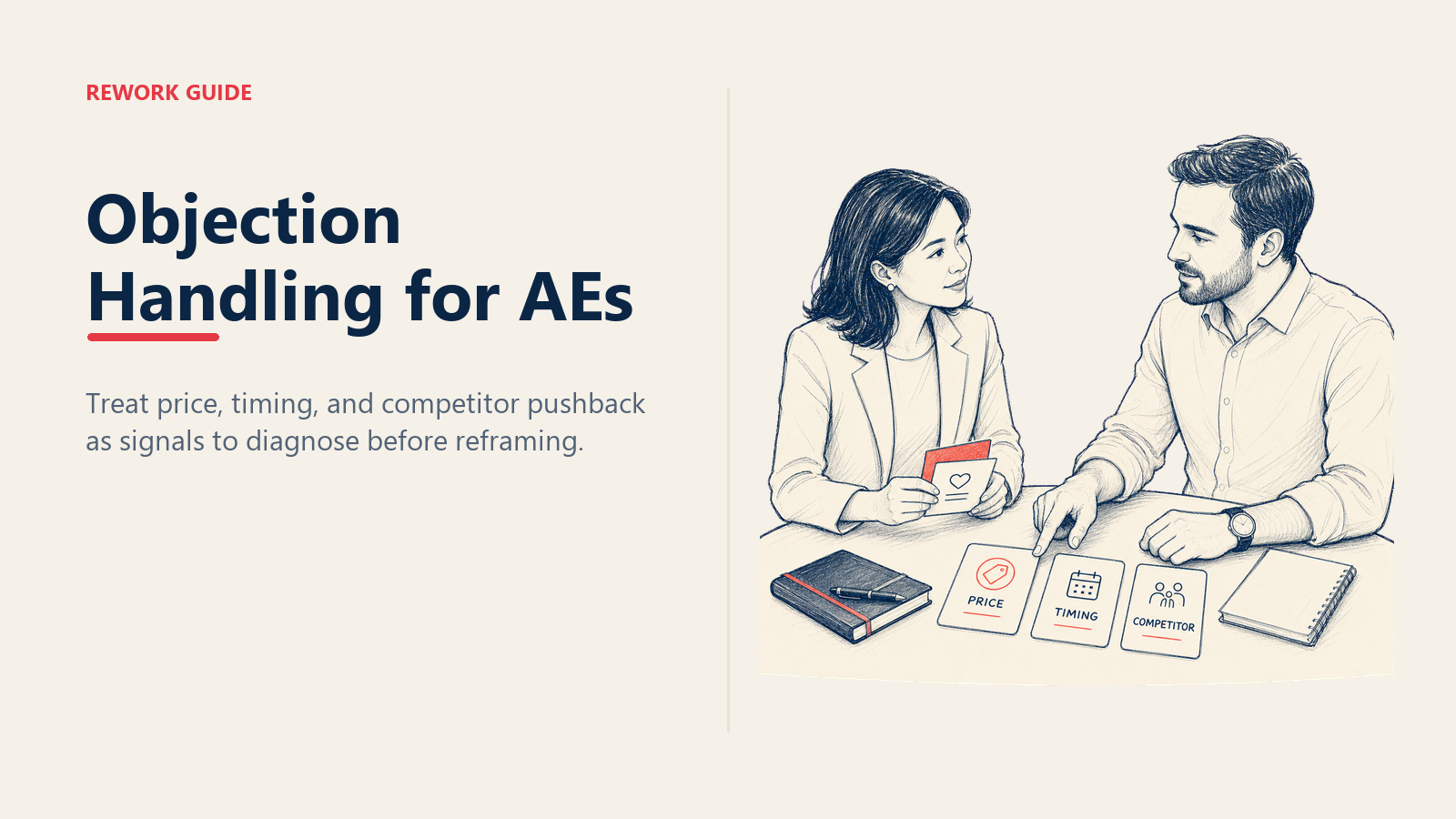
Reframe the whole category. Objections aren't roadblocks. They're the buyer telling you what's missing in your deal.
A price objection means you haven't anchored value to the cost of their problem. A timing objection means you haven't quantified the cost of waiting. A competitor objection means they don't yet see the dimension where you win and they care. A "let me think about it" stall means there's an unspoken concern your discovery missed.
Every objection is a diagnostic. The AE's job is to surface the real one, not deflect the surface one.
The AEs hitting quota and the AEs missing it have roughly the same product knowledge. The difference is the line they run when a buyer pushes back. One group has a script. The other has a defense, an apology, or silence.
If you read Discovery Calls Using MEDDIC before this, you already know that strong discovery prevents most objections. This guide is for the ones that survive discovery and show up at the proposal stage anyway.
Price Objection: Anchor and Value Reframe
The fastest way to lose margin is to discount on the first push. The buyer says "it's expensive," you say "let me see what I can do," and you've just trained them to push every time, on every renewal, forever.
Never discount in the first response. Anchor to the cost of the problem, not the cost of the product.
Script 1, when the buyer says "it's too expensive":
"When you say it's expensive, expensive compared to what: the status quo, a competitor, or your budget? I want to make sure I'm answering the actual question."
Why it works: each answer routes to a completely different play.
If they say "the status quo," you anchor to the cost of the problem you uncovered in discovery. ("You told me missed follow-ups are costing you about 15 deals a quarter at $40K average. That's $600K a quarter. Our license is $48K a year.")
If they say "a competitor," you redirect to differentiation (covered in the next section).
If they say "our budget," you have a budget conversation, not a price conversation. Budget is solvable. Price is a fight you'll lose.
Script 2, when the buyer asks for a discount before you've sent pricing:
"Happy to talk about that. Before we do, what number would make this a yes today, and what's that based on?"
Why it works: most discount requests are reflexive. The buyer doesn't have a number; they're testing. Asking them to ground the request usually surfaces that they haven't done the math, which puts the conversation back on value.
Script 3, when procurement says "we need at least 20% off":
"Got it. Help me understand: is that a hard threshold from finance, or a target you've been asked to hit? If we can't get there on price, are there other levers we could pull, like contract length or payment terms, that get you to the same place?"
Why it works: it acknowledges procurement's job without conceding. It also opens up the trade-space (annual prepay, multi-year, expanded scope), which usually gets you to a number that works without cutting list price.
The rule across all three: discounting is the last move, never the first. If you discount on the first push, you've told the buyer that your price was inflated, and you've taught them to negotiate harder next time.
Timing Objection: Cost-of-Delay Framing
"Now isn't a good time" is the second-most common objection and the most lethal because it sounds reasonable. Of course they're busy. Of course Q2 is bad. Of course they want to wait until after the offsite.
What "now isn't a good time" actually means: "I haven't quantified the cost of waiting, so the path of least resistance is to do nothing."
Your job is to make the math visible.
Script 4, when the buyer says "let's revisit in Q3":
"Totally fair. Help me think through it with you: if we delay 90 days, what happens to [the metric they care about]? Walk me through what changes between now and then."
Why it works: it forces the buyer to construct the case for delay out loud. Most of the time they can't. The metric keeps bleeding whether they buy or not. The delay isn't free; they just haven't priced it.
Cost-of-Delay Worked Example
This is the math you should be able to run in your head on any call.
A buyer at a 200-rep sales org tells you their close rate dropped from 26% to 19% over the last two quarters because reps are missing follow-ups. Average deal size is $35K. Each rep works ~60 opportunities per quarter.
Cost of delay calculation:
- Lost win rate: 26% − 19% = 7 percentage points
- Lost deals per rep per quarter: 60 × 7% = 4.2 deals
- Lost revenue per rep per quarter: 4.2 × $35K = $147K
- Across 200 reps: $147K × 200 = $29.4M per quarter
- Per month: ~$9.8M
- Per business day: ~$465K
Then you say:
"If we go live in 30 days, you start clawing that back next month. If we revisit in Q3, that's another 90 days at roughly $465K a day in lost win rate. I'm not saying our tool fixes all of that. Let's say it recovers a third. That's still $3M a month. The license is $480K a year. The math says the cost of waiting is bigger than the cost of buying."
You don't need to be exact. You need to be in the right zip code with numbers the buyer can't dismiss. Keep a spreadsheet of cost-of-delay calcs by industry and team size so you can run this live on any call.
Competitor Objection: Differentiation, Not Disparagement
When the buyer says "we're also looking at [Competitor]," the worst thing you can do is trash the competitor. Trash-talking signals insecurity and makes the buyer defensive, because they've already spent political capital evaluating that vendor.
The right play: acknowledge the competitor's strength, then redirect to a dimension where you win and the buyer cares.
Script 5, when the buyer says "we're also evaluating [Competitor]":
"[Competitor] is a solid choice. They're particularly strong for [legitimate use case where they actually are good]. Where teams switch to us is when [specific scenario the buyer mentioned in discovery]. Does that match what you've been hearing?"
Why it works: you've validated their judgment for shortlisting the competitor (so they don't feel defensive), then you've planted the question that re-centers the comparison on your strength. The "does that match" close gets them to either confirm (your dimension matters) or push back (which surfaces what they actually care about).
The Battle Card Template
Build one of these for every competitor you face. Three columns, no more.
| Their Strength | Our Strength | The Question That Makes Our Strength Matter |
|---|---|---|
| Pre-built integrations with niche vertical tools | Cross-team workflow (CRM + lead mgmt + chat in one platform) | "How often does the sales team need to coordinate handoffs with CS or marketing in real time? What does that look like today?" |
| Lower entry-level price | Time-to-value on the full stack: most teams are live in weeks, not quarters, on the broader use case | "When you've rolled out tools like this before, how long did it actually take to get the full team using it for what you bought it for?" |
| Long-standing brand recognition | Modern UX that reps actually adopt without forced training | "What's your CRM adoption rate today? When you ask reps to log activities, are they doing it?" |
The point of the battle card isn't to win on every dimension. It's to know which dimension you win on, and to have the question that makes the buyer realize that dimension is the one that matters for them.
You will not win every competitive deal. You should win every competitive deal where your dimension is the deciding one, and you should lose fast on the deals where their dimension is.
The "Let Me Think About It" Stall: Surface the Real Concern
This is the silent killer. The buyer says "send me a proposal" or "let me think about it" or "let me circle back internally." You feel relieved because it's not a no. You send the proposal. You wait. They go dark.
"Let me think about it" is almost never about thinking. It's an unspoken objection, usually about a stakeholder you don't know about, a budget concern they're embarrassed to raise, or a competing priority you didn't surface.
Your job is to flush it out before the call ends, not after.
Script 6, when the buyer says "send me a proposal" or "let me think about it":
"Happy to send it. Before I do, if the proposal lands exactly how you'd want it, what's the next step on your side? And if it doesn't, what would be missing?"
Why it works: the first question forces them to walk you through the actual buying process (signers, legal, security review, board approval). The second question is the one that matters. "What would be missing" is permission to name the unspoken concern. They almost always do.
You'll hear things like: "Honestly, I'd need our CFO to sign off, and she's been pushing back on net-new tools." Or: "I'm not 100% sure we have buy-in from the CS team, and they'd need to be on board." Or: "I want to make sure we're not locked in if we end up going with [Competitor]."
Each of those is a real objection. Now you can handle it. Without that question, it would have lived under the surface and killed the deal silently.
Script 7, when the buyer goes silent for 5+ business days after you send pricing:
"Hey [Name], wanted to check in. I'm assuming one of three things is true: (1) the timing slipped and you'll get back to it, (2) something on our side wasn't a fit and you're ghosting because that's awkward, or (3) you've got a question you haven't had time to send. All three are fine. Just let me know which one and we'll go from there."
Why it works: it gives the buyer permission to say no without losing face, which is the actual reason most deals go silent. It's also direct enough to break the pattern of polite-but-empty follow-ups they've been ignoring. You'll get a reply roughly 60% of the time, and the reply is almost always the truth.
Script 8, when the buyer says "we need to think about it" and you suspect the real issue is internal alignment:
"Of course. Quick question: when you say 'we,' who specifically still needs to weigh in? I don't want to send something that's missing the right context for someone I haven't met yet."
Why it works: it pulls the org chart out of them. You learn who the unidentified stakeholder is, and you get the chance to either get in the room with that person or to arm your champion with what they need to sell internally. If you read Demo to Close: Engineering the Closing Event, you already know that mapping every signer before the proposal goes out is non-negotiable. This script is the rescue play when you didn't.
Common Pitfalls
The mistakes that show up over and over in deal reviews:
- Discounting on the first push. Trains the buyer to push every time. Once they know the price is negotiable, list price stops being a real number.
- Accepting "we need to think about it" as a soft yes. It's a soft no until proven otherwise. If you don't surface the real concern on the call, you won't surface it after.
- Comparing competitor features line-by-line. You lose by playing on their turf. Always redirect to the dimension where you win and the buyer cares.
- Defending price instead of reframing it. "Our price reflects the value" is a non-answer. Reframe to the cost of the problem.
- Going silent after the objection because you're afraid to push. The deal is already at risk. The only way out is through. One more clarifying question is almost never the wrong move.
For a fuller catalog of late-stage mistakes, see Common Pitfalls AEs Hit.
Measuring Whether Your Objection Handling Is Working
Four metrics matter.
Objection-stall recovery rate. Of deals that hit a meaningful objection, what percentage still close within 30 days? Top AEs are above 40%. Bottom AEs are under 15%, and the gap is almost entirely about whether they surfaced the real concern or accepted the surface one.
Average discount given. Target under 10% for non-strategic deals. If your average discount is 15%+, you're discounting reflexively, and your team is reading it as the price you actually believe in.
Deal cycle length. Objections handled well shorten cycles because they surface the real blocker early. Objections deferred lengthen cycles because the blocker doesn't go away. It just gets discovered later, when the deal is already cold.
Real-objection surface rate. Of deals that go to proposal, what percentage had the real objection named on a call before the proposal went out? This is the leading indicator. If you're sending proposals into uncertainty, you're going to lose deals you should have won.
Track these in your weekly deal review. The AE who masters this stops losing deals at the proposal stage and starts losing them earlier, which is the right place to lose them. That's also the path described in The Path from AE to Senior AE: Senior AEs lose fewer deals at the proposal stage because they surface the real concern in discovery, not after pricing goes out.
The One Rule That Holds All of This Together
When the buyer pushes back, do not deflect, defend, or discount. Ask the question that surfaces what's actually missing.
Price isn't the objection. Cost-of-problem framing is missing. Timing isn't the objection. Cost-of-delay framing is missing. Competitor isn't the objection. Your differentiating dimension hasn't been made to matter. "Let me think about it" isn't the objection. The real concern hasn't been named.
Your script for every objection is the same shape: acknowledge, ask, surface, reframe. The eight scripts above are templates. Make them yours, run them on every call, and the deals that used to die in silence start closing on time instead.

On this page
- Why Objections Are Buying Signals
- Price Objection: Anchor and Value Reframe
- Timing Objection: Cost-of-Delay Framing
- Cost-of-Delay Worked Example
- Competitor Objection: Differentiation, Not Disparagement
- The Battle Card Template
- The "Let Me Think About It" Stall: Surface the Real Concern
- Common Pitfalls
- Measuring Whether Your Objection Handling Is Working
- The One Rule That Holds All of This Together