Organizational Capability Building: How Leaders Develop Lasting Competitive Advantages
Turn this article into takeaways for your work.


Each assistant summarizes the article only for you and suggests best practices for your work.
There's a difference between a company that has talented people and a company that has organizational capability. Talented people leave. They get recruited away, burn out, or retire. When they go, they take their knowledge with them. But organizational capability is different. It lives in the systems, processes, culture, and shared knowledge of the organization. It reproduces itself. It compounds over time.
The distinction matters enormously for leaders thinking about competitive advantage. Talent advantages are real but fragile. Capability advantages are more durable. Apple's design capability isn't dependent on any one designer. Toyota's production capability doesn't evaporate when a plant manager leaves. Amazon's operational excellence persists through thousands of leadership transitions.
This is what organizational capability building aims to create: advantages that belong to the organization, not to individuals within it.
What Organizational Capability Actually Is
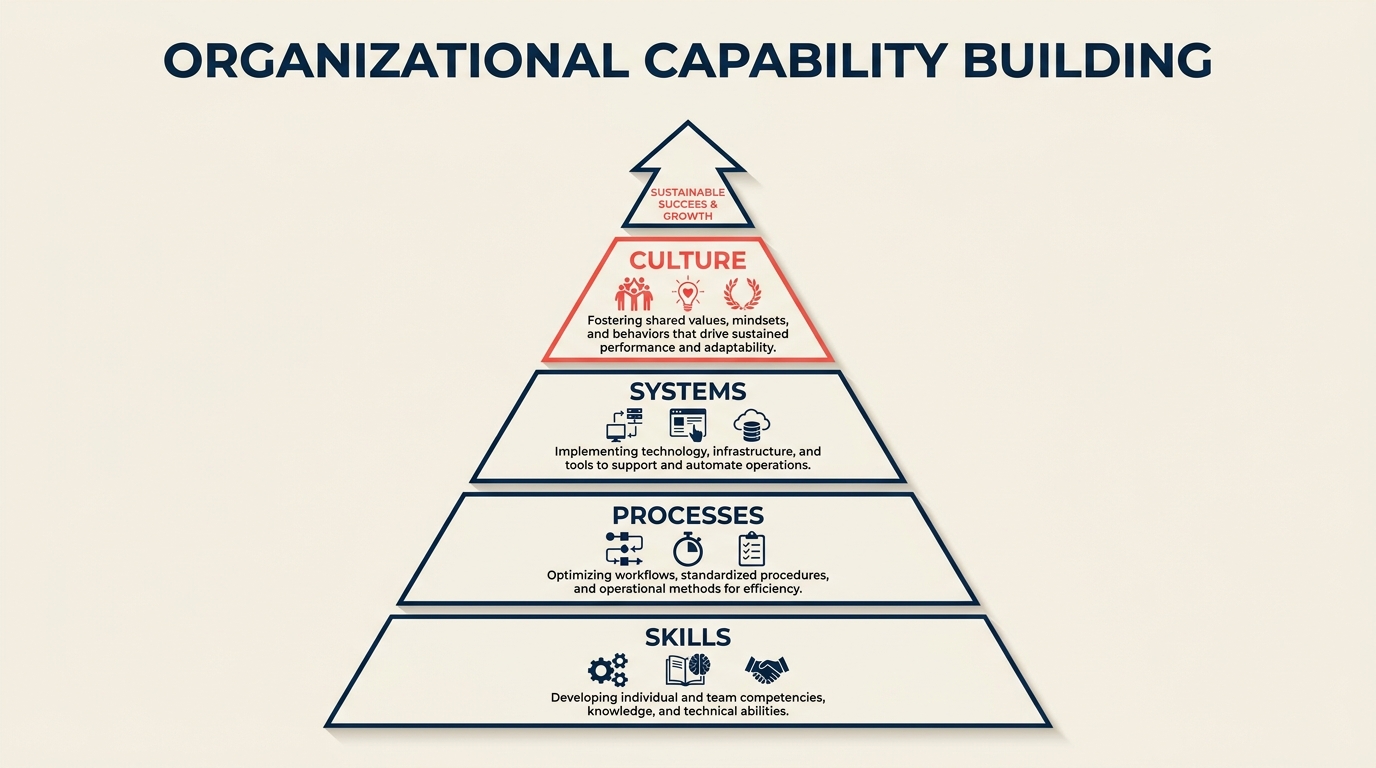
Organizational capability is the collective ability of an organization to perform a category of activities consistently, at scale, and to a high standard. It has four components that must all be present:
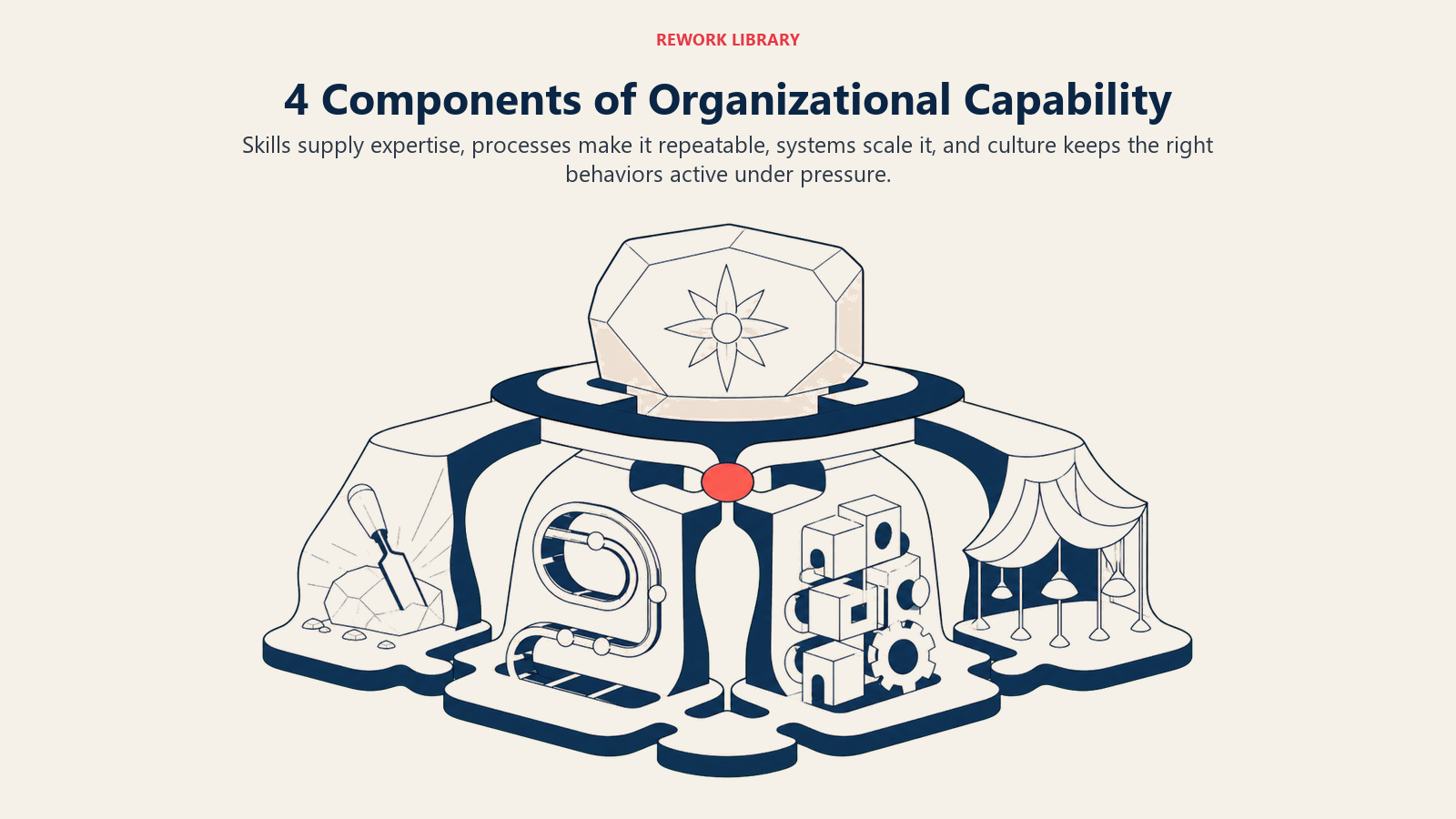
Skills. The individual knowledge and abilities that employees bring to specific tasks. Skills are the building blocks of capability, but skills alone don't create organizational capability. A company full of skilled data analysts doesn't have a data analytics capability if those analysts work in silos, use inconsistent methods, and produce outputs that no one knows how to act on.
Processes. The repeatable systems and workflows that channel individual skills into consistent organizational output. Process is what makes capability scalable beyond the individuals who originated it. A sales methodology that produces predictable results across 200 salespeople is a capability. One star salesperson with no documented process is not.
Systems. The tools, technology, data infrastructure, and measurement systems that support and scale the processes. Systems don't create capability, but they constrain it. Without the right systems, even strong skills and well-designed processes hit a ceiling.
Culture. The values, norms, and expectations that determine whether capabilities are applied consistently. Culture is often the hardest component to build and the hardest to change. An organization can have strong skills, good processes, and adequate systems but still fail to execute if the culture doesn't support the behaviors the capability requires.
All four components must align. Organizations that invest heavily in systems while neglecting process design, or that develop individual skills without building the culture that applies them, wonder why their capability investments underperform.
The Capability Assessment: Where You Stand Now
Building capability starts with an honest assessment of current state. Most organizations overestimate their capabilities because they confuse the presence of skilled individuals with the presence of organizational capability.
Identify the capabilities that matter strategically. Not all capabilities are equally important. Start with your strategic priorities (see strategic planning) and work backward to ask: what capabilities must we have to execute this strategy? Organizations pursuing growth through customer intimacy need different capabilities than those pursuing efficiency through operational excellence.
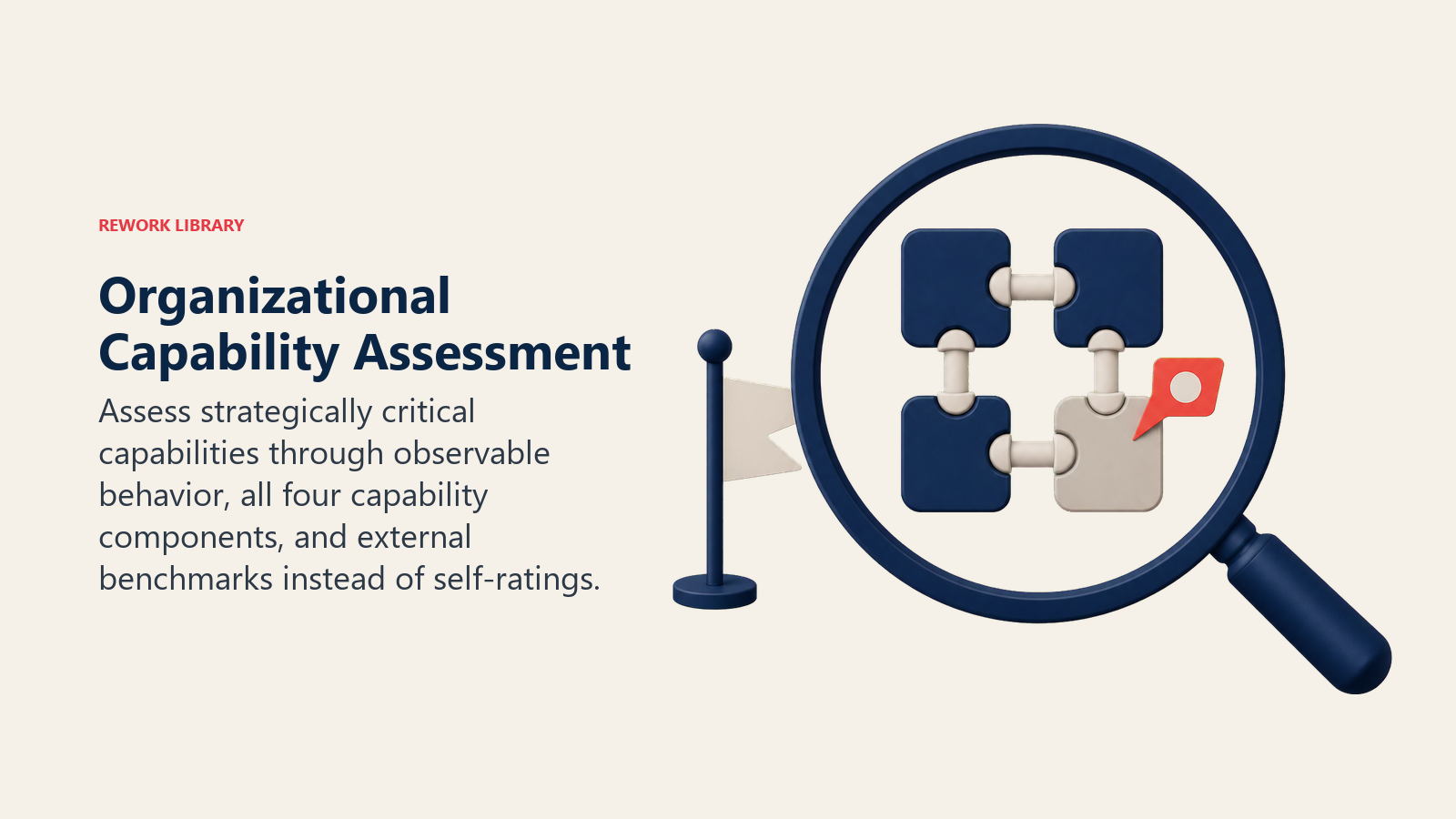
Assess each critical capability across all four components. For each capability that matters strategically, assess honestly:
- Do we have sufficient skills at each level (frontline, manager, leader)?
- Do we have documented, consistent processes that encode those skills?
- Do our systems adequately support those processes?
- Does our culture reinforce the behaviors the capability requires?
A capability is only as strong as its weakest component. A capability with strong skills but weak processes will be inconsistently executed. A capability with strong processes but weak culture will be ignored under pressure.
Use behavioral indicators, not self-assessments. Ask "what does this capability look like in action?" rather than "how would you rate your capability?" Behavioral indicators are harder to game and reveal the gap between stated capability and actual behavior. If your strategic thinking capability is strong, you should see leaders consistently framing decisions in terms of strategic trade-offs, not just operational urgency.
Benchmark externally where possible. Internal assessments are vulnerable to organizational blind spots. Where possible, compare your capability levels to industry peers or best-in-class organizations. External benchmarks reveal whether your internal sense of "strong" actually means competitive.
Gap Analysis: From Current to Required
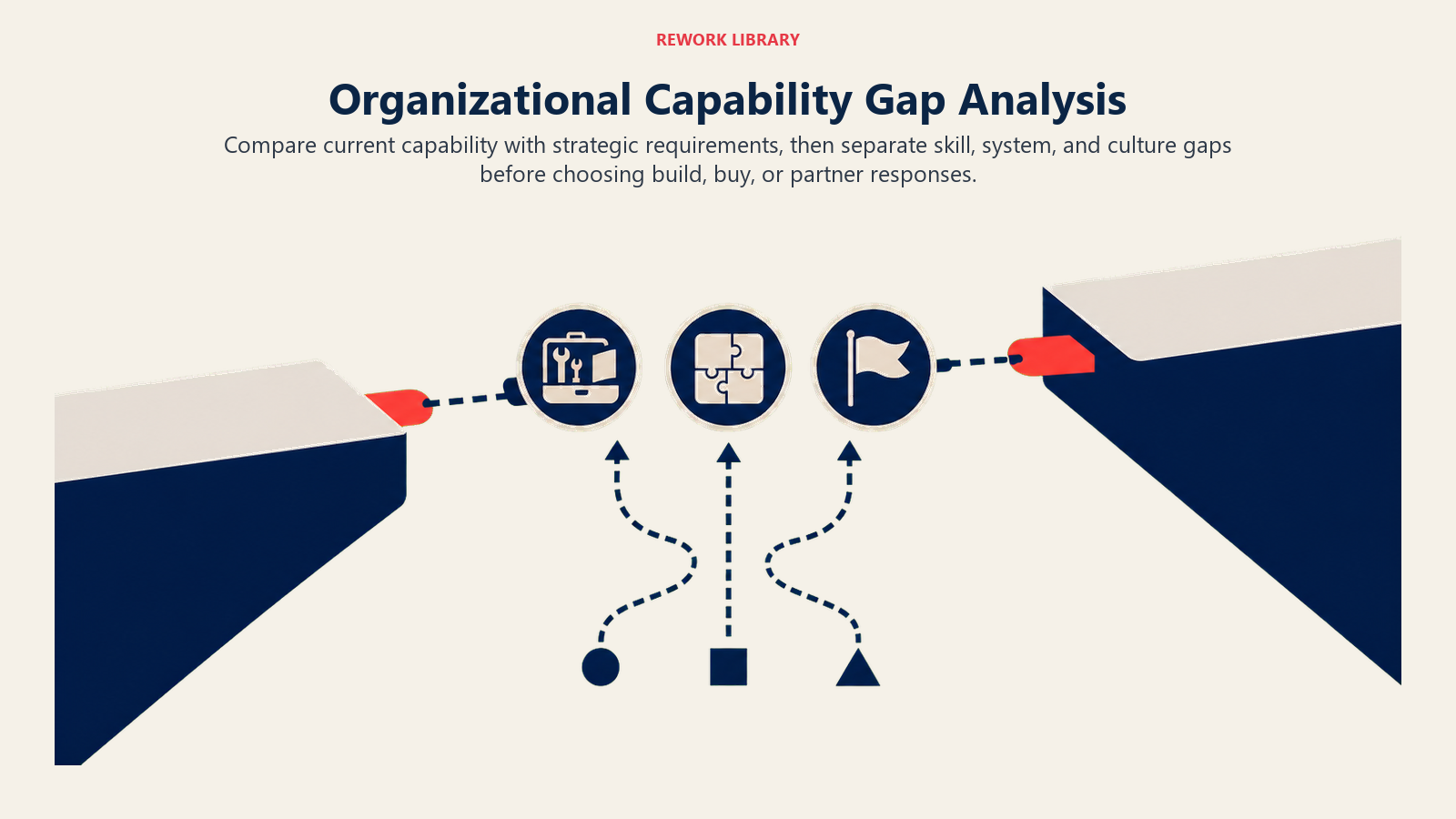
Once you have an honest picture of current capability, compare it to the capability profile your strategy requires. The gaps drive the development agenda.
Prioritize gaps by strategic impact. Not all capability gaps are equally urgent. A gap in a capability that's core to your competitive strategy is more urgent than a gap in a supporting capability. A capability gap that's limiting current performance is more urgent than one that will limit future performance.
Distinguish between skills gaps and system gaps. Training solves skills gaps. Process redesign and technology investment solve system gaps. Trying to solve a system gap with training is a common mistake that produces frustration and wasted investment. A team that doesn't have access to customer data can't develop data analytics capability no matter how much training they receive.
Identify culture gaps separately. Culture gaps require different interventions than skills or system gaps. Culture changes when leaders consistently model different behaviors, when incentive systems reward the desired behaviors, and when the organizational narrative shifts. These changes take time and can't be accelerated by training programs alone.
Assess build-versus-buy trade-offs. For each capability gap, decide whether to build the capability internally, acquire it through hiring or acquisition, or partner with external providers who have the capability. Building creates lasting organizational advantage but takes time. Buying is faster but creates dependency and may not transfer into organizational capability. The right answer depends on how central the capability is to your competitive position and how much time you have.
Building the Development Plan
A capability development plan translates gap analysis into a prioritized, resourced initiative. Most organizations attempt to close too many gaps at once and make progress on none of them.
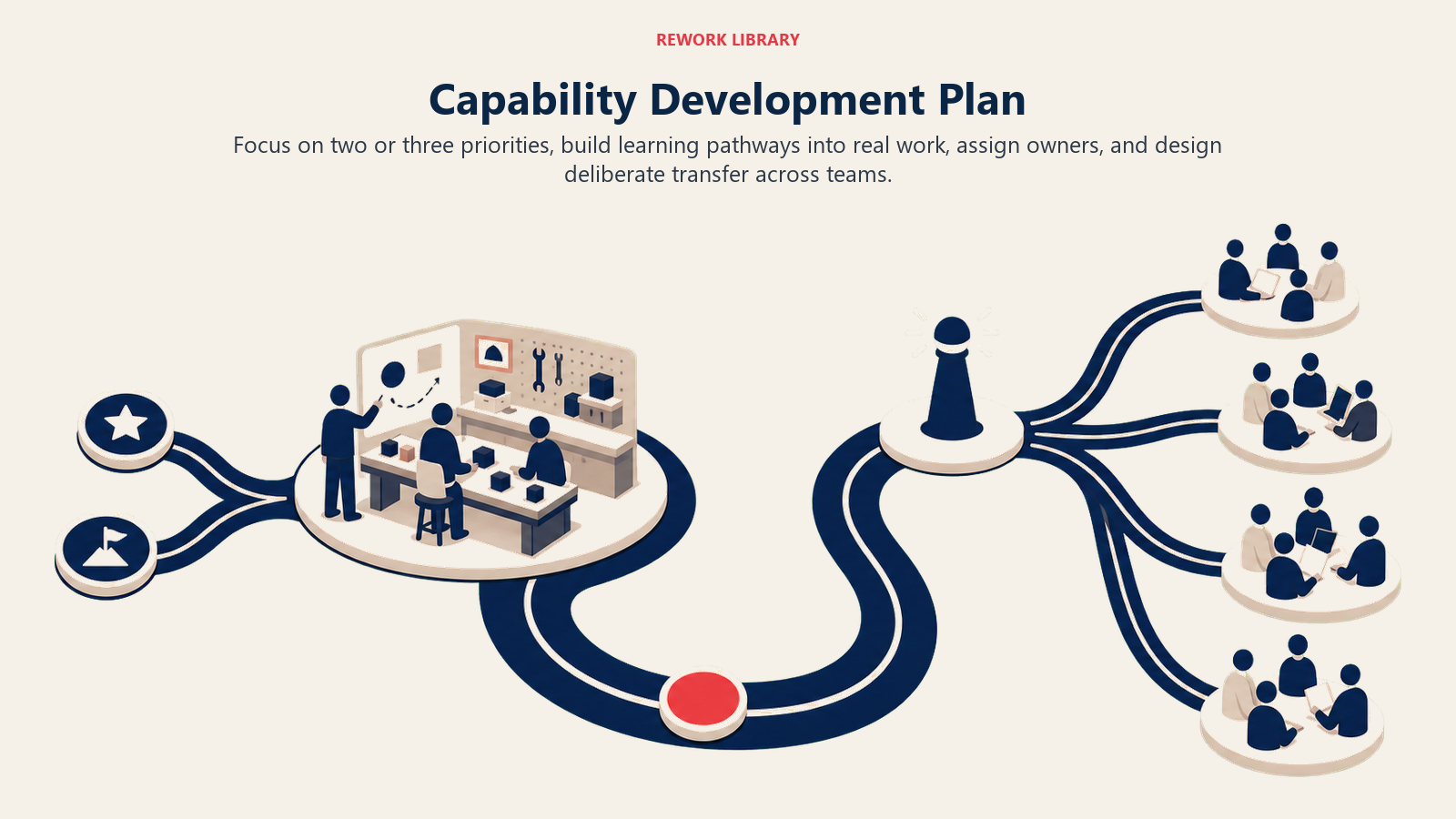
Focus on 2-3 priority capabilities per year. Capability building requires sustained attention from leadership, consistent investment, and organizational patience. Spreading effort across too many capabilities dilutes all of them. Pick the 2-3 gaps that matter most to near-term strategy, commit fully, and plan to address others in subsequent cycles.
Design learning pathways, not one-off training. A training event teaches knowledge but rarely builds capability. Capability requires repeated application, feedback, and refinement over time. An effective learning pathway for a decision making capability might include a foundational framework workshop, application in real decisions with coaching, peer case reviews, and gradual expansion of decision scope as the capability develops.
Embed capability building in real work. The most powerful capability development happens through deliberate practice in actual work contexts, not in simulated training environments. Build capability development into how work gets done: structured project debriefs, peer review processes, manager coaching conversations, and deliberate stretch assignments. This approach develops capability while getting real work done.
Designate internal capability owners. Each priority capability needs an owner who is responsible for the capability's development across the organization. The owner designs the development program, monitors progress, maintains the processes and tools that support the capability, and advises on how the capability should be applied to strategic priorities. Without ownership, capability development becomes everyone's responsibility and therefore no one's.
Plan for capability transfer. A capability that lives in one team or one function isn't an organizational capability. Plan explicitly for how the capability will spread: through internal rotations that transfer knowledge, through training that encodes tacit expertise in explicit frameworks, through communities of practice that sustain development after initial programs end.
Embedding Capabilities in the Organization
Development programs build capability. Embedding it is the harder challenge, because embedding requires changing how the organization works, not just what it knows.
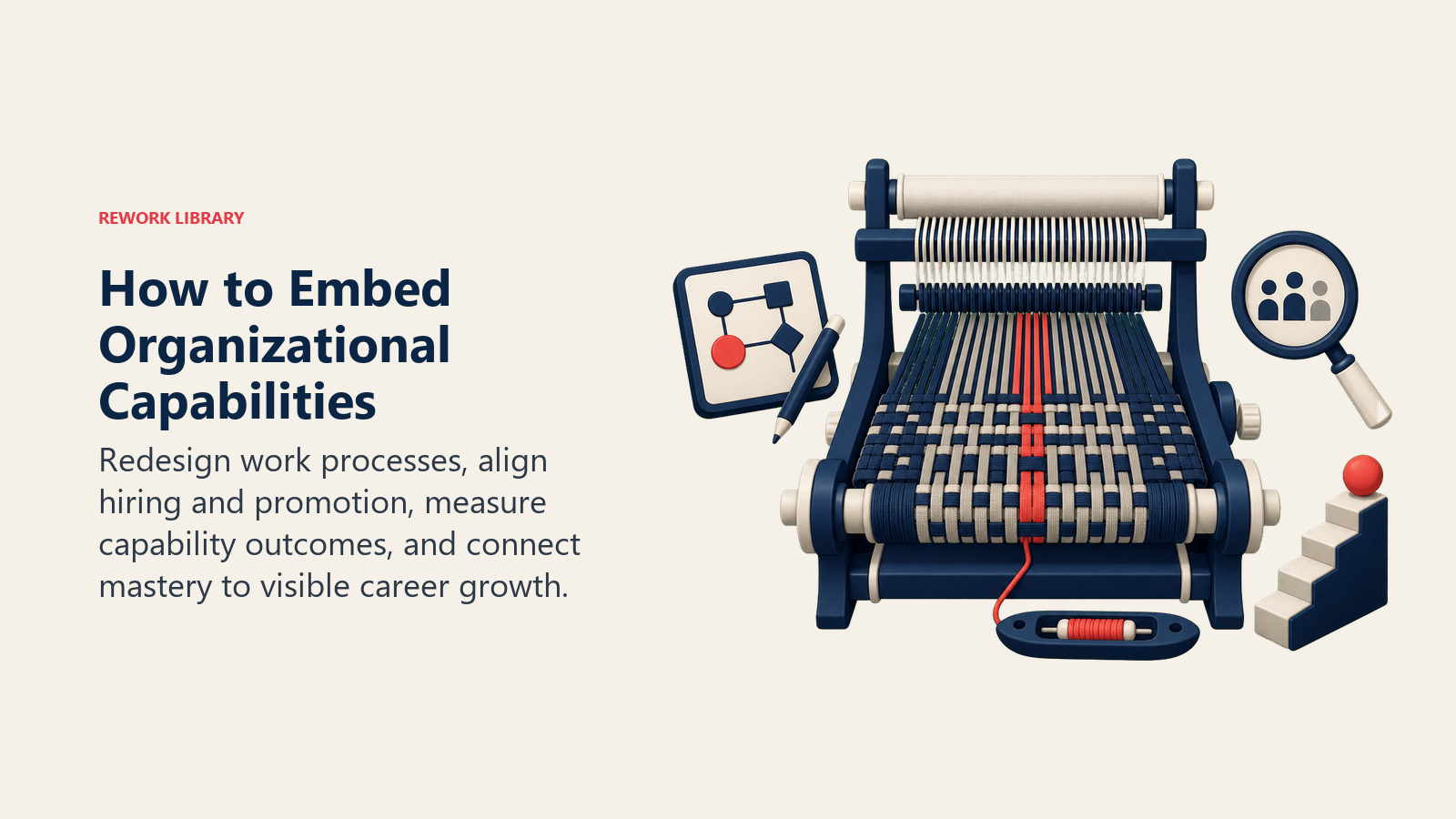
Redesign processes around the new capability. If you're building a customer analytics capability, the analytics output needs to flow into decision processes that didn't exist before. New processes need to be designed: how do analytics insights reach account teams? How do product decisions incorporate customer data? How are analytics priorities set? Skills and tools without process integration produce reports that no one reads.
Update hiring and promotion criteria. Organizational capability signals what the organization values. If your hiring and promotion decisions don't reflect the capabilities you're building, the culture signal contradicts the development investment. Update job descriptions, interview processes, and performance frameworks to align with the capabilities you're developing. This signals organizational commitment and helps self-select for candidates who strengthen the capabilities you need.
Build in accountability and measurement. Capability levels should be measured and reported as operational metrics. An organization building a process optimization capability should track improvement project completion rates, realized savings, and the percentage of process areas with documented standard work. Measurement creates accountability and lets you see whether investment is generating capability improvement.
Connect capability to career development. Employees invest in developing capabilities when they see that capability matters for their career growth. If advanced practitioners of a desired capability earn recognition, expanded scope, and career advancement, others invest in developing the same capability. Capability development programs that don't connect to career development generate compliance, not commitment.
Common Failure Modes
Confusing training attendance with capability development. Training participation metrics are easy to measure and easy to report to leadership. But attendance doesn't build capability. Application does. Measure capability development through behavioral indicators and performance outcomes, not training completion rates.
Building capability without changing the context. New capabilities developed in isolation don't survive re-entry into the same old context. If leaders don't model new behaviors, if processes don't create space for new approaches, if incentives still reward the old way of working, the new capability withers within months of the training program ending.
Under-investing in manager capability. Frontline capability development is only effective when managers reinforce it. Managers who don't use the new methods, don't coach their teams on application, and don't create opportunities to practice are the most common reason capability development programs fail to stick. Invest at least as heavily in manager capability as in frontline capability.
Ignoring tacit knowledge. Much organizational capability lives in tacit knowledge that's hard to articulate, hard to transfer, and hard to measure. The best performers often can't explain what makes them effective. Capturing tacit knowledge requires observation, apprenticeship, and deliberate knowledge elicitation processes. Don't assume that explicit training programs transfer tacit expertise.
Treating capability building as a one-time project. Capabilities decay if they're not sustained. New hires need development. Experienced practitioners need refreshment as methods evolve. Capability building is an ongoing operational commitment, not a project that ends with a rollout. Build the ongoing investment into operating budgets rather than treating it as a special initiative.
The Connection to Competitive Advantage
Organizational capability building creates competitive advantages in three ways.
Speed. Organizations with strong capabilities execute faster. A sales team with a well-embedded sales capability closes deals in 45 days that take competitors 90. A product team with deep design thinking capability ships products that resonate in 6 months that competitors take 18 months to get right. Speed compounds into market position.
Consistency. Individual talent is inconsistent. Organizational capability is consistent. When you have 50 account managers all operating with a well-embedded account management capability, your customer experience is predictable. Predictability builds trust with customers, which builds retention, which builds revenue.
Regeneration. Capabilities regenerate when people leave. If your supply chain optimization capability lives in systems, processes, and culture rather than in one expert, it survives that expert's departure. New hires are onboarded into the capability. The organization gets stronger through additions, not weaker through subtractions.
Organizations that invest seriously in capability building typically see the returns compound over 3-5 years. The first year is mostly investment with modest return. By year three, the capability has embedded into processes and culture. By year five, the capability gap between the investing organization and its competitors has become structural.
That structural gap is the point. That's what organizational capability building is for.
Frequently Asked Questions about Organizational Capability Building
How long does it take to build an organizational capability?
A meaningful capability development initiative takes 18-36 months to embed. The first 6 months develop skills and design processes. Months 6-18 see initial application and iteration. Months 18-36 see the capability embed into culture and normal operations. Full competitive differentiation through capability typically takes 3-5 years.
How do we measure capability development progress?
Track behavioral indicators (how often are people applying the capability?), process metrics (what percentage of processes reflect the capability?), and outcome metrics (what results is the capability producing?). Avoid measuring only training activity. A useful milestone is when the capability gets applied without being mandated, which signals it has become part of how the organization works.
What's the difference between a competency framework and capability building?
A competency framework defines what good looks like for individual roles. Capability building creates organizational-level proficiency that transcends individual roles. Competency frameworks are the foundation; capability building is the ongoing investment that develops people against those frameworks and embeds the results into organizational systems and culture.
How do we prevent capability from walking out the door when key people leave?
Encode tacit knowledge in explicit processes and tools. Rotate people through capability-intensive roles so knowledge spreads. Build communities of practice that sustain capability development. Document the decisions, frameworks, and approaches that define how the capability works. When any single person's departure would eliminate a capability, the capability hasn't been built yet.

Senior Operations & Growth Strategist