Sprout Social vs Sprinklr vs Publer: Which Social Media Platform Fits Your Team's Scale in 2026
Turn this article into takeaways for your work.


Each assistant summarizes the article only for you and suggests best practices for your work.
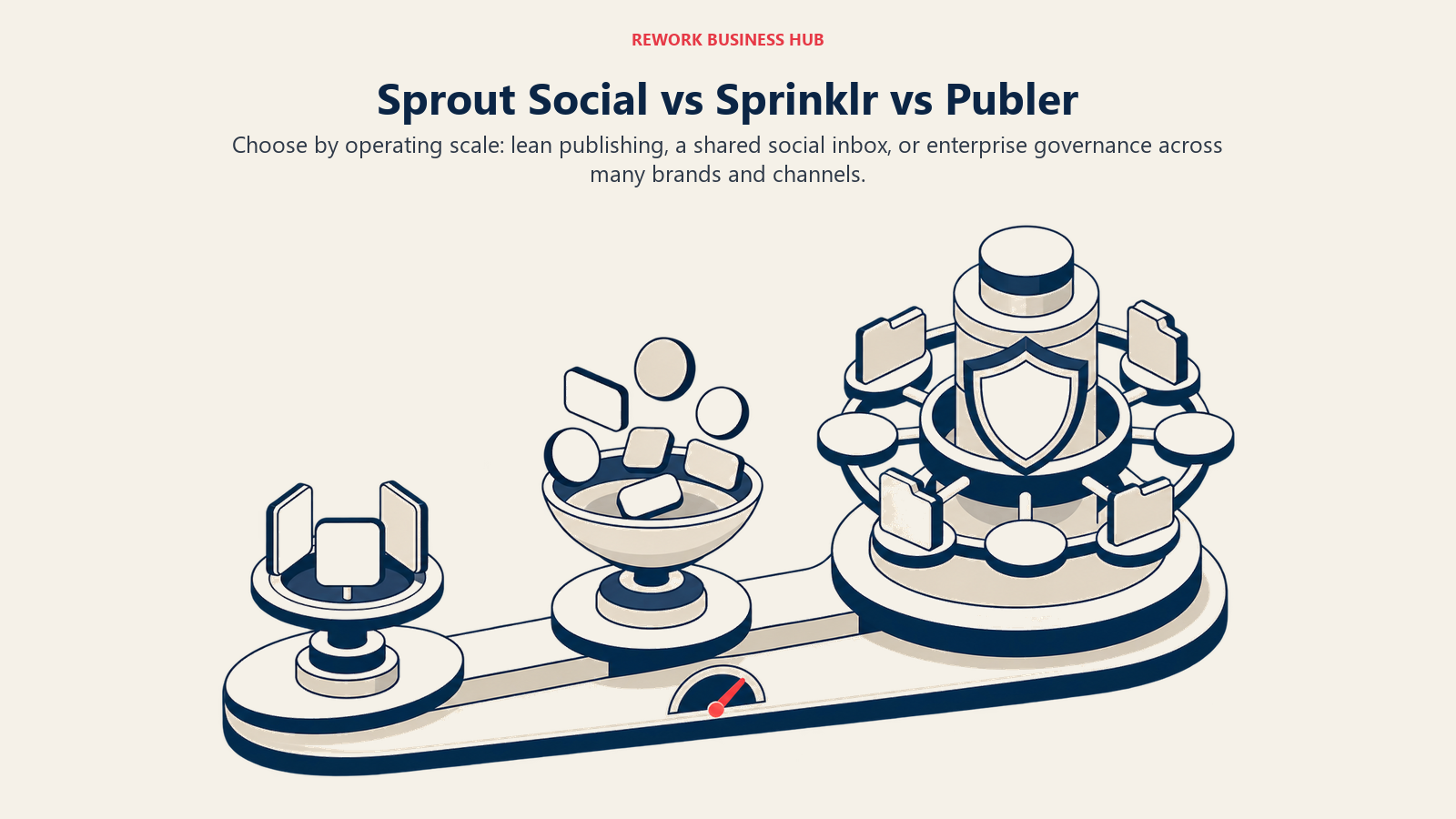
If you've put Sprout Social, Sprinklr, and Publer on the same shortlist, stop and check your assumptions first. These three don't compete on the same axis of price, and treating them like they do is how a five-person team ends up three months into a Sprinklr discovery call, or a large brand tries to run global community care through a tool built for a solo creator's Instagram grid. Publer prices in single digits per account per month. Sprout Social prices in the hundreds per seat per month. Sprinklr prices in the tens or hundreds of thousands per year, and won't give you a number until you've talked to sales. That's not a small gap. It's roughly two orders of magnitude between the cheapest and most expensive option here, and understanding what that money actually buys, not just what each vendor claims it buys, is the point of this comparison.
This is written for whoever owns the decision: a marketing director, a founder-operator, a Head of Ops, or a VP of Customer Experience sizing up social tooling against a real team and a real budget. A five-person marketing team doesn't belong in a Sprinklr sales cycle, and a global brand running a large customer care operation can't run its social presence on Publer, no matter how good its free plan is. Most readers land somewhere between those two extremes, which is exactly where Sprout Social sits, and exactly why its per-seat pricing becomes the real conversation once a team outgrows Publer's account-based math but hasn't outgrown a marketing department into a full customer-experience operation. We'll walk through what each platform is actually built to do, price all three at real team sizes, and cover the governance ground that justifies, or doesn't, paying 50 to 500 times more than the cheapest option here.
TL;DR
| Publer | Sprout Social | Sprinklr | |
|---|---|---|---|
| Pricing model | Per social account, plus a small per-member fee | Per seat, with a profile cap on entry tiers | Per module and contracted volume, quote only |
| Starting price | $5/month for 1 account (Professional) | $79/seat/month billed annually (Essentials), 5 profiles | No published price; self-serve retired April 30, 2026 |
| Free plan | Yes: 3 accounts (excluding X), 1 workspace | None, 30-day trial | None, demo required |
| Core strength | Cheap multi-platform scheduling with a real free tier | Unified inbox plus reporting depth | Governance and listening at enterprise scale |
| Where the money actually goes | Extra accounts and extra team members | Extra seats, and any tier past 5 profiles | Modules (Care, Insights, Advertising), user licenses, contract term |
| Governance depth | Basic: three-tier post approval, no SSO | Moderate: SAML 2.0 SSO, tiered permissions | Deep: SOC 2, unified data model, regulated-industry archiving via partners |
| Typical contract | Cancel anytime, no lock-in | Annual, auto-renews without 30 days' notice | 12 to 36 months, often with multi-year discounts |
| Best for | Solo operators and small teams on a handful of accounts | Mid-market marketing teams needing a real inbox and reports | Large enterprises running social inside a broader CX operation |
What Each Tool Is Actually Built For
Publer's design starts from a simple premise: most of the cost in a social tool should scale with what you're managing, accounts, not with how many people happen to have a login. A founder, a part-time assistant, and a contractor can share one Publer workspace for a few dollars more than a single account costs alone. It covers the core publishing job well: a shared calendar, bulk scheduling, RSS-based auto-posting, AI-assisted captions and hashtag suggestions on Business, and a straightforward three-tier approval flow for anyone who needs a second set of eyes before a post goes live. What it doesn't try to be is a reporting platform or a listening tool. There's no competitive intelligence, no sentiment tracking, and nothing resembling a contact-level inbox history.
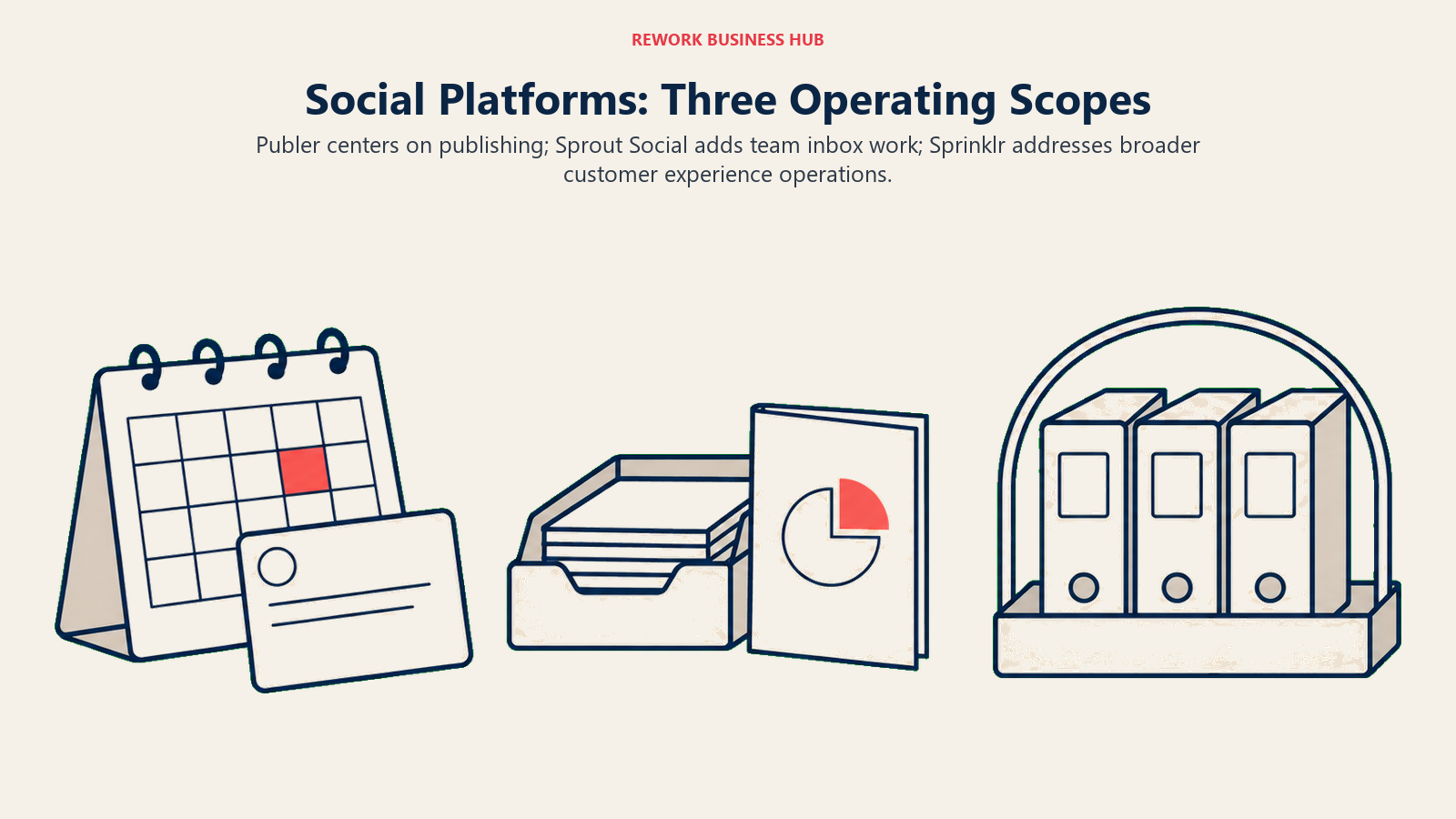
Sprout Social's bet is that a mid-market marketing or social team needs two things Publer doesn't offer at any price: a genuinely unified inbox with contact-level history, and reporting deep enough to hand to a CMO without rebuilding it in a spreadsheet. That reputation is well earned. Sprout's analytics are consistently cited as the category benchmark, and its Smart Inbox turns social replies into something closer to a lightweight CRM than a comment queue. The tradeoff is architectural: Sprout charges per seat, and its two entry tiers cap you at 5 social profiles no matter how many seats you buy. A team managing more than a handful of brand accounts hits that ceiling early, and the only way past it is a tier that costs roughly 50 percent more per seat and unlocks unlimited profiles in the same move. Listening, meanwhile, isn't bundled into any tier. It's a separately quoted add-on layered on top of the seat price.
Sprinklr isn't a scheduling tool that happens to be expensive. It's a customer experience management platform where social publishing is one module sitting next to Care (support and service), Insights (listening at a scale most tools don't attempt), Marketing and Advertising, and a governance layer spanning all of them. A large brand running social, support, and paid social through Sprinklr gets one identity model, one permission system, and one data set across every team touching the customer, instead of stitching four separate tools together with four separate exports. That architecture is also exactly why Sprinklr doesn't sell a $99 plan: the product isn't priced to compete with a scheduler, it's priced to replace a stack of enterprise software, and Sprinklr retired its last self-serve entry point ($199 a seat a month) on April 30, 2026, moving every remaining buyer into a custom enterprise sales process.
| Publer | Sprout Social | Sprinklr | |
|---|---|---|---|
| Core use case | Multi-platform scheduling on a tight budget | Publishing plus a real inbox plus reporting | Social as one module inside enterprise CX |
| Ideal team | Solo operators, founders, small in-house teams | Marketing or social teams of roughly 3 to 50 | Enterprise social, care, and marketing orgs |
| Natural ceiling | No listening, light inbox, no SSO | 5-profile cap on entry tiers; listening costs extra | Not purchasable below enterprise scale |
| Where it wins | Cost per account, a real free tier | Inbox depth and client-ready reporting | Governance, listening scale, multi-brand data model |
Key Facts
- Sprinklr discontinued its self-serve plan (formerly around $199 a seat a month) on April 30, 2026, moving every buyer into a custom enterprise contract. Vendr's benchmark data puts the median resulting deal at roughly $129,380 a year, ranging from about $50,000 at entry past $500,000 for large multi-module deployments, according to Chatarmin.
- Sprout Social holds a 4.4 out of 5 rating across 7,422 reviews on G2, with reviewers consistently pointing to its reporting and inbox as the reason they pay a per-seat price.
- Instagram's Graph API caps every publishing tool, regardless of vendor or price tier, at 100 API-published posts per rolling 24-hour period per account, according to Meta's own developer documentation.
- Publer's help center, not its marketing pricing page (which redirects in a loop), is the only vendor-confirmed source for its rates: $5 a month for a first account on Professional, plus $4 for each additional account and $2 per extra team member, per Publer's own help center.
- The global social media management software market is valued at $39.14 billion in 2026 and is projected to reach $164.52 billion by 2034, a 19.70% CAGR, according to Fortune Business Insights.
Decision by Business Goal
Match your actual goal to the list below before sitting through three sales demos that don't apply to your situation.
| Your goal | Best fit |
|---|---|
| Keep social software spend under a few hundred dollars a year while covering 5 to 10 accounts | Publer |
| Give a growing marketing team a real shared inbox and client-ready reports without a six-figure commitment | Sprout Social |
| Prove ROI to a CFO on the lowest cost per account managed, not the deepest feature set | Publer |
| Scale from a handful of brand accounts to a real team without re-platforming every 18 months | Sprout Social |
| Run social, care, and listening under one governance and compliance layer across many brands or countries | Sprinklr |
| Meet FINRA, SEC, or other regulated-industry archiving requirements for social communications | Sprinklr |
Team and Role Fit
Team composition matters as much as headcount. A five-person team that includes a compliance reviewer looks nothing like a five-person team that's all marketers, and the table below reflects that.

| Role | Publer | Sprout Social | Sprinklr |
|---|---|---|---|
| Solo founder or freelance marketer | Strong fit, free plan often enough | Overkill, priced and built for teams | Not purchasable at this scale |
| Social media manager, small team (2 to 10) | Good fit if reporting needs stay light | Strong fit, especially past a 5-profile footprint | Not a realistic buyer |
| Marketing director, mid-market (10 to 50) | Workable, but governance is thin | Strong fit, the platform's home turf | Possible only at the largest end of this range |
| VP Customer Experience or enterprise social lead | Not viable, no care or listening module | Partial fit via CRM and helpdesk integrations | Strong fit, built for exactly this role |
| Compliance or legal (regulated industries) | No archiving story | No dedicated regulated-archiving integration | Strong fit via WORM-compliant archiving partners |
Pricing at Real Team Sizes
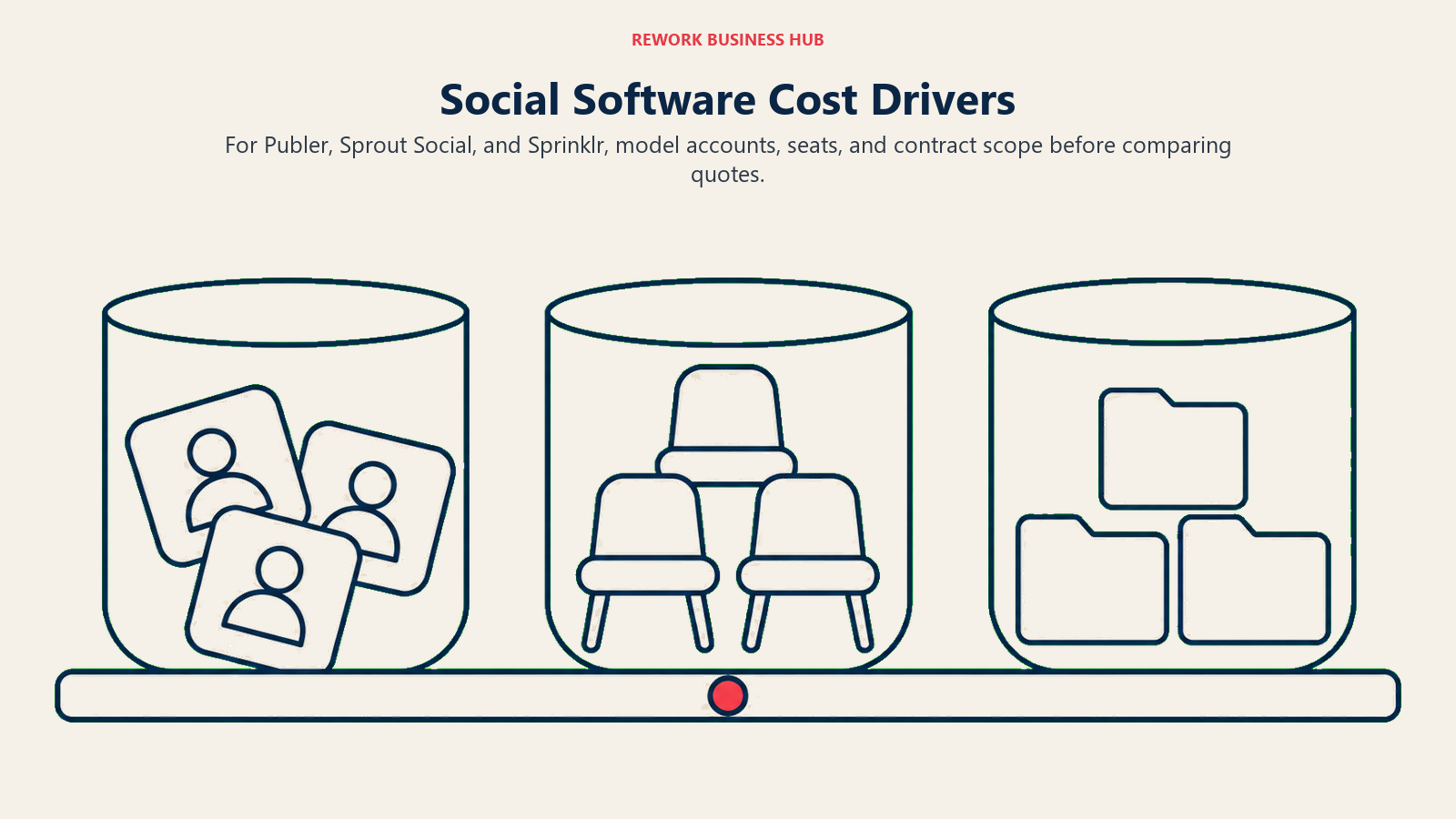
These three vendors don't just charge different amounts, they charge on entirely different axes, and that's the first thing to understand before comparing a single dollar figure. Publer meters on social accounts, plus a small per-person fee once a workspace has more than one member. Sprout Social meters on seats, with a hard profile cap on its two cheapest tiers that forces an early upgrade for any team managing more than 5 accounts. Sprinklr meters on modules and contracted volume: user licenses, channel count, and which of its products (Social, Care, Insights, Advertising) you're buying, none of it published, all of it negotiated. Below, we price all three at three real team sizes using each vendor's own current rate where one exists, and label every third-party figure (reported) with its source. For Publer's per-member math, we assume the workspace owner is the included member at no extra charge and only additional invited teammates trigger the per-member fee, the standard convention, though Publer's own pricing page doesn't spell it out explicitly.
Solo Operator, 5 Accounts
A single operator managing 5 social accounts is squarely Publer's and Sprout's target buyer, and squarely outside Sprinklr's, which doesn't sell to teams this size at all.
| Publer (Professional) | Sprout Social (Essentials) | Sprinklr | |
|---|---|---|---|
| Tier needed | 1 account base + 4 extra accounts | Essentials, 5-profile cap | Not purchasable at this scale |
| Monthly cost | $21/month ($5 base + 4 x $4) | $79/month (1 seat, annual billing) | N/A |
| Annual cost | $252/year | $948/year | N/A |
| Notes | No annual discount published | Fits exactly at the 5-profile ceiling | Self-serve retired; no entry point exists here |
At this scale, Publer runs a bit over a quarter of Sprout's cost, and the gap is entirely explained by what you're not getting. Sprout's inbox and reporting depth aren't things a true solo operator managing 5 accounts usually needs to justify.
5-Person Team, 15 Accounts
Add a team and push past 5 accounts, and the math changes fast, because Sprout's profile cap forces a tier jump that has nothing to do with headcount.
| Publer (Professional) | Sprout Social (Professional, forced) | Sprinklr | |
|---|---|---|---|
| Tier needed | 1 account base + 14 extra accounts + 4 extra members | Professional, forced by 15 profiles exceeding the 5-profile cap | Below Sprinklr's realistic entry point |
| Monthly cost | $69/month ($5 + 14x$4 + 4x$2) | $1,495/month (5 seats x $299) | N/A |
| Annual cost | $828/year | $17,940/year | Reportedly starts near $50,000/year even at the low end |
| Notes | Scales cleanly with accounts and people | The same $299/seat rate applies whether you need 6 profiles or 6,000 | Unlikely to be quoted seriously at this size |
That's roughly a 21-times gap between Publer and Sprout at this exact configuration, and it's worth naming plainly: a five-person team weighing whether to even take a Sprinklr sales call is asking the wrong question. Sprinklr's own contract data, via Vendr, places its smallest realistic bracket, 10 to 50 users, at $50,000 to $200,000 a year, a range with no relationship to what a 5-person, 15-account team is trying to solve.
30-Seat Brand Team
At enterprise scale, all three numbers grow, but not proportionally, and this is where the real decision usually gets made. We're pricing 30 people needing platform access and roughly 30 social profiles across brands and regions, a reasonable shape for a large marketing or social operations team.
| Publer (Professional) | Sprout Social (Professional) | Sprinklr (reported, Vendr) | |
|---|---|---|---|
| Tier / basis | 1 account base + 29 extra accounts + 29 extra members | 30 seats x $299/seat/month, unlimited profiles | Mid-market to enterprise bracket, 10 to 50 users |
| Monthly cost | $179/month (before Publer's every-10th-free discount) | $8,970/month | Not billed monthly, contract based |
| Annual cost | Roughly $2,148/year | $107,640/year | $50,000 to $200,000-plus/year (reported) |
| Notes | Cheapest by far, but has no enterprise governance story at this scale | Advanced tier ($399/seat) or a Listening add-on push this higher | Buys care, listening, and governance Sprout and Publer don't offer at any price |
Read that last row carefully, because it's the actual decision, not the price. At 30 seats, Sprout and Sprinklr land in roughly the same order of magnitude, tens of thousands to low hundreds of thousands a year, and Publer is cheaper than both by a wide margin. But a 30-person brand team choosing between Sprout and Sprinklr at similar spend isn't choosing on price at all. It's choosing between a deeper scheduler with a great inbox (Sprout) and a governance-first customer experience platform that happens to include scheduling (Sprinklr). Publer's number looks appealing next to either, until you reach the Risk and Governance section below and see what that price doesn't include.
What Sprout's Add-On Actually Costs
Sprout's seat price is only part of the bill once a team wants Listening or Premium Analytics, both sold as separate add-ons to Standard and up, and neither carries a published price. Sprout's own pricing page confirms the add-ons exist and lists what they include, then routes you to schedule a demo rather than show a number. Vendr's benchmark data, drawn from actual purchase records, doesn't publish an exact add-on price either, but it does note that Social Listening in particular "can double or triple total contract value" depending on topic, keyword, and user count, a useful warning that the seat price you budget for Sprout is very likely not the number you'll actually pay once listening is on the table.
What Leaving Costs
None of the three make an exit equally easy, and the differences are worth knowing before you sign, not after.
Sprout Social's own Terms of Service require at least 30 days' written notice before your annual Subscription Term ends, or the plan auto-renews for another full year. Miss that window and Sprout is explicit: no refunds or credits for prepaid, unused fees for the remainder of the term.
Sprinklr's contracts run 12, 24, or 36 months, and per Vendr's data, multi-year commitments carry 20 to 30 percent discounts that make a shorter term look expensive by comparison, a structural incentive to lock in longer. Renewal notice windows of 60 to 90 days are commonly built into Sprinklr's order forms; Vendr's own guidance to buyers is to negotiate 90 to 120 days up front, specifically to leave room for a competitive evaluation before an auto-escalated renewal takes effect.
Publer is the outlier in the other direction: cancel anytime through account settings, no contract, and access continues through the end of the current billing period. There's one sharp edge worth flagging plainly, since it's exactly the kind of detail that's easy to miss: downgrading straight from a paid plan to the Free plan deletes all currently scheduled posts, not just future reporting access, according to Publer's own help center.
Implementation and Change Management
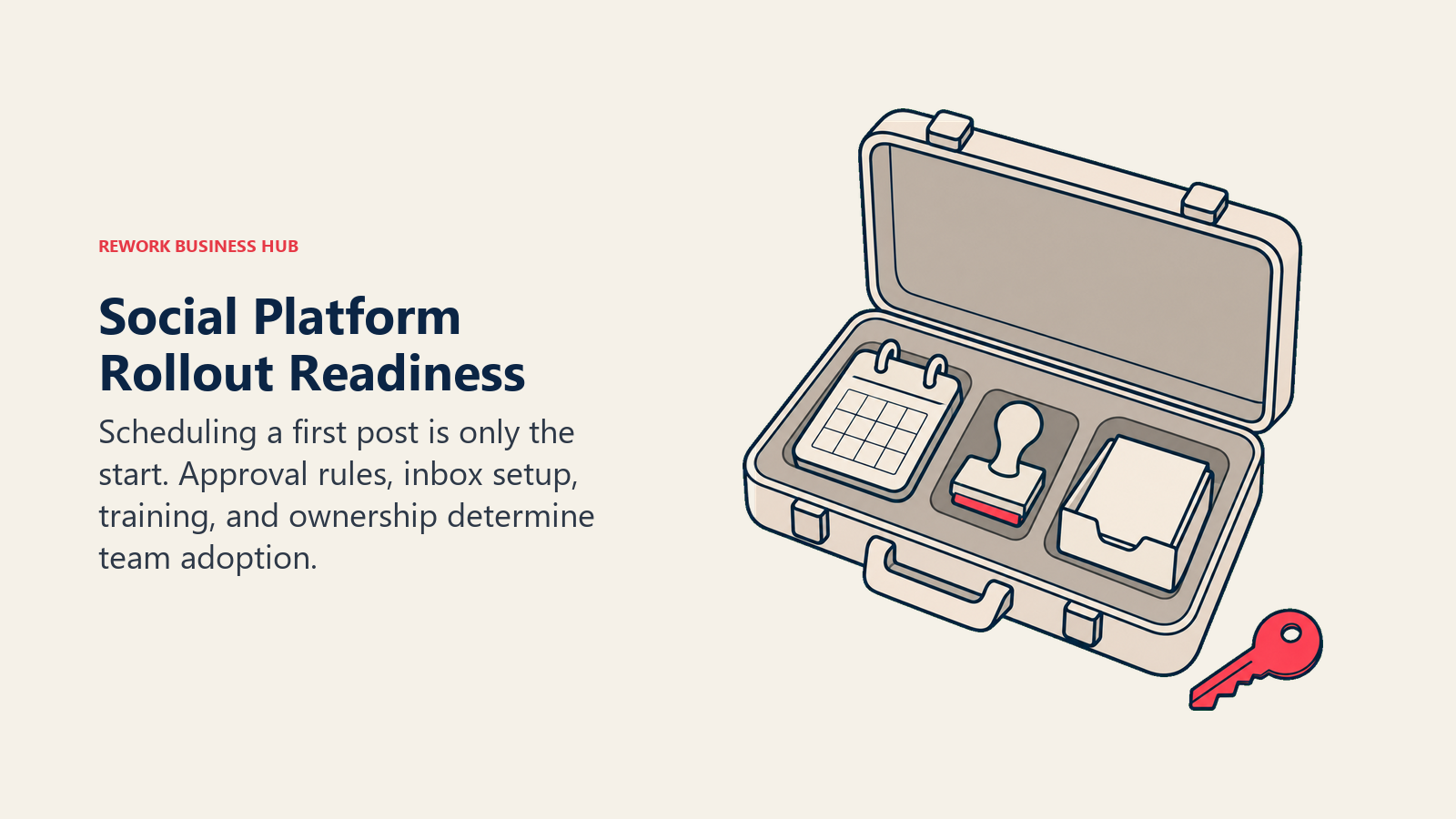
Time to first post and time to full adoption aren't the same question, and the gap between them widens as you move from Publer to Sprinklr.
| Publer | Sprout Social | Sprinklr | |
|---|---|---|---|
| Time to first scheduled post | Minutes | Same day | Not applicable, sales process comes first |
| Time to full team adoption | Same day to a few days | Days to a couple of weeks, depending on approval and inbox setup | Months: discovery, scoping, and implementation commonly run 3 to 6 months (reported) before go-live |
| Dedicated admin needed | Rarely, workspace roles are simple | Helpful past a handful of profiles or once approval chains exist | Expected, enterprise deployments assume a dedicated platform owner |
| Training load | Low, minimal learning curve | Moderate, especially for the inbox and reporting tools | High, a multi-module rollout across teams that may never have shared one platform before |
If your team can't survive a multi-month rollout before the first post goes out under the new tool, Sprinklr isn't a fit regardless of budget. That sales-to-live timeline is a real operational cost most pricing comparisons leave out entirely.
Risk and Governance
Price gets most of the attention in a comparison like this one, but the governance gap between these three tools is at least as wide, and it's the part buyers underestimate most often. Here's what each one actually offers, and where the real, easy-to-miss risks sit.
| Capability | Publer | Sprout Social | Sprinklr |
|---|---|---|---|
| Approval workflow | Yes, three tiers per account: full access, admin approval, client approval | Yes, group-based permissions and approval routing by tier | Yes, enterprise-grade, spans every module under one governance layer |
| Dedicated external or client role | Yes, a named Client role for agency approval flows | Available, more common via agency-facing permission tiers | Yes, built for multi-stakeholder, multi-brand sign-off |
| Single sign-on (SSO) | Not offered | Yes, SAML 2.0 for web and mobile, with just-in-time provisioning | Yes, enterprise identity and access management |
| Audit trail depth | Basic, workspace-level activity | Moderate, tied to permission tier | Deep, built for compliance review |
| SOC 2 or equivalent certification | Not published | Not confirmed here; verify directly | Yes, confirmed |
| Capability | Publer | Sprout Social | Sprinklr |
|---|---|---|---|
| Multi-brand structure | Unlimited workspaces on paid tiers | Profile-based, scoped by seat and tier | Purpose-built, unified data model across dozens of brands and regions |
| Multi-market or multi-language governance | Not a core feature | Limited, not the platform's design center | A core use case, built for global enterprise operations |
| Regulated-industry archiving (FINRA, SEC Rule 17a-4) | Not offered | Not a dedicated capability | Commonly paired with WORM-compliant archiving partners (Global Relay, Smarsh) for financial services compliance |
| Typical buyer needing this | Rarely relevant at this scale | Occasionally, via Advanced-tier CRM integrations | Regularly, a primary reason large regulated firms choose it |
Three Things Buyers Underestimate
Beyond the feature tables, three practical questions tend to surface after the contract is signed, not before, and all three are worth resolving in writing during evaluation.
Does your analytics history survive a downgrade? None of the three vendors state this plainly on a public page. Publer's help center is explicit about one adjacent risk: dropping from a paid plan straight to Free deletes every currently scheduled post, not just older reports. Sprout's and Sprinklr's public terms don't address data retention after a downgrade at all. Get this answered by a person, in writing, before signing, especially if a full year of campaign history is the reason you're paying for a higher reporting tier in the first place.
Do platform API limits cap you regardless of which tool or tier you buy? Yes, and this trips up buyers who assume a higher price tier means a higher publishing ceiling. Instagram's Graph API allows 100 API-published posts per rolling 24-hour period per account, carousels counting as one post, per Meta's own developer documentation, and that limit applies to Publer, Sprout, and Sprinklr identically. TikTok's Direct Post API caps audited integrations around 15 posts per 24-hour window per creator account, and restricts unaudited integrations to private-only content shared with at most 5 users a day, per TikTok's own developer documentation. Which vendor has completed TikTok's app audit, not which tier you buy, decides whether your account can publish public TikTok content through the tool at all, and that audit status is rarely stated clearly on a marketing page. Ask directly.
What does leaving actually cost? Covered in full above, but worth restating here as a governance question, not just a pricing one. Sprout's 30-day notice requirement, Sprinklr's multi-year contracts with 60-to-90-day renewal windows, and Publer's cancel-anytime model represent three different levels of vendor lock-in, independent of the sticker price.
When Sprout Social Is the Right Call
- You're a marketing or social team of 3 to 50 managing somewhere between 5 and a few dozen profiles, past Publer's comfortable range but nowhere near Sprinklr's.
- A real unified inbox with contact-level history matters more than the lowest possible per-account cost.
- You need to hand a CMO or client a polished, white-label report on a schedule, not a screenshot.
- You want SSO and tiered permissions without a multi-month enterprise sales process to get them.
- Your account count is stable enough that the 5-profile cap on entry tiers won't force a surprise upgrade six months in.
When Sprinklr Is the Right Call
- Social is one function inside a larger customer experience operation that also includes care, listening at scale, and paid social, and you want one governance layer across all of it.
- Worth knowing before you start: Sprinklr discontinued its self-serve products and service for the remaining self-serve customers ended on 30 April 2026, so every buyer now goes through a quote. Best Sprinklr Alternatives sorts the options by whether you need that enterprise footprint or a published price.
- You're running dozens of brand or regional accounts and need a unified data model, not a spreadsheet stitching four tools' exports together.
- You operate in a regulated industry, financial services being the clearest case, and need archiving that satisfies FINRA or SEC Rule 17a-4 retention requirements.
- Your organization can absorb a 3-to-6-month implementation and a multi-year contract in exchange for governance depth no mid-market tool offers.
- Budget authority for a $50,000-plus annual commitment already sits with the team requesting the platform, not something you're building a business case to unlock.
When Publer Is the Right Call
- You're a solo operator, founder, or small team managing a handful of accounts and want to stay well under a few hundred dollars a year.
- Several people need light, occasional access (approving a post, reviewing a client's calendar), and a per-seat price would punish that.
- You don't need social listening, deep reporting, or a unified inbox with contact history, just reliable scheduling across the core networks.
- Client approval matters, but a lightweight three-tier permission system covers it without needing agency-grade workspace governance.
- You'd rather outgrow a tool later than overpay for capacity you don't need yet.
Decision Framework
| If you are... | Pick |
|---|---|
| A solo operator or small team on 5 to 15 accounts watching every dollar | Publer |
| A marketing team of 3 to 50 that needs a real inbox and reporting you can hand to leadership | Sprout Social |
| Scaling past 5 profiles and tired of per-account math, but not ready for an enterprise contract | Sprout Social |
| An enterprise running social alongside care, listening, and advertising under one governance layer | Sprinklr |
| Operating in a regulated industry that requires FINRA- or SEC-grade communications archiving | Sprinklr |
| Still narrowing the category before committing to any one platform | See our full social media management software roundup |
The verdict: don't let the fact that all three showed up on your shortlist convince you they're actually competing for the same budget. Publer and Sprout Social genuinely compete with each other up to about 5 profiles, and Sprout pulls ahead once an inbox and real reporting matter more than the lowest per-account rate. Sprinklr isn't competing with either of them. It's competing with the cost of running social, care, and listening as three separate line items, and it only wins that comparison at a scale most readers on this page haven't reached yet. Price the tool to the team you actually have, not the team a vendor's sales deck imagines you might become.
What to Do Next
Count your actual account number and team size today, then run it against the three tables above before taking a single demo call. If Sprinklr is even on your list, confirm with your own finance team that a five- or six-figure annual commitment and a multi-month implementation are genuinely approved, before your team spends a quarter in discovery calls that go nowhere.
If Sprout Social looks like your likely landing spot, our Sprout Social vs Hootsuite comparison and our Sprout Social alternatives guide cover the mid-market field in more depth than we could here. If Publer's per-account model appeals but you want to see it against the other popular budget scheduling model, our Hootsuite vs Buffer comparison covers per-channel pricing, the other major low-cost structure in this category. And if you're still mapping the whole field before narrowing down, our full social media management software roundup covers 14 platforms, including all three tools here.
Social rarely sits alone in a marketing stack, either. If you're evaluating the broader toolset around it, how to choose an all-in-one marketing platform, how to choose email marketing software, and a SaaS vendor evaluation scorecard apply directly to whichever of these three you end up running a formal evaluation against, especially the Sprinklr track, where a structured scorecard matters more given the length of the sales process. And if Sprinklr's Care module is part of what's pulling you toward it, our guide on how to choose help desk software is worth reading alongside it, since a dedicated help desk platform is what a smaller team would use to solve the same problem at a fraction of the cost.
Frequently Asked Questions about Sprout Social, Sprinklr, and Publer
Why is there such a big price gap between these three tools?
Because they're built for entirely different buyers. Publer is priced for a solo operator or small team managing a handful of accounts, Sprout Social is priced for a mid-market marketing team that needs a real inbox and reporting, and Sprinklr is priced as enterprise customer experience software where social is one module beside care and listening. The roughly two-orders-of-magnitude gap reflects genuinely different products, not the same product marked up.
Can Publer realistically support a 20 or 30 person team?
Technically yes, since its per-account and per-member pricing scales without a hard ceiling, and the cost stays far below Sprout or Sprinklr even at that size. What it can't support is enterprise governance: there's no SSO, no dedicated audit trail, and no listening or care module. A large team can afford Publer; a large team that needs governance usually can't run on it.
What does Sprout Social's Listening add-on actually cost?
Sprout doesn't publish a figure. It's sold as a separate add-on to Standard and up, and Vendr's benchmark data indicates it can double or triple total contract value depending on topic, keyword, and user count. Budget a real conversation with sales, not the seat price alone, if listening matters to you.
Is Sprinklr's self-serve plan really gone?
Yes. Sprinklr discontinued its self-serve tier, which had public pricing around $199 a seat a month, on April 30, 2026. Every buyer now goes through a custom enterprise sales process, and reported contract values range from roughly $50,000 a year at entry to well past $500,000 for large multi-module deployments, according to Vendr benchmark data cited by Chatarmin.
Which of these three has the best social listening?
Sprinklr, by a wide margin, since listening at scale is a core module, not an add-on. Sprout Social offers listening as a separately priced add-on with real but narrower scope. Publer has no listening product at all.
Does downgrading any of these lose historical data?
Publer confirms one specific risk: downgrading from a paid plan straight to Free deletes all currently scheduled posts. Sprout Social and Sprinklr don't address data retention after a downgrade in their public terms, so confirm this directly with sales or support before you sign, particularly if historical reporting is why you're paying for a higher tier.
Which tool is easiest to cancel?
Publer, without question. It has no contract and can be cancelled anytime through account settings, with access continuing through the end of the current billing period. Sprout Social requires 30 days' written notice before an annual term ends or it auto-renews with no refund for unused time. Sprinklr's contracts typically run 12 to 36 months with 60-to-90-day renewal notice windows built into the order form.

Principal Product Marketing Strategist
On this page
- TL;DR
- What Each Tool Is Actually Built For
- Key Facts
- Decision by Business Goal
- Team and Role Fit
- Pricing at Real Team Sizes
- Solo Operator, 5 Accounts
- 5-Person Team, 15 Accounts
- 30-Seat Brand Team
- What Sprout's Add-On Actually Costs
- What Leaving Costs
- Implementation and Change Management
- Risk and Governance
- Three Things Buyers Underestimate
- When Sprout Social Is the Right Call
- When Sprinklr Is the Right Call
- When Publer Is the Right Call
- Decision Framework
- What to Do Next