AI in the UX Designer Workflow: What Actually Helps, What Ships Six-Finger Hands
Turn this article into takeaways for your work.


Each assistant summarizes the article only for you and suggests best practices for your work.
The Slack message arrives on a Tuesday. "Hey, have you tried Figma AI yet? We should be moving 3x faster on these flows." It's from your design lead, who hasn't shipped a real flow in three years and recently watched a keynote.
So you try it. You type "settings page for a B2B CRM with notification preferences and security tab" and twelve seconds later you have a settings page. It is, technically, a settings page. Aesthetically, it's a 2023 dashboard template: rounded corners on everything, that specific shade of indigo, a toggle component lifted from someone else's design system, and microcopy that says "Customize your experience to unleash your productivity." You ship none of it. The lead asks why velocity didn't go up.
This article is the answer.
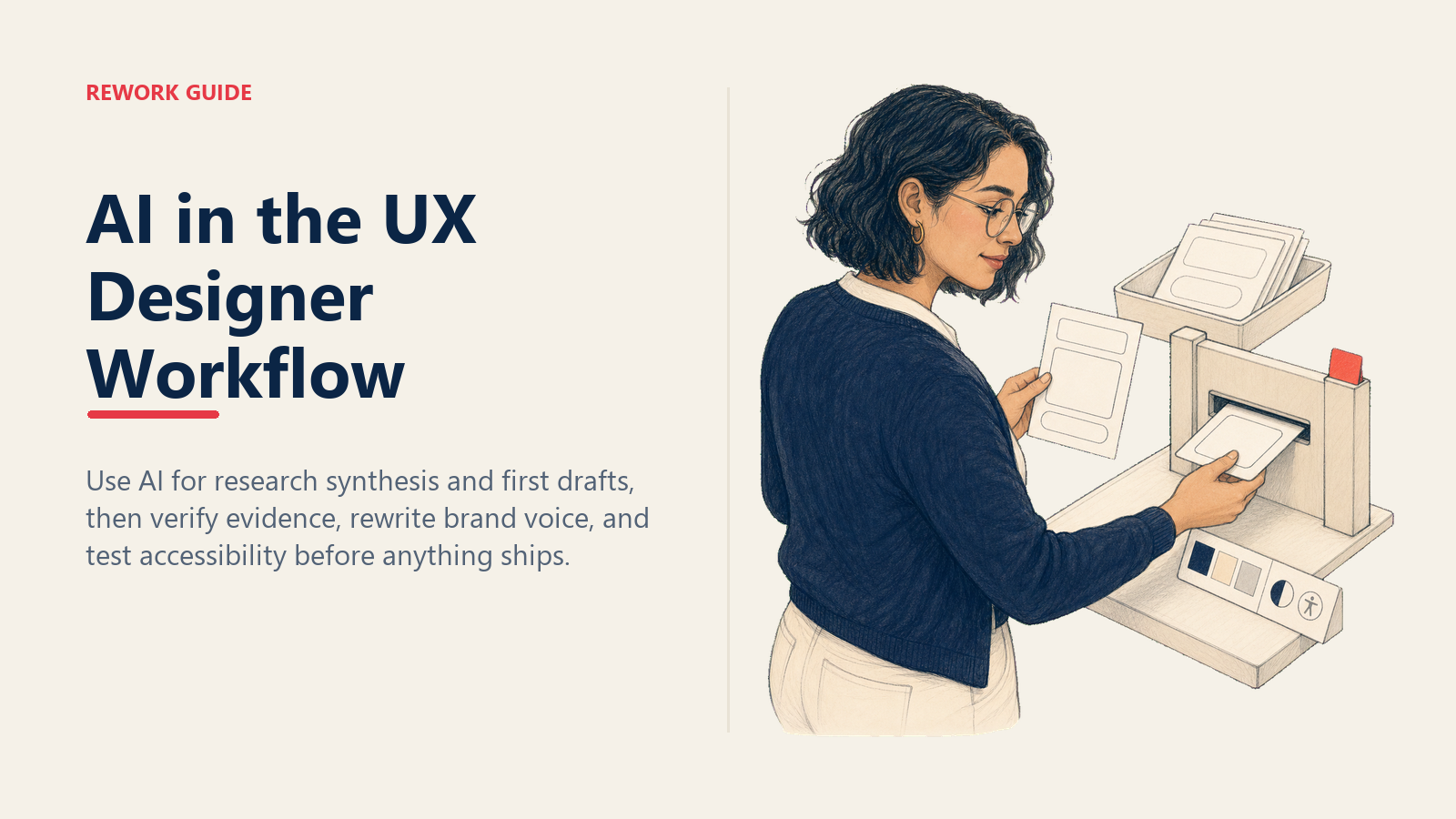
The honest version: AI is genuinely useful in roughly 20% of a UX designer's day, completely unhelpful in another 30%, and actively dangerous in the remaining 50%. The trick is knowing which is which before you prompt, not after. Designers who use AI well treat it like a confident, fast junior with no taste, no brand context, and no accessibility judgment. You give it tightly scoped tasks. You verify everything. You never ship its first draft.
Where AI Actually Earns Its Seat in the Workflow
Research transcript synthesis
This is where AI is closest to magic. Forty user-interview transcripts, 800 pages of raw text, the kind of qualitative pile that used to take a researcher a full week to cluster. Paste it into Claude or run it through Dovetail AI or Notion AI and you get themes with verbatim quotes in about 20 minutes.
What it's good at: clustering, surfacing unexpected adjacent themes, pulling exact verbatims, generating a first-pass affinity map. What it lies about: frequency. AI will confidently say "users frequently mentioned that the export flow is confusing" when in fact 2 of 12 participants said it once each. It anchors on vivid quotes, not statistical weight.
The prompt structure that works: paste transcripts, ask for themes, then for each theme require (a) verbatim quotes with participant ID, and (b) a count of how many distinct participants raised it. Then verify the counts manually. Five minutes of verification on a synthesis that took 20 minutes is still a 5x speedup over doing it from scratch, and you don't ship false frequency claims to your PM.
Microcopy variants
Empty states, error messages, button labels, confirmation dialogs. AI will give you 8 variants of any string in 30 seconds. This is real, useful leverage.
The non-negotiable rule: you pick one, and then you rewrite it. The first draft is almost never brand voice. AI defaults to a kind of LinkedIn-poster English where every error is an opportunity, every empty state is a journey, and every dialog uses an em-dash where a period would do. If you ship it without editing, your product sounds like every other SaaS, which is a brand failure even if no individual sentence is wrong.
Track the percentage of AI strings you keep verbatim across a month. Mine sits at about 7%.
Alt-text drafts
This one is unambiguously good. Alt text is the kind of work designers and writers skip when they're tired, which is most of the time, which is why so much of the web is inaccessible. AI gets you to 70%, a draft you can edit faster than you'd write from scratch. You fix the 30% that matters: decorative vs. informative distinction, brand-specific terms it doesn't know, the difference between "screenshot of a chart" and "bar chart showing Q3 revenue up 22% over Q2."
Faster than writing from scratch, infinitely more accessible than skipping it, and the failure mode (slightly generic alt text) is much better than the no-alt-text status quo on most B2B SaaS sites.
Moodboards and reference images
Midjourney, Ideogram, and Sora are useful for internal moodboards and stakeholder pitches. The line is bright: if it's going on a Figjam to align taste with your PM and EM, fine. If it's going on the marketing site, the product, or a real shipped artifact, no.
Generative image tools are pattern-averagers. They produce work that looks like the median of their training data, which is exactly what you want for "show me what a calm enterprise dashboard moodboard looks like" and exactly what you don't want for "design our actual hero image."
Prototype seeding
v0, Galileo, and Figma Make can give you a clickable starting point in 10 minutes that would have taken three hours from scratch. The frame to use: treat the output as a wireframe with opinions, not a design. You will strip about 60% of what it generates. You will keep the structural decisions (this layout makes sense, this hierarchy is roughly right) and discard the visual ones (no, our buttons don't look like that, no, our error state isn't a sad cloud).
If you ship the output unedited, you're shipping someone else's design system, slightly remixed, in your product. Users won't be able to articulate why it feels off, but they'll feel it.
Where AI Helps and Where It Breaks
| Task | AI helpful? | What to actually do |
|---|---|---|
| Research transcript synthesis | Yes, with verification | Generate themes + verbatims, manually verify all frequency claims |
| Microcopy variants | Yes, as drafts | Generate 8, pick 1, rewrite to brand voice |
| Alt-text drafts | Yes | Edit for specificity and brand terms before shipping |
| Internal moodboards | Yes | Use for taste alignment only, never in product |
| Prototype seeding (low-stakes flows) | Yes | Treat as wireframe with opinions, strip 60% |
| Brand voice / tone of voice work | No | AI averages to LinkedIn English; brand needs a point of view |
| Accessibility judgment | No | AI generates patterns that look accessible but fail WCAG |
| UX heuristics on your product | No | AI doesn't know your data model, IA, or edge cases |
| Onboarding / error / empathy copy | No | AI hedges; brands have to decide |
| Shipped product UI from generative image tools | Absolutely not | Midjourney for UI is malpractice |
Where AI Breaks (and What to Do Instead)
Taste
AI averages its training set. Your job is to be specific. The "AI-designed UI" trap is uncanny consistency. Every button has the same 8px radius, every empty state uses the same illustration energy, every microcopy hits the same em-dash cadence. Readers can feel it. Designers can definitely feel it. The fix isn't "use AI less," it's "have a strong opinion before you prompt." If you don't know what you want, AI will give you the median of what other people wanted.
Brand voice
Your brand probably isn't LinkedIn English. AI's default is. If you're at a serious B2B product, your voice might be calm-and-precise (Linear), warm-and-clear (Stripe docs), or wry-and-sharp (Mailchimp's old voice). AI doesn't know any of those. It knows the average of all SaaS copy, which is none of them. Ship AI microcopy without rewriting and you erase years of brand work.
Accessibility judgment
This is the dangerous one. AI will generate beautiful inaccessible patterns: 3.2:1 contrast on labels, 12px tap targets, color-only state indicators (green for success, red for error, no icon, no text), keyboard traps in custom dropdowns, focus rings removed because they're "ugly." It doesn't know WCAG. It knows what WCAG-compliant designs look like on average, which is a very different thing.
If you're shipping AI-generated UI without an accessibility pass, you're shipping inaccessible UI. Run every AI-seeded screen through a contrast checker, a keyboard-only test, and a screen-reader pass before it leaves your file.
UX heuristics
AI doesn't know your users, your data model, your edge cases, or your existing IA. It will happily generate a settings page that contradicts five existing patterns in your product. It will create a delete confirmation that doesn't match the destructive-action pattern you've used everywhere else. It will introduce a navigation paradigm that's lovely in isolation and incoherent next to the rest of your app. Systems thinking is still your job.
Copy that requires a point of view
Onboarding voice. Error tone. The empathy in a deletion confirmation when a user is about to lose 18 months of work. AI hedges on all of these because hedging is the safest output across its training data. Brands have to decide. "Are you sure you want to delete this?" is the AI version. "This will permanently delete 14 months of customer notes. This can't be undone." is the brand version. Same intent, different product.
Honest Takes on the Four Tools Your Lead Keeps Mentioning
Figma AI / Make
Best for: first-draft layouts of common patterns. Settings pages, data tables, empty states, modals. The output is roughly a 2023 template (generic but structurally sound), which is exactly what you want as a starting block.
Worst for: anything with brand voice, anything non-standard, anything that needs to fit into an existing design system. Figma Make doesn't know your tokens, your spacing rhythm, or your component library. It generates plausible Figma frames, not on-brand Figma frames.
Verdict: useful as a 5-minute head start on common patterns. Don't ship the output. Use it to skip the blank-canvas step, then rebuild on your own components.
v0 (Vercel)
Best for: engineering handoff. v0 generates Tailwind and shadcn/ui code that actually runs. For prototyping flows you want engineers to play with, this is genuinely faster than Figma-to-code-by-hand.
Worst for: visual originality. v0 has one aesthetic dialect: rounded, neutral, slightly Vercel. Every output looks subtly like Vercel's marketing site. Strip the visual decisions, keep the structural ones, and let your design system reassert itself.
Verdict: the most genuinely useful of the four for anyone working closely with engineering. Treat it as a fast wireframing tool that happens to output code.
Galileo AI
Best for: divergent thinking. When you're stuck on a layout and want to see five different approaches in five minutes, Galileo is fine. It demos beautifully in keynotes.
Worst for: actually shipping. Galileo's output rarely survives a real design review against an existing system. The generated screens look polished but don't compose with the rest of your product, and the components don't map to anything in your library.
Verdict: a moodboard tool with a UI skin. Use it to break out of a rut, not to ship.
Midjourney / Ideogram for UI
Don't.
These tools generate images of UIs, not UIs. Buttons don't align. Labels are misspelled or hallucinated. Anything with text is fiction. The six-finger-hands problem extends to interfaces. At a glance the screen looks plausible, on a second look the spacing is wrong and the menu items don't make sense.
If you're using Midjourney for an internal moodboard about vibe, fine. If you're using it to generate UI that anyone will mistake for a real screen, you're producing slop. Verdict: malpractice for UI work.
The "AI-Designed UI" Trap, in Detail
Three signs a screen was AI-generated and never edited:
Identical border-radius across unrelated components. Buttons, cards, inputs, modals, toasts, all rounded to the same 8px or 12px because the model picked one value and applied it everywhere. Real design systems vary radius by component type for hierarchy reasons.
Three-word headline plus one-sentence subhead on every empty state. "No projects yet" / "Create your first project to get started." Every. Single. Empty. State. With identical visual energy and a vaguely cheerful tone.
Em-dashes in microcopy where a period would do. AI strings clauses together with an em dash where a period belongs: pairing "Couldn't connect" and "try again" instead of writing "Couldn't connect. Try again." The em-dash cadence is a tell. Models love them. Humans use them sparingly.
Adjacent tells: low-contrast pastel toasts (pretty in a Dribbble post, fail WCAG AA), ghost buttons that disappear into the background, generic empathy that means nothing ("Oops! Something went wrong"), stock illustration energy on every state, and the specific shade of indigo that has somehow become the default for every AI-generated B2B interface.
If three of these are on your screen, you generated it and didn't edit it. Edit it.
Three Microcopy Variants, Same Empty State
Empty state for a CRM contacts list, no contacts yet:
AI-generic version (what you'll get on the first prompt):
No contacts yet Add your first contact to unleash the full power of your CRM and start building meaningful relationships with your customers. [Add Contact]
This is fine. It's also forgettable, slightly grandiose ("unleash the full power"), and could be on any product. Ship this and you've added nothing to your brand.
Rewritten to brand voice (assuming a calm, precise B2B brand):
No contacts yet. Import from a CSV, sync from Gmail, or add one manually. Most teams start with a CSV. [Import CSV] [Sync Gmail] [Add manually]
Same empty state. Now it teaches the user what to do, names the most common path, and doesn't try to inspire anyone. The CTAs do the work; the copy stays out of the way.
Rejected (too cute):
Your CRM is hungry. Feed it some contacts and watch it grow. [Feed it]
No. We're not doing that.
The pattern: AI will give you the first version reliably. The second version is your job. The third version is what happens when you give AI free rein on tone and ship without editing.
A 30-Day Plan to Integrate AI Without Losing Your Taste
The point of this plan is to figure out, with real data, where AI saves you hours and where it creates rework. Run it once and you'll know which 20% of your day to keep automating and which 80% to leave alone.
Week 1: Research synthesis only
Run your next research synthesis through Dovetail AI, Notion AI, or Claude (paste raw transcripts directly). Generate themes with verbatim quotes and counts. Verify every frequency claim manually against the transcripts. Time yourself before/after vs. your usual synthesis pace.
Deliverable: one synthesis doc, with verification notes, plus a time-tracking line in your design journal. Expect a 3-5x speedup with verification cost subtracted.
Week 2: Microcopy variants
For your next three flows, generate 8 microcopy options per string using your tool of choice (ChatGPT, Claude, or Writer if you've got brand voice configured). Pick the best, rewrite to brand voice. Track which AI strings you actually keep verbatim, and track the count.
Deliverable: a microcopy doc with three columns per string (AI variant, your rewrite, why). At end of week, calculate your verbatim-keep rate. Below 15% is normal.
Week 3: Alt text and internal moodboards
Add AI alt-text drafting to your design handoff checklist. For every image and screenshot in the next batch of work, generate alt text with AI, then edit for specificity. For one internal moodboard (not a shipped artifact), use Midjourney or Ideogram to generate 12 reference images. Notice which ones push you toward generic and which ones unlock something useful.
Deliverable: alt-text checklist updated in your team handoff template, plus one Figjam moodboard with a self-critique on which AI images felt generic.
Week 4: Prototype seeding
Pick one low-stakes flow you'd usually wireframe by hand. Use v0 or Figma Make to seed it. Compare time-to-clickable vs. your usual process. Note exactly what you stripped and what you kept. Run the result through a contrast checker and a keyboard-only test before you call it done.
Deliverable: a side-by-side artifact (AI seed, your refined version) with a time delta and a strip-list of everything you removed.
End-of-month review
Three questions, on paper:
- Where did AI save real hours? (Probably research synthesis, alt text, microcopy variants.)
- Where did it create rework? (Probably anywhere requiring brand voice, accessibility judgment, or systems thinking.)
- Where did it nudge you toward generic? (Probably moodboards if you used them on shipped work, prototype seeding if you skipped the strip step.)
The output of this review is your personal AI-in-workflow policy. Write it down. Revisit it every quarter as the tools change.
Optional: The ACE Framework Lens
If you're trying to explain to your design lead, your PM, or a skeptical CTO where AI fits in your specific workflow, the ACE Framework gives you a clean vocabulary.
A UX designer's AI usage lives mostly in Generate (microcopy variants, alt-text drafts, moodboards, prototype seeding) and a slice of Analyze (research transcript synthesis). It does not live in Predict (forecasting, ML models, which is PM and data territory) or Execute (autonomous agentic workflows, which is engineering and ops territory).
Naming where AI fits in your workflow keeps the conversation honest with leadership. "We're using AI for Generate-tier tasks with human review on every output" is a sentence that gets nods. "We're using AI to 10x design velocity" is a sentence that gets you shipped slop.
The Frame to Take Away
AI is a fast, confident junior collaborator with no taste, no brand context, and no accessibility judgment. It does not know your users. It does not know your design system. It will produce work that looks plausible and is generic, and the failure mode is invisible until it's everywhere.
You direct it. You verify it. You don't ship its first draft.
The designers who use AI well are the ones who know what they want before they prompt. Strong opinions in, useful leverage out. Vague prompts in, average-of-the-internet out. The 30-day plan above is mostly an exercise in learning to recognize the difference for your own workflow.
If your design lead Slacks you next week to ask why velocity isn't 3x, you now have an honest answer. AI made some specific tasks 3-5x faster: synthesis, alt text, microcopy drafts. It made other tasks slower because verification and rewriting cost real time. Net is somewhere around 20-30% faster on the right work, zero on the wrong work, and slower-but-worse if you skip the rewriting step. That's the truth. Anyone selling you a different number is selling you something.
Learn More

Principal Product Marketing Strategist
On this page
- Where AI Actually Earns Its Seat in the Workflow
- Research transcript synthesis
- Microcopy variants
- Alt-text drafts
- Moodboards and reference images
- Prototype seeding
- Where AI Helps and Where It Breaks
- Where AI Breaks (and What to Do Instead)
- Taste
- Brand voice
- Accessibility judgment
- UX heuristics
- Copy that requires a point of view
- Honest Takes on the Four Tools Your Lead Keeps Mentioning
- Figma AI / Make
- v0 (Vercel)
- Galileo AI
- Midjourney / Ideogram for UI
- The "AI-Designed UI" Trap, in Detail
- Three Microcopy Variants, Same Empty State
- A 30-Day Plan to Integrate AI Without Losing Your Taste
- Week 1: Research synthesis only
- Week 2: Microcopy variants
- Week 3: Alt text and internal moodboards
- Week 4: Prototype seeding
- End-of-month review
- Optional: The ACE Framework Lens
- The Frame to Take Away
- Learn More