Your First 30/60/90 Days as a New RevOps Manager
Turn this article into takeaways for your work.


Each assistant summarizes the article only for you and suggests best practices for your work.
You start Monday. By Tuesday afternoon, your CRO has asked you (in a hallway, casually, the way people ask for things they've been thinking about for months) when you can commit to a forecast accuracy number. He's hoping for day 30.
You open Salesforce and find 14 opportunity stages. Three of them are named some variation of "Negotiation." Two more haven't been used in 18 months but nobody will turn them off because "Marketing's old reporting depends on it." There are 47 custom fields on the Opportunity object. About a third are populated less than 5% of the time. There are 11,000 open opps with a close date in the past. Six of them are from 2022.
Welcome to RevOps.
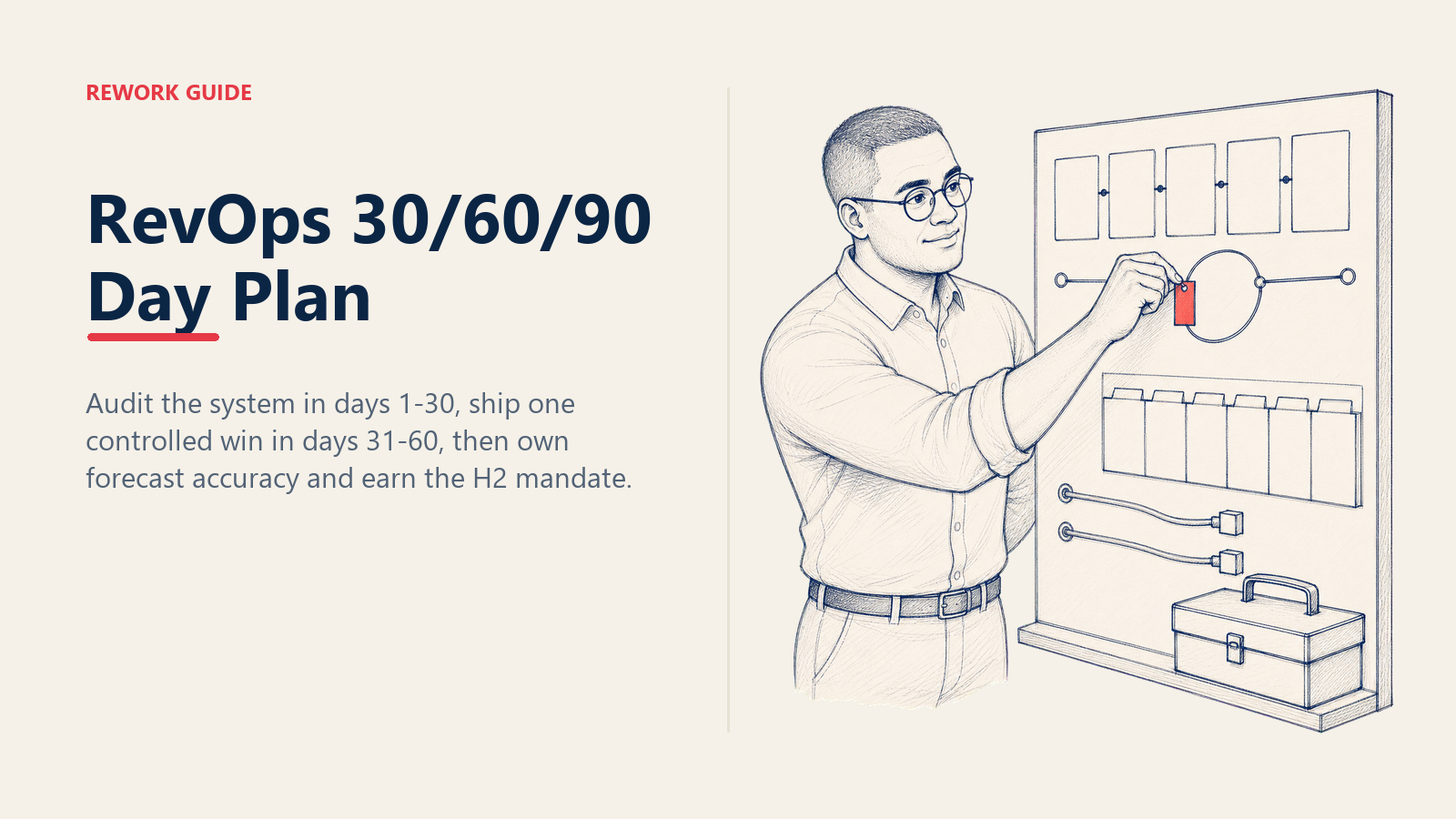
Here's the truth most onboarding plans skip: the first 90 days aren't about fixing any of this. They're about earning the right to fix it. Ship a "quick win" in week one and you'll spend the next two years explaining why the forecast number is off. Audit first, propose second, deliver one small win, earn the H2 mandate. That's the play.
Why Most 30/60/90 Plans Fail for RevOps
Generic onboarding templates assume you're walking into a clean system. A new marketing hire gets handed a campaign brief. A new AE gets a territory and a quota. A new RevOps hire gets handed six prior owners' worth of technical debt and a CRO who's been waiting eight months for "someone who can finally fix the forecast."
The pressure to ship something visible in your first three weeks is enormous. And it's the trap. Every change you make before you understand the system is a future bug. Every "quick fix" to an automation you haven't traced end-to-end is a small bomb you've planted in your own quarter-end reporting.
The job in days 1-30 isn't to fix things. It's to map what you have so the fixes you ship in days 60-90 actually hold.
Days 1-30: Audit, Don't Act
The audit phase has five workstreams. Run them in parallel, not sequence.
Salesforce Stage Audit
Open the Stage picklist. Write down every value. Next to each, fill in three columns: the official definition, the entry criteria reps think it has, and the exit criteria reps think it has. Then sit with two AEs and ask them what each stage means. You'll find at least four stages where reps and the official definition disagree. You'll find two stages that mean different things to different reps on the same team. Note all of it. Don't fix anything.
While you're there, pull a quick report: how many opps moved through each stage in the last 90 days. The stages with near-zero traffic are the ones nobody uses. The ones with disproportionate traffic are doing the work of two or three stages combined. That's your real pipeline structure, regardless of what the picklist claims.
Custom Fields Inventory
Pull a list of every custom field on Opportunity, Account, Contact, and Lead. For each, calculate the population rate over the last 12 months. Anything below 20% is a dead field. Anything above 80% is load-bearing. The middle band (20-80%) is where the politics live. Some are populated by automations you don't understand yet. Some are populated by exactly one rep who'll quit if you remove them.
Don't propose deletions yet. Just build the inventory. You'll need it in day 75.
Automation Map
List every active automation: workflow rules, process builder flows, modern flows, Apex triggers, validation rules, scheduled jobs. For each, note the last-modified date, the last-modified user, and what it's supposed to do. You will find at least one automation last modified by an admin who left the company in 2023. You will find at least one workflow rule that no longer fires because its entry criteria reference a field that's been renamed.
Flag the ones reps actively complain about. Those are your day-31 targets.
Integration Catalog
What's connected to Salesforce? HubSpot or Marketo on the marketing side. Outreach or Salesloft for sequences. Gong for calls. Clari or BoostUp for forecasting. ZoomInfo or Apollo for enrichment. The billing system. For each, document which direction data flows, what fields sync, and how often. Then ask the admin who set it up (if that person still works there) what was supposed to happen versus what actually happens. The gap between those two is where your duplicate accounts live.
Sit in Five Forecast Calls
This is the most important thing you'll do in your first 30 days. Don't talk. Take notes. Watch where the manager and the rep disagree on stage definitions. Watch which deals get pulled out of the forecast at the last minute and which ones get sandbagged in. Watch the body language when the CRO asks "is this one really commit?" The forecast call is where every single Salesforce decision you've inherited gets stress-tested in real time.
By the end of five calls, you'll know more about your pipeline than the entire sales leadership team thinks they do. That's not because you're smart. It's because they've stopped noticing the dysfunction. You haven't.
Day 30 Deliverable
Not a fix list. A current-state document, six to ten pages, with three questions for the CRO at the end. Examples of good questions: "We have three stages named some variation of Negotiation. Which one is the contracting stage?" "The Opportunity Stage Reason field is populated 4% of the time, but pipeline reviews keep referencing it. Should I require it or retire it?" "Forecast calls happen Tuesdays at 9am. Two of three managers don't attend. Is that a tooling problem or a process problem?"
Do not bring a fix list. The CRO will push for one. Hold the line. The audit is the deliverable.
Days 31-60: One Small Win, One Proposal
You've got the map. Now you ship one thing, propose one set of rules, and run a methodology check. That's it. Three things in 30 days. Not fifteen.
Kill One Broken Automation
Pick the single automation reps complain about most. Usually it's a stage-back routing rule, something that bumps an opp backward when a field changes, breaking the forecast snapshot. Trace it end-to-end before you touch it. Make sure killing it doesn't break a downstream report. Get the sales leader's sign-off in writing. Disable it. Send a one-paragraph note to the team explaining what changed and why. Watch for fallout for two weeks.
One automation. Not three. The point isn't the fix. The point is proving you can ship a controlled change without breaking anything.
Fix One Stage Definition
Pick the stage with the most disagreement from your day-1 audit. Sit with the sales leader and rewrite the entry criteria, exit criteria, and a one-sentence definition. Run a 20-minute Friday training. Add the definition as field-level help text in Salesforce so it shows up where reps actually work. Update the stage in your forecast methodology doc.
Resist the temptation to fix all 14 stages. You get one shot at stage reform. Save it for day 90+.
Propose Pipeline Hygiene Rules
Write a one-page proposal: opps with no activity in 30 days get auto-flagged for review; opps with a close date in the past get a mandatory update before the next forecast call; opps over 180 days old without a recent stage change get auto-moved to a "stale" status. Don't implement yet. Walk it through the CRO and the two sales managers. Get to "yes" with revisions. The buy-in matters more than the rules.
Run a Methodology Gut-Check
Pull 10 closed-won and 10 closed-lost opps from last quarter. Reconstruct the stage progression for each. Did the deal really sit in "Proposal" for the duration the data shows? Or did the rep slam-update three stages on the same day to backfill the forecast call? You'll learn more about your forecast accuracy from this exercise than from any dashboard. Document the patterns. They're your day-90 ammunition.
Days 61-90: Own the Metric, Present the Plan
Now you commit to a number. Not before.
Take Ownership of Forecast Accuracy
Tell the CRO: "I'll commit to ±10% of the called number by quarter-end, starting next quarter." Not this quarter. You don't own the methodology yet. Next quarter, on the methodology you'll have rolled out by day 90. That's the difference between a number you can hit and a number you'll regret committing to.
Build the dashboard. Three views: weekly called vs. last-week called, end-of-quarter called vs. actual landed, and rep-level call-quality scores. Make it simple enough that the CRO can read it in 30 seconds during a board prep.
Build the 90-Day Report
Five sections: what I found (the audit), what I shipped (the one automation, the one stage definition, the hygiene rules in proposal form), what's still broken (the inventory you didn't fix), what it costs (estimated revenue impact of the unfixed problems, conservative numbers), and what I need (the H2 plan and its asks).
Length: ten slides max, plus an appendix with the full audit doc. Read it out loud before you present it. If any slide takes more than 90 seconds to walk, cut it.
Propose the H2 Systems Plan
This is the moment. You've earned it by not blowing things up in days 1-60. Propose stage consolidation: 14 stages down to 6. Propose the data hygiene SLA you drafted in day 50. Propose integration cleanup: which tools to renew and which to cut. Propose the field deprecation list from your custom fields inventory.
Sequence it. Don't try to do everything in Q3. A realistic H2 plan is: stage reform in July, hygiene SLA rollout in August, integration cleanup in September, field deprecation in October. One major change per month. Anything faster will get reversed by the field within a quarter.
Lock in the Operating Cadence
Weekly forecast cadence with the sales leaders. Monthly pipeline council with marketing and finance. Quarterly tech-stack review with the CRO. Get them on the calendar before you leave the 90-day mark. Cadence makes everything else stick.
The Stale Opportunity Reality Check
You'll inherit somewhere between 5,000 and 15,000 open opps that should be closed-lost. Some of them are from 2022. Some are owned by reps who left two years ago. The temptation to mass-close them in your second week is overwhelming. It's the most visible cleanup you can imagine. The dashboard will look beautiful afterward.
Don't do it.
The optics of "new RevOps person nuked the pipeline in week two" will follow you for years. Some of those stale opps are real. The AE who's been there five years has 40 of them and knows which ones are actually live. Marketing's source-of-pipeline reporting depends on the historical data. Finance's bookings model uses some of those records as comparison cohorts.
Wait until day 75. Propose the cleanup with the CRO's sign-off. Run it as a documented project: criteria for inclusion, owners notified two weeks ahead, a 30-day window for exceptions, a snapshot of pre-cleanup state for rollback. Communicate it three times before you execute. Then run it cleanly.
The cleanup itself takes 20 minutes. The trust you preserve by waiting takes years to build.
Common Pitfalls
Shipping changes in week one to "show value." Every change you make before you understand the system is a future bug. Your value in the first 30 days is the audit, not the fix.
Saying yes to a 30-day forecast accuracy commitment. Push back. Commit to a methodology by day 60 and an accuracy number for the following quarter. Anything else is a number you'll miss and pay for.
Trying to fix Salesforce, HubSpot, and Outreach simultaneously. Sequence them. Salesforce first because it's the system of record. Marketing automation second. Sequencer third. Anything else is yak shaving.
Not building a relationship with the AE who's been there five years. They know which fields are load-bearing. They know which automations exist because some VP demanded them in 2021 and forgot. They know which stages mean what to which manager. Buy them coffee in your first week. Buy them coffee again in your fourth.
Confusing the CRO's urgency with your job description. The CRO wants forecast accuracy. Your job is to build the system that produces it. Those are not the same thing on day 15. They become the same thing on day 90.
The 30-Day Audit Checklist
Use this as your day-1 to day-30 working doc.
- Stage list with official definition, rep-perceived entry criteria, rep-perceived exit criteria, 90-day stage traffic
- Custom field inventory with population rate over last 12 months for Opportunity, Account, Contact, Lead
- Automation list with last-modified date, last-modified user, current behavior, rep complaints
- Integration catalog with sync direction, fields, frequency, known issues
- Forecast call observation log: stage, rep called amount, manager called amount, actual close, gap reason
- Data flow map: lead source -> MQL -> SQL -> Opp -> Closed-Won -> Renewal, with the system of record at each step
- Three questions for the CRO at end of month one
Closing
The first 90 days aren't about fixing RevOps. They're about earning the right to fix RevOps.
Audit before action. Ship one controlled win in days 31-60 to prove you can. Use days 61-90 to own the forecast accuracy metric and earn the H2 mandate. The 14-stages-to-6-stages move, the field deprecation, the stale opp cleanup: those are H2 wins, not Q1 wins.
The RevOps hires who flame out are the ones who tried to ship a forecast accuracy number on day 30 and a stage reform on day 45. The ones who last seven years are the ones who said "I'll have the audit by day 30, the methodology by day 60, and the H2 plan by day 90" and held the line when the CRO pushed for more.
Hold the line. Then deliver.
Learn More

Principal Product Marketing Strategist
On this page
- Why Most 30/60/90 Plans Fail for RevOps
- Days 1-30: Audit, Don't Act
- Salesforce Stage Audit
- Custom Fields Inventory
- Automation Map
- Integration Catalog
- Sit in Five Forecast Calls
- Day 30 Deliverable
- Days 31-60: One Small Win, One Proposal
- Kill One Broken Automation
- Fix One Stage Definition
- Propose Pipeline Hygiene Rules
- Run a Methodology Gut-Check
- Days 61-90: Own the Metric, Present the Plan
- Take Ownership of Forecast Accuracy
- Build the 90-Day Report
- Propose the H2 Systems Plan
- Lock in the Operating Cadence
- The Stale Opportunity Reality Check
- Common Pitfalls
- The 30-Day Audit Checklist
- Closing
- Learn More