Product Designer Tools and Tech Stack: The Honest 2026 Audit
Turn this article into takeaways for your work.


Each assistant summarizes the article only for you and suggests best practices for your work.
Every design team I've worked with has the same artifact lying around. It's a Notion page titled "design tools" with twenty-three SaaS subscriptions on it. Half of them are charged to a corporate card belonging to a designer who left two years ago. Three of them do the same thing. Two of them haven't been opened since onboarding. One of them is a $400/month moderated research panel that the company used exactly twice.
This isn't a stack. It's an accretion. A stack is something you designed; this is something that happened to you.
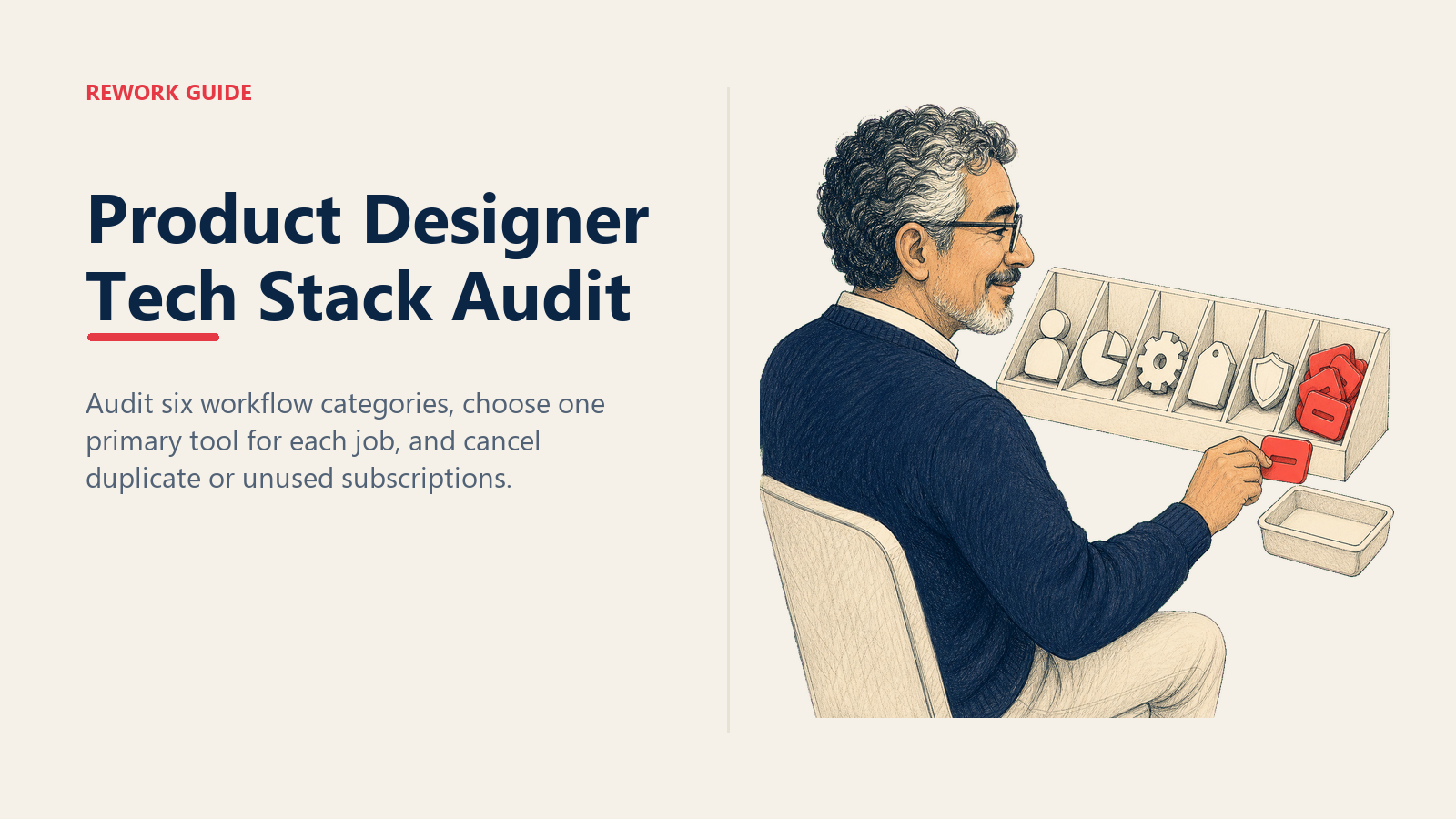
The fix isn't another tool. The fix is the discipline to answer six questions about your work and pick one tool per question. That's the whole essay. The rest is just the receipts.
Why Most Stacks Are Bloated
Figma plus a pile of plugins isn't a stack. It's the default. Defaults are fine when the cost of choosing is high and the cost of being wrong is low. Tools are the opposite. Being wrong is expensive (migrations, retraining, lost institutional memory), and choosing isn't actually that hard if you know what you're choosing for.
A real product design stack answers six questions:
- How do we design? (the file, the canvas, the source of truth)
- How do we prototype? (low-fi, high-fi, and the rare hardware/native case)
- How do we research? (unmoderated tests, moderated panels, synthesis)
- How do we watch real users? (session replay, not analytics)
- How do we measure usage? (product analytics, the funnels and retention curves)
- How do we hand off to engineering? (the design system, dev mode, the receipt that says "yes this is what we shipped")
If your stack has more than two tools per question, you have a stack problem. If your stack has zero tools for a question, you have a maturity problem. Most teams have both.
The Core Six (with real prices, April 2026)
Prices below are public list prices as of April 2026. Enterprise discounts exist; ignore them for the audit and do the math at list. If you can't justify the tool at list, you can't justify keeping it on a corporate card.
1. Design: Figma Professional ($15/editor/month, billed annually)
Figma is still the floor. I wish I had a more interesting take. Sketch exists, Penpot exists, the Adobe acquisition didn't happen and people moved on. Pick Sketch only if you have a Mac-only team and a strong reason. Pick Penpot only if you genuinely need open-source and self-host (regulated industries, mostly). Otherwise, Figma Professional, $15 per editor per month at annual billing, $20 monthly. Viewers are free. Stop paying for viewer seats by accident.
The honest call: most teams are over-licensed on editor seats. PMs and engineers don't need to edit. Audit your seat list, demote everyone who hasn't pushed a frame in 60 days. That alone usually pays for the next two tools on this list.
2. Prototyping: Figma for low-fi, Framer or ProtoPie for the rest
Three tools, three jobs.
Figma for low-fi click-throughs and design reviews. You already pay for it. Don't pay twice.
Framer ($15/month Mini, $30/month Basic) for production-feel web prototypes (anything where the demo needs to feel like a real website with real interactions, page transitions, and CMS-driven content). Framer's value isn't that it's a better Figma; it's that the prototype can become the marketing site. For B2B SaaS teams, this matters more than people admit.
ProtoPie ($13/month Pro per editor, $33/month Enterprise per editor) for hardware and native interactions. Sensors, accelerometers, branching logic, multi-device handoffs. If you're designing a phone app, a smartwatch interaction, or anything that touches hardware, ProtoPie is the only tool that takes the work seriously. If you're not, skip it. Most product designers don't need it. The ones who do need it know exactly why.
The trap: buying ProtoPie because a senior designer demoed it and it looked cool. Tools you don't use weekly are tools you should cancel.
3. Research: Maze, UserTesting, Dovetail (pick the ones that match your reality)
Research is where stacks sprawl fastest because every research vendor sells "we replace all the others." None of them do.
Maze ($99/month Starter, $375/month Professional) for unmoderated usability tests, tree tests, card sorts, and quick prototype validation. Fast, cheap, lives next to Figma. If you ship weekly, Maze pays for itself the first month.
UserTesting is the moderated panel. Quote-based pricing, historically $25K-$40K per year for a starter contract, more if you want recruiting and segmentation. Worth it only if you're running 4+ moderated studies per quarter. Below that, freelance recruiters plus Calendly plus Zoom is cheaper and more flexible. Most teams keep UserTesting out of inertia.
Dovetail ($99/user/month Professional, $159/user/month Enterprise) for research synthesis, tagging, and the "where did we hear that insight" question. Dovetail is the tool that actually matters for research-mature teams, because raw recordings are not insights. The synthesis is the asset. If you're not synthesizing, you're not doing research.
The honest call: small teams (1-3 designers) get away with Maze plus a shared Notion database. Mid-size teams (5-15 designers) need Maze plus Dovetail. Large teams add UserTesting on top, and only because they have a research ops person who runs it. If you don't have a research ops person, UserTesting becomes shelfware in six months.
4. Session Replay: FullStory or Hotjar (pick one, not both)
Session replay is for watching real users rage-click the nav. It is not analytics. It is not a research replacement. It's the qualitative layer on top of your quant.
FullStory is the enterprise pick: quote-based pricing, historically around $199/month entry tier and climbing fast based on traffic. Better filtering, better team features, better integrations.
Hotjar ($32/month Plus, $80/month Business) is the small-team pick. Heatmaps, recordings, basic funnels. Cheap, decent, has limits. Above ~50K monthly sessions Hotjar gets painful.
I've seen exactly one team that actually needed both. They were wrong; they needed one of them and a clearer point of view. Pick one.
5. Product Analytics: Amplitude, Mixpanel, or PostHog (one, learn it deeply)
This is the category where designers lose the most leverage by not engaging.
Amplitude has a generous free tier (up to 50K monthly tracked users) and quote-based paid plans. Best-in-class behavioral analytics, strong cohorts, and the funnel/retention queries are genuinely useful.
Mixpanel ($28/month Growth tier, scales with events) is the lightweight competitor. Cleaner UI, faster to learn, weaker on advanced segmentation.
PostHog is the engineer-favorite. Free if you self-host, $0.00005 per event on cloud (effectively free up to ~1M events/month). Bundles session replay, feature flags, and analytics. If your eng team already runs PostHog, just use it. There's no separate tool to buy.
Designers who can write a funnel query in their analytics tool get listened to twice as often in product reviews. I've watched it happen for a decade. Pick one, get past "I'll learn it later," and learn it. You don't need to be a data scientist; you need to be the person in the room who can answer "what happened after we shipped that?" without asking a PM to pull a report.
6. Design System + Handoff: Figma Dev Mode + Storybook
Figma Dev Mode ($25 per dev seat per month) is the handoff layer. It gives engineers measurements, tokens, code snippets, and version diffs without anyone needing an editor seat. Worth every dollar; the alternative is a Slack thread per spec.
Storybook is open-source and free. It's where your built components live, documented, with their props and states. Together with Figma Dev Mode, "is this built right?" becomes a 30-second comparison instead of a back-and-forth that eats two days of engineer time per sprint.
Storybook isn't a design tool. It's a design system tool. If you don't have one, your design system isn't a system; it's a Figma library and some hopes. The teams who maintain Storybook ship 30-40% fewer visual regressions, in my experience. The teams who don't, file the same bug three times a quarter.
The Core Six at a Glance
| Category | Pick | Price (April 2026) | When to skip |
|---|---|---|---|
| Design | Figma Professional | $15/editor/mo annual | Never (unless regulated, then Penpot) |
| Prototyping (low-fi) | Figma | Included | Never |
| Prototyping (hi-fi web) | Framer | $15-30/mo | If you don't ship marketing sites |
| Prototyping (hardware/native) | ProtoPie | $13-33/editor/mo | If you don't touch hardware |
| Research (unmoderated) | Maze | $99/mo | Below 1 study/month |
| Research (moderated) | UserTesting | ~$25K+/yr | Below 4 studies/quarter |
| Research (synthesis) | Dovetail | $99/user/mo | Solo designer, < 5 studies/yr |
| Session replay | Hotjar or FullStory | $32-199+/mo | If you have <10K sessions/mo |
| Product analytics | Amplitude / Mixpanel / PostHog | Free tier - quote | Never |
| Design system + handoff | Figma Dev Mode + Storybook | $25/dev + free | Never |
Total at the small-team end (3 designers, 5 engineers, modest traffic): about $200-280/designer/month all-in. At the mid-size end (10 designers, 20 engineers, real traffic): $300-450/designer/month. If you're paying more than $500/designer/month for the core six, you have an audit problem, not a tooling problem.
The 30-Day Stack Audit
This is the part most teams skip and then complain about tool sprawl. Block the four weeks. Put it on the calendar. Here's what to do.
Week 1: Inventory
List every tool, every seat, every renewal date, every owner, every monthly cost. One spreadsheet. Columns: tool, category, seat count, owner, monthly spend, last login (pull from admin), renewal date, contract terms.
Be honest about the last-login column. If nobody opened a tool in 90 days, it's a candidate for cancellation. If nobody opened it in 180 days, it's not a candidate, it's a confirmed kill.
The output of week 1 is one number: total stack spend per designer per month. Most teams have never calculated it. The number is usually 2x what people guess.
Week 2: Pick One Per Category
Take the core six. For each, pick exactly one tool. Document the pick and the reason in one sentence each. Reasons that count: "the team already knows it," "it's already paid for," "it integrates with our analytics stack." Reasons that don't count: "we've always used it," "the senior designer prefers it."
The output of week 2 is a one-page doc with six rows. Tool, why, owner.
Week 3: Migrate or Sunset
This is the painful week. Anything in your inventory that didn't make the picks list gets a sunset date. Migrate the data, cancel the contract, redistribute the seats. Two prototyping tools become one. Three research tools become two (sometimes one). The eight Figma plugins that overlap become two.
Communicate the sunsets in advance. Designers will resist losing tools they like. Most of the resistance is sentimental, not operational. Ask "what work do you do with this that you can't do without it?" If the answer is hand-wavy, sunset.
Week 4: Document and Share
Write a one-page "design stack" doc. Six categories, the picked tool, the price, the owner, the access process, the link to the team library/account. Share it with PM and Engineering. Pin it in the design channel. Update it quarterly.
The doc is the deliverable. If the doc doesn't exist, the audit didn't happen: the team will drift back to the Notion page of 23 subscriptions within a quarter.
The output of week 4 is that nobody on the team has to ask "wait, where do we put research findings again?" That question alone costs hours per week across a 10-person team.
Common Pitfalls
A few traps I've watched teams fall into more than once.
Buying tools to fix process problems. A research tool will not make stakeholders read the report. A design system tool will not make engineers stop forking components. A handoff tool will not make a PM write better specs. If the bottleneck is human, no SaaS subscription fixes it. The right move is a hard conversation, not a procurement request.
Confusing session replay with analytics. Session replay tells you what one user did. Analytics tells you what 10,000 users did. They answer different questions. Teams that buy Hotjar thinking it'll replace Mixpanel end up with neither category covered properly.
Treating Figma as the design system. Figma is where the design system lives in design tools. Storybook is where it lives in code. Notion or Zeroheight is where it lives in documentation. All three matter. A "design system" that's just a Figma library is a component kit, not a system.
Buying enterprise tools for solo or duo teams. UserTesting at $30K/year for one researcher running two studies a quarter is grief, not value. Dovetail at $99/user for a single user with 12 studies a year is fine. The math has to work at your actual usage, not your aspirational usage.
Letting renewals auto-pilot. Set a calendar reminder 60 days before every renewal. Use that window to renegotiate or cancel. Vendors expect renewal pushback; they price the first year as a hook. The teams that never renegotiate pay 30-50% more over three years than the teams that do.
What "Done" Looks Like
You'll know the audit worked when three things are true.
You can name every tool, every price, every owner, and every renewal date without opening a doc. The total spend per designer is a number you can defend to your finance partner. Engineers know exactly where to look when they need a spec, and stop asking in Slack.
That's it. No more 23-subscription Notion pages. No more mystery charges to a card belonging to a designer who left two years ago. No more "I think we have a research tool, somewhere?" The stack becomes invisible, which is what a good stack should be: present when you need it, silent when you don't.
The best designers I know spend almost no time thinking about their stack. They picked once, they audit once a year, and the rest of the time they're shipping work. That's the bar.
Learn More
- Product Designer Job Description
- Building a Design System from Zero
- Working with Engineers Without Friction
- Running Lightweight User Research

Principal Product Marketing Strategist
On this page
- Why Most Stacks Are Bloated
- The Core Six (with real prices, April 2026)
- 1. Design: Figma Professional ($15/editor/month, billed annually)
- 2. Prototyping: Figma for low-fi, Framer or ProtoPie for the rest
- 3. Research: Maze, UserTesting, Dovetail (pick the ones that match your reality)
- 4. Session Replay: FullStory or Hotjar (pick one, not both)
- 5. Product Analytics: Amplitude, Mixpanel, or PostHog (one, learn it deeply)
- 6. Design System + Handoff: Figma Dev Mode + Storybook
- The Core Six at a Glance
- The 30-Day Stack Audit
- Week 1: Inventory
- Week 2: Pick One Per Category
- Week 3: Migrate or Sunset
- Week 4: Document and Share
- Common Pitfalls
- What "Done" Looks Like
- Learn More