Editorial Calendars That Actually Ship
Turn this article into takeaways for your work.


Each assistant summarizes the article only for you and suggests best practices for your work.
The calendar looked beautiful in January. Color-coded swimlanes for SEO, thought leadership, product launches, and partner co-marketing. Quarterly themes mapped to pipeline goals. A clean Notion database with seven views. Everyone nodded in the kickoff.
By March, the same calendar was a graveyard. Three pieces stuck "in legal review" with no named reviewer. Two zombie drafts from a Q4 partner deal nobody wanted to admit was dead. A founder pitch from January still sitting in "ideas" because the writer who was supposed to scope it had taken parental leave and nobody re-assigned it. About 73% of what was on that January board hadn't shipped on its original due date, and the IC running it was getting blamed for "execution issues" in their Q1 review.
The execution wasn't the problem. The system was the problem from day one.
The first calendar I shipped on time had four columns, not twelve. It also had one rule taped to the top of the doc: nothing enters the calendar without a human name in the Owner column. That was the unlock. Not a better tool, not a fancier template, not a quarterly offsite. A name on every row, and the discipline to hold the line when somebody pushed back.
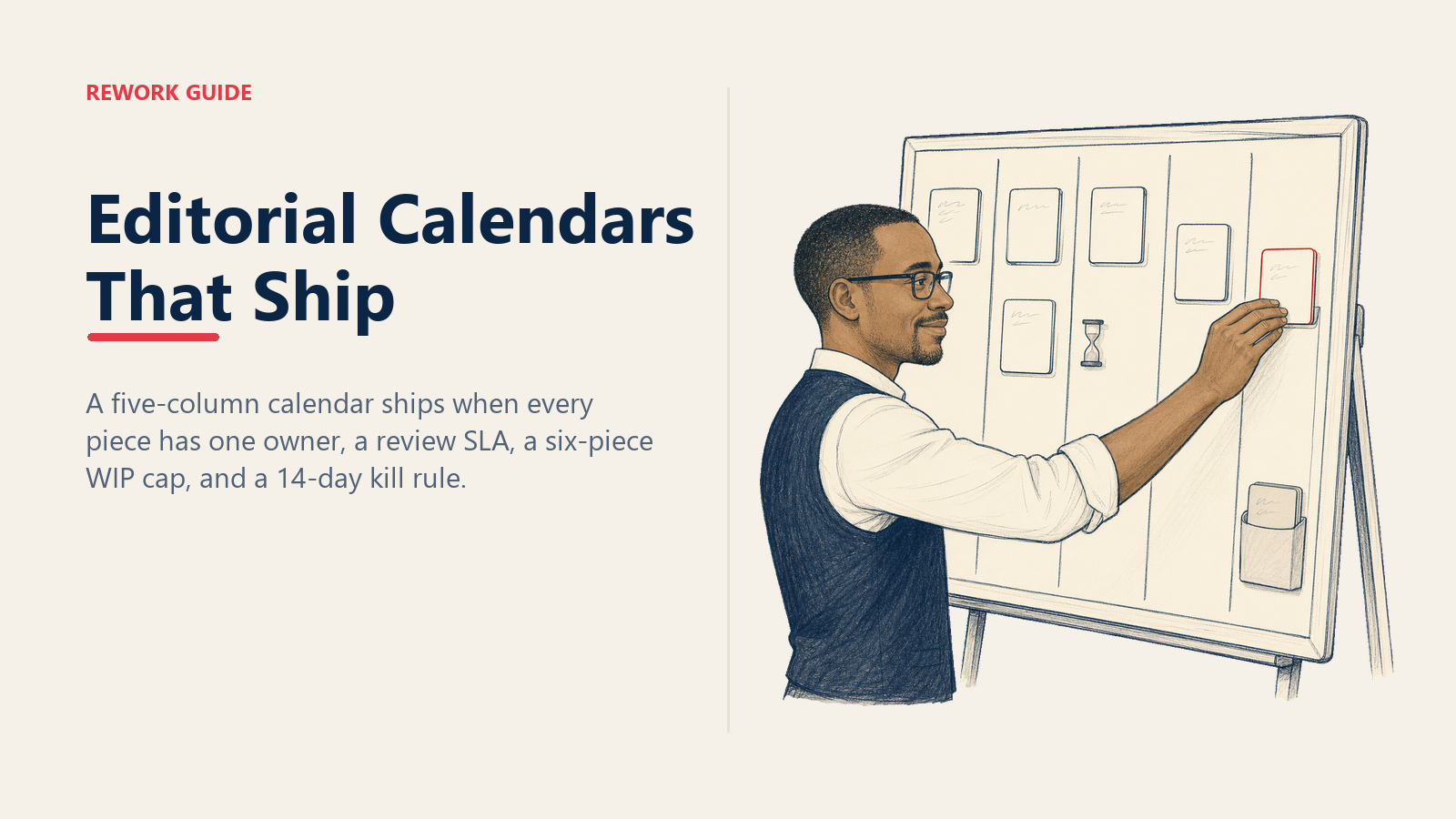
This guide is the operating system version of that lesson. Diagnose what kills most calendars, install the 5-column structure, cap the work in flight, install a kill rule, run a 15-minute standup, and pick a tool you can actually live in.
Why Most Editorial Calendars Fail
Three patterns kill most calendars. They're not strategy problems. They're operational ones.
Ghost ownership. A row says "Marketing team" or "Content + Product" in the owner column. Both are pleasant lies. When something goes wrong on that row (a missed source interview, a stalled draft, a brief that nobody scoped), there's no one to text. Diffuse ownership means the calendar runs on hope. Ship rate on ghost-ownership rows tracks at roughly 40-50% in calendars I've audited. Single-named-owner rows track at 80%+.
No review SLA. The piece gets drafted on time. Then it goes to "review" and disappears for eleven days because the SME is in customer meetings and legal is queued behind a contract review. The IC checks in twice, gets "I'll get to it this week," ships nothing. Without a named reviewer and a published turnaround commitment, review is a black hole. Half your slip is here, and almost none of it shows up in the writer's drafting time.
No kill rule. A piece pitched in January is "still being scoped" in April. The exec who pitched it doesn't want to hear it's dead. The IC doesn't want to have the conversation. So it stays on the board, taking up a planning slot, eating bandwidth in every weekly review, blocking a fresher idea from entering. Multiply by three or four zombie pieces and you've lost an entire month of capacity to politeness.
The before/after looks like this. Before: Row says "Q1 partner co-marketing piece, Owner: Marketing + Partner team, Due: TBD, Status: In progress." Three months in, no one can tell you what's actually happening with it. After: Row says "How cut onboarding time 60%, Owner: Camellia, Due: Feb 18, Reviewer: Jordan (5-day SLA), Status: Drafting." The second row will ship. The first one will rot.
The 5-Column Calendar That Ships
The calendar has five columns. Every additional column is a tax. It hits the IC running it, the people filling it in, and the weekly review where you have to scan it. Resist the urge to add more.
| Idea | Owner | Due Date | Review Owner (SLA) | Status |
|---|---|---|---|---|
| How cut onboarding time 60% | Camellia | Feb 18 | Jordan (5 days) | Drafting |
| Q1 SEO play: "lead scoring frameworks" | Maya | Feb 25 | Priya (3 days) | In Review |
| Webinar replay teardown: H2 demand gen | Camellia | Mar 4 | Devon (5 days) | Idea |
| ICP refresh announcement post | Sam | Mar 11 | Jordan (3 days) | Scheduled |
| Customer story: sales-ops migration | Maya | Mar 18 | Priya (5 days) | Live |
Five columns, five status states. That's it. Here's why each one earns its place.
Idea is a working title, not the final headline. Final headline gets locked at draft time. Putting "TBD" or "headline TBD" in this column is a smell. If you can't articulate the idea in a sentence, it's not ready to enter the calendar.
Owner is one human name. Not a team. Not "Maya + Sam." If two people need to collaborate, one of them is the Owner and the other is in the brief. The Owner is who the IC running the calendar messages when something slips. If that name is two people, neither of them feels the slip.
Due Date is the publish date, working backwards. Not "draft due." Publish. If the piece needs SME review (5 days), copy edit (1 day), and design (2 days), the Owner mentally maps backwards from the publish date and protects their own draft deadline. The calendar doesn't track the sub-deadlines because that explodes the column count. It trusts the Owner to do the math.
Review Owner is one named reviewer with a published SLA. "Jordan, 5 days" is a contract. If Jordan can't honor it, Jordan negotiates a different SLA when the row enters the calendar. They don't ghost it after the fact. Review SLA is the single biggest unlock for ship rate. Most teams skip it because it feels confrontational. It's the opposite. It's the thing that lets reviewers say no to scope creep, because they've already committed to a turnaround.
Status has five states max: Idea, Drafting, In Review, Scheduled, Live. No "Blocked." If something is blocked, it's still in its current state and the standup names the blocker. Adding a "Blocked" status creates a holding pen where pieces go to die. No "Editing." Editing happens inside Drafting or inside In Review, depending on whose hands the doc is in.
The tax of a sixth column is real. Every column adds a field to fill in, a column to scan in the weekly review, a query to write when the IC pulls a status report, and a decision the team has to make every time a row enters the board. I've worked with calendars that had columns for primary keyword, target persona, distribution channels, internal links, image status, legal-review-flag, and content-type. Every one of those is useful information. None of them belong in the master calendar. Put them in the brief doc the Owner writes when they pick up the piece. The calendar is for shipping cadence. The brief is for everything else.
The WIP Cap That Prevents Drift
Six pieces in flight per IC. Hard cap.
Here's the math. A healthy pipeline looks like:
- 2 pieces in Drafting (one early, one near-final)
- 2 pieces In Review (one with SME, one with copy edit)
- 2 pieces Scheduled (queued for publish in the next 2-3 weeks)
That's six. Anything in Idea status doesn't count toward the cap because it hasn't started consuming attention yet. Anything Live is done.
Why six and not eight or ten? Because attention is the bottleneck, not capacity. An IC running the calendar has to hold the state of every in-flight piece in their head: what's blocking it, who they need to nudge, what changed since last week. Past six, you start losing pieces in your own short-term memory. You stop nudging the SME on day three of their five-day SLA because you forgot the clock started. The piece slips, and the slip wasn't because the SME was slow, it was because nobody was running the SLA.
The math doesn't care about how fast you write. A writer who can draft a 2,000-word piece in two days still can't run more than six pieces in flight, because the bottleneck is review and scheduling attention, not drafting throughput. ICs who try to push past six end up with a higher work-in-progress count and a lower ship rate. They feel busier and produce less.
How to enforce it: refuse new ideas until a slot opens. When a stakeholder pitches a piece and the board is full, the response is not "great, let me add it to the queue." The response is "the board is at WIP cap. We can either add it for when ships, or we kill to make room. Which do you want?" Forcing the trade-off is the whole point. It surfaces priorities that were never explicit. It also stops the calendar from being a wishlist, which is the thing that turns it into a graveyard.
The Kill Rule
Fourteen days without movement equals kill or restart. Movement means status change, owner change, or substantive doc activity. Not a Slack comment. Not "I'm thinking about it." Real movement.
When a piece hits 14 days static, the IC running the calendar messages the Owner: "Hey, this hasn't moved in two weeks. Is it dead, or is something blocking it I can help unblock? If it's blocked, what do you need from me by Friday to get it moving? If it's dead, I'm killing the row tonight."
Then you actually kill it. Not "park it." Not "move to backlog." Kill it. Backlogs are graveyards with extra steps. If the idea was good, somebody will re-pitch it later, with fresher context, and the new pitch will be better than the stale one anyway.
The kill conversation with the original stakeholder, usually an exec or a partner-team lead, is the part most ICs avoid. Here's a script that works:
"Hey , the we scoped in hasn't moved in two weeks. From what I can see, the blocker is {real reason: SME unavailable, competing priority, scope unclear}. I'm going to kill the row today so it stops eating planning capacity. If the underlying need is still real in , we can re-scope it fresh with the context we'll have then. Let me know if you'd rather we make a different call."
Two things this script does. First, it names the real blocker, not the polite one. Second, it gives the stakeholder a graceful exit. They can agree to kill, or they can step up and unblock. Most of the time they agree to kill, because deep down they knew the piece was dead. Occasionally they unblock it, which means it gets fresh momentum.
Killing is cheaper than zombie-revising. A piece that's been static for 14 days has stale facts, stale framing, and stale stakeholder energy. Reviving it costs more than scoping a new piece from scratch. The math always favors the kill.
The Weekly Editorial Standup (15 minutes)
Three questions. No status theater.
- What shipped last week? (Not "what did we work on." What actually went Live.)
- What's at risk this week? (Any in-flight piece that the Owner thinks won't hit its due date.)
- What's blocked, and who unblocks it? (Name the blocker, name the unblocker, set a deadline for resolution.)
That's it. No project status updates. No round-robin "what are you working on." No deck. Fifteen minutes, every Monday morning, ICs and reviewers in the same room or on the same call.
A real transcript snippet from a standup that was working:
Camellia: "Shipped last week: partner co-marketing piece, ICP announcement post. Two pieces. Behind on the webinar teardown by 3 days."
Jordan (Reviewer): "At risk. I'm behind SLA on Maya's lead-scoring piece. I'm in customer meetings until Wednesday. I can clear it Wednesday afternoon. Maya, that pushes you to a Friday publish instead of Wednesday. Okay?"
Maya: "Fine. I'll move the social schedule."
Camellia: "Blocked. Webinar teardown needs the H2 demand-gen numbers from finance. Sam, you have the relationship there. Can you ping by EOD today and ack me back if you've got an ETA?"
Sam: "Yes, by 5pm."
Six minutes. Done.
What this format kills: status theater, where everyone takes a turn explaining what they're "working on" without surfacing actual risk. Status theater feels productive and produces nothing. The three-question standup is uncomfortable the first two weeks because people aren't used to admitting at-risk pieces in front of the group. By week three it becomes the most useful 15 minutes of the week.
Tool Choices, Opinionated
Pick one. Commit. Tool-hopping is a calendar killer because every migration loses context, breaks the standup rhythm, and gives every stakeholder an excuse to pretend the old commitments don't apply.
| Tool | Best for | Watch out for |
|---|---|---|
| Notion | Solo IC or small team (1-3 people), under 30 pieces/quarter. Clean, fast, easy templating. | Weak on dependencies and cross-database rollups. Falls apart past 50 active pieces. Database views feel slow with heavy filtering. |
| Airtable | 50+ pieces/quarter, multiple ICs, real cross-functional dependencies. Real views, real relationships, real automation. | Steeper learning curve. The temptation to add 12 fields is strong: discipline yourself to 5 columns in the master calendar view. |
| Asana | When the editorial calendar is one stream inside a bigger marketing operating system (campaigns, events, paid, lifecycle). | Native calendar UI is mediocre. Use the timeline view, not the calendar view. Watch out for task proliferation: every sub-deadline becomes its own task and the board gets noisy. |
| Trello | Under 10 pieces/month, very small team, no cross-functional reviewers. | Falls over fast. No real views, no SLAs, no automation. If you outgrow it, you'll outgrow it before you notice. Migrate before you hate it. |
Notion is what I'd pick for a brand-new content marketer or a 2-person team. It's fast to set up, the documentation lives next to the calendar, and you won't outgrow it for at least two quarters. When you do outgrow it, the migration to Airtable is straightforward because the data model is similar.
Airtable is what I'd pick for a Senior Content Marketer running 50+ pieces a quarter with real cross-functional dependencies. The views, the rollups, and the automation cover everything Notion can't. Budget two weeks to set it up properly. Sloppy Airtable is worse than tidy Notion.
Asana is the right answer if your VP of Marketing has already standardized the team on it for campaign management. Don't fight that battle. Fit the editorial calendar into Asana as a project with the 5-column structure. The UX is fine, not great.
Trello is the right answer for almost no one running a real content function in 2026. If you're at 5 pieces a month and you genuinely don't need anything more, fine. The minute you hit 10, migrate. Don't wait.
The Calendar Isn't the Artifact
The calendar isn't what ships content. The shipping cadence is. The calendar is just the place where the cadence lives.
A team with a beautiful calendar and no Owner per piece, no review SLA, and no kill rule will miss two-thirds of its dates. A team with a plain spreadsheet, named owners on every row, published review SLAs, and a 14-day kill rule will hit 90% of its dates. The artifact almost doesn't matter. The operating system around it is everything.
If you're a Content Marketer reading this and your calendar is rotting, the move isn't to redesign the calendar. The move is to install the four things in this guide (owners, SLAs, WIP cap, kill rule) on the calendar you already have. You can ship the new version on Monday. No tool migration required.
If you're hiring a Content Marketing Manager or leveling up into the role, the Content Marketing Manager job description template covers the full scope of what running this operating system looks like at the management level: calendar ownership, team SLAs, and the cross-functional politics of making the kill rule stick.
Learn More
